D’Orsay
BY THE SAME AUTHOR
A Soul’s Awakening [Crown 8vo, 6s.
Times.—“Mr Teignmouth Shore has captured our sympathy for his characters in an unusual degree.”
Morning Post.—“A charming and pathetic melody.… A tenderness that is infinitely moving.”
Punch.—“Powerful and pathetic. This truly charming story.”
Above All Things [Crown 8vo, 6s.
Daily Telegraph.—“All small investors in a hurry to make much out of little should read this novel, for it puts plainly and precisely before them some of the methods by which a swindler may, with seemingly virtuous intentions, appropriate, with perfect safety, other people’s money.”
Yorkshire Post.—“The people of his fiction play their parts so naturally and so simply that we sympathise almost as humanly with their troubles and joys as we might with those of our personal friends.”
Bookman.—“Delicate and unobtrusive art.”
Creatures of Clay
Recently published.] [Crown 8vo, 6s.
JOHN LONG, LIMITED, LONDON
Art Repro. Co.
Count d’Orsay
After a painting by Sir Francis Grant, P.R.A.
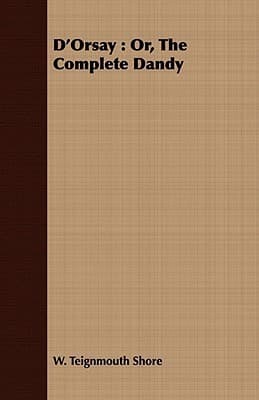
D’ORSAY OR The Complete Dandy
By W. Teignmouth Shore
WITH PHOTOGRAVURE AND SIXTEEN OTHER PORTRAITS
London John Long, Limited Norris Street, Haymarket (All Rights Reserved)
First Published in 1911
Contents
List of Illustrations
Dandiacal
What a delightful fellow is your complete dandy. No mere clothes’ prop he, the coat does not make the dandy; no mere flâneur in fine garments; far more than that is our true dandy.
Though there is not any authority for making the statement, we do not think that we are wrong in asserting that on the day when Adam first complained to Eve that she had not cut his fig-leaf breeches according to the latest fashion dandyism was born. It is not dead yet, only moribund, palsied, shaking and decrepit with old age, blown upon by an over-practical world of money-spinners and money-spenders. Joy seems to have become a thing of which it is necessary to go in pursuit; in the golden days of the dandies it was a good comrade which came almost without hailing to those who desired its company. A real dandy would wither and wilt in a world where joy is so much of a stranger as it is now to most folk.
It is curious that there does not exist any history of the Rise, Decline and Fall of Dandyism, a subject fit for the pen of Gibbon. But the reason is, that to write it with anything approaching to accuracy and completeness, or with sufficient sympathy and insight, would stagger the painstaking pedantry of a German philosopher and tax the wit and wisdom of George Meredith. Perhaps some day the University of Oxford or of Cambridge, when it has finished trifling with ponderous records of kings and queens, of statesmen and soldiers, of men of science and of writers of books, will gather together a happy band of scholars and men of the world, and will issue to us a joint-stock history of Dandyism. Reform is in the University air; let us hope. Might not the Academic authorities go even further with profit to themselves and to the nation? Ought they not to found and well endow a Chair of Dandyism? Should there not be a Professor of Dandyism to teach the young idea how to distinguish between dress and mere clothes? Between those two there is as great a gulf fixed as between the gentle art of the gourmet and the mere feeding of the gourmand. To teach also the art of living and the history of dandies and of dandyism? In these prosaic days we are only too ready to learn how to obtain the means of living without acquiring also a knowledge of how to use those means to good purpose. The Universities should likewise institute scholarships of dandyism, to encourage the study of dandyism in our Public and Board Schools, in both of which it is so grossly neglected. These scholarships must not be of meagre twenties and thirties of pounds, but of several hundreds per annum, so as to enable the scholar to practise the arts that he studies. We commend this outlet for money to millionaires of a practical turn of mind. The future happiness of our race depends upon its dandyism.
The dandy has played a conspicuous part upon the stage of history: Alcibiades, Marc Antony, Buckingham, Claude Duval, Benjamin Disraeli prove the truth of this statement. It would be a nice point to decide how far their dandyism was part and parcel of their equipment for attaining greatness. At one period of English history the whole population of the country was divided between dandies and anti-dandies, Cavaliers and Puritans, the former dandified in dress, religion, methods of fighting and in morals. They were great dandies those martial Cavaliers, and so were a few of their successors, who flirted and frivoled at Whitehall under Charles II.
The literature of dandyism is varied, vast and interesting, but space forbids our doing more than briefly alluding to two of its lighter branches in English letters. The drama—or rather the comedy—of dandyism holds a very high place in the history of the British Stage. Lyly, the Euphuist, was a literary dandy of the first water, and his euphuism the height of dandyism in literary style. Shakespeare in Love’s Labour Lost has given us a whole comedy of dandyism, and in Mercutio a portrait of the complete Elizabethan dandy. But the comedy of dandyism was at its zenith in the days of Charles II. Congreve and Wycherley were its high priests, who preached through the mouths of their brilliant puppets the gospel of joy which the Court so ably practised. We have in The School for Scandal another bright flash of dandyism, though Charles Surface has too much heart for a true and perfect dandy.
In fiction we have many striking examples of dandiacal literature, notably Vivian Grey and Pelham, both written by dandies.