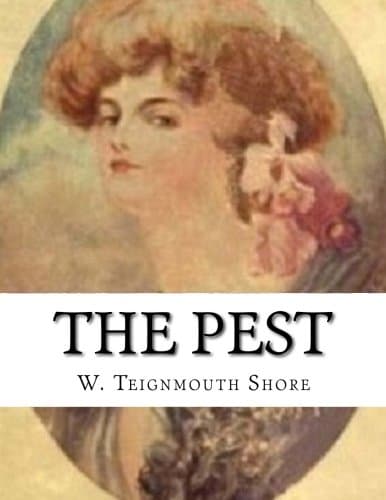
The Project Gutenberg eBook, The Pest, by W. Teignmouth (William Teignmouth) Shore
THE PEST
The Pest
BY
W. TEIGNMOUTH SHORE
AUTHOR OF “THE TALKING MASTER,” “EGOMET,” ETC., AND
PART AUTHOR OF “THE FRUIT OF THE TREE”
NEW YORK
C. H. DOSCHER & CO.
1909
Copyright, 1909, by
C. H. DOSCHER & CO.
The Pest
CHAPTER I
Pavements and roadway slippery with greasy, black mud; atmosphere yellow with evil-tasting vapor; a November afternoon in London; evening drawing on, fog closing down.
George Maddison, tall, erect, dark, walked slowly along, his eyes, ever ready to seize upon any striking effect of color, noting the curious mingling of lights: the dull yellow overhead, the chilly beams of the street lamps, the glow and warmth from the shop windows. Few of the faces he saw were cheerful, almost all wearing that expression of discontent which such dreary circumstances bring to even the most hardened and experienced Cockneys. For his own part he was well pleased, having heard that morning of his election as an Associate of the Royal Academy, a fact that gratified him not as adding anything to his repute, but as being a compliment to the school of young painters of which he was the acknowledged leader and ornament: impressionists whose impressions showed the world to be beautiful; idealists who had the imagination to see that the ideal is but the better part of the real.
Maddison paused before a highly lighted picture-dealer’s window, glancing with amusement at the conventional prettiness there displayed; then, turning his back upon it, he looked across the street, debating whether he should cross over and have some tea at the famous pastry cook’s. A tall, slight figure of a woman, neatly dressed in black, caught his attention. Obviously, she too was hesitating over the same question. In spite of the simplicity and quiet fashion of her black gown, her air was elegant; her head nicely poised; her shoulders well held; the lines of her figure graceful, lithe and seductive. Though he could not see her face he felt certain that she was interesting and attractive, if not beautiful; also, there was a something wistful and forlorn about her that appealed to him. Warily stepping through the slippery mud, he crossed over and stood behind her for a moment, marking the graceful tendrils of red-gold hair that clustered round the nape of her neck and the delicate shape and coloring of her ears. As she turned to move away, she came full face to him, instant recognition springing into her eyes.
“George—!” she exclaimed.
“Miss Lewis!”
There was immediate and evident constraint on each side, as though the sudden meeting were half-welcome, half-embarrassing.
“Were you going in to tea here?” he asked. “I was. Let me come with you? It’s an age since we met. It’s horrid and damp out here.”
“It is,” she replied, slightly shivering. “Yes, I should like a cup of tea.”
They went through the heavy swing doors, opened for them by a diminutive boy in buttons, into the long, highly decorated, dimly lighted, discreet tea room, which lacked its usual crowd. A few couples, in one case two young men, occupied the cozy corners, to one of the more remote of which Maddison led the way, and settled himself and his companion in the comfortable armchairs. He ordered tea and cakes of the pretty, black-eyed waitress, dainty and demure in the uniform of deep, dull red.
“You sigh as if you were tired, Miss Lewis, and glad to rest?” he said, trying in the dim light to study her expression.
“I am tired and I am glad to rest. It’s very cozy in here. I’ve never been here before.”
She laid her hand upon the arm of the chair next to him and he noticed that she wore a wedding ring.
“I called you Miss Lewis. I see——?”
“Yes—I’m married. I don’t suppose you remember much about Larchstone—I recognized you before you did me; I saw you across the road. But just possibly you do remember our curate, Mr. Squire—you used to laugh at him. I’m Mrs. Squire. He’s still a curate, but not any longer in the country. We live at Kennington; what a world of difference one letter makes! Kennington—Kensington. Have you ever been in Kennington?”
Maddison remembered Edward Squire distinctly: a tall, gaunt enthusiast, clumsy in mind and in body. He leaned back in his chair as a whirl of recollections rushed across his mind: the red-roofed, old-fashioned village of Larchstone; the old-world rector and his daughter, a pretty slip of a country girl, who had grown into—Mrs. Squire. He remembered the summer weeks he had spent there, painting in the famous woodlands, and the half-jesting, half-serious love he had made to the rector’s daughter. Since then until this afternoon he had not met her, though the memory of her face, with the searching eyes, had come to him now and again.
She watched him as he dreamed. He had changed very little; how distinctly she had always remembered him; the swarthy, narrow face framed in heavy black hair, the deep-set black eyes, the thin nose, the trim pointed beard and mustache hiding the sensual mouth, the tall, well-knit figure. Far more vividly than he did she recall those summer months; in her life they had been an outstanding event, an episode merely in his.