Of Mice and Men Audiobook & Text to Speech Guide (2026) — John Steinbeck's Gary-Sinise-Penguin-Audio-Definitive Depression-Era-California-Salinas-Valley-Migrant-Ranch-Tragedy Nobel-Prize-Winner Masterpiece
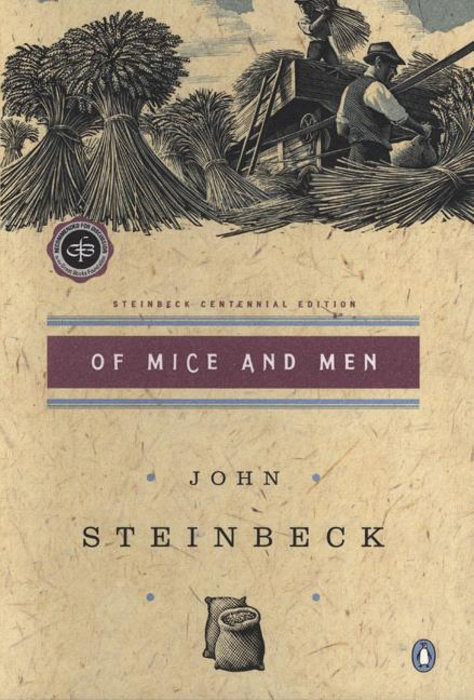
Of Mice and Men — John Steinbeck
First published: February 6, 1937 · Covici Friede
Pages: 107 (paperback)
Goodreads: 3.90★ (2.88M+ ratings) · view
Audiobook runtime: ~3h 8m · Gary Sinise Penguin Audio (Sinise played George in 1992 Sinise-directed / Malkovich-Lennie film — character-authenticated production)
Commercial scale: 6M+ global sales · 88+ years continuous print · universal U.S. HS American-Literature curriculum (top-5 most-taught)
Cultural impact: Steinbeck Nobel Prize 1962 · Pulitzer Prize 1940 (for The Grapes of Wrath) · 1939 Milestone / 1992 Sinise-Malkovich film adaptations · Broadway stage-play · banned-books-list perennial
The defining Depression-era California-migrant-worker compressed-novella — 88 years of continuous print, 6+ million copies, Gary Sinise's character-authenticated Penguin Audio recording (Sinise played George in the definitive 1992 film), and a 3h 8m runtime that makes the Steinbeck-Nobel-defining work a single-afternoon commitment. Skip the Libby wait with Kindle + free CastReader AI TTS →
Of Mice and Men is John Steinbeck's February 1937 Depression-era California-Salinas-Valley migrant-ranch-tragedy canonical text — the 107-page six-chapter theatrical-novella (Steinbeck wrote it simultaneously as prose fiction and stage-play script) where migrant workers George Milton and Lennie Small arrive at a ranch near Soledad after fleeing their previous Weed job (where mentally-disabled giant Lennie, fascinated by a woman's dress, was accused of attempted rape), share their dream of buying a small farm where Lennie will tend rabbits, briefly make the dream achievable when aging ranch-hand Candy offers to contribute his savings, and see the dream destroyed when Lennie accidentally breaks Curley's wife's neck in the barn. George finds Lennie at their pre-arranged riverbed hiding spot near the Salinas River, tells him their farm dream one final time while Lennie imagines the rabbits, and shoots Lennie in the back of the head with Carlson's Luger to save him from Curley's lynch mob — the single most-studied act of mercy-killing in American literature. The novella's title (from Robert Burns's 'To a Mouse': 'The best laid schemes o' mice an' men / Gang aft agley') names its thesis: the American-pastoral small-farm dream is destroyed by Depression-era economic reality and human fragility. Of Mice and Men has sold 6+ million copies globally, has been in continuous print since 1937, and is one of the top-5 most-taught novellas in U.S. public high schools. John Steinbeck's 1962 Nobel Prize in Literature specifically cites his 'realistic and imaginative writings, combining as they do sympathetic humor and keen social perception.' The 3.90★ Goodreads rating across 2,878,962+ ratings reflects 88 years of sustained reader engagement. At 3h 8m with Gary Sinise's character-authenticated Penguin Audio production (Sinise played George opposite John Malkovich's Lennie in his 1992 Sinise-directed film adaptation), Of Mice and Men is the genre-defining Depression-era American-migrant-literature primary-source text.
This guide covers the 3h 8m runtime, the Gary Sinise character-authenticated canonical production, the Steinbeck-Nobel-canon dimension, and every free / paid path.
Why 3h 8m Matters for Depression-Era American Literature
American-Literature-canon compressed-work runtime benchmark.
| Title | Runtime | Year | Goodreads rating |
|---|---|---|---|
| Of Mice and Men (Steinbeck) — this book | 3h 8m | 1937 | 3.90★ |
| The Grapes of Wrath (Steinbeck) | 21h 7m | 1939 | 4.01★ |
| East of Eden (Steinbeck) | 24h 54m | 1952 | 4.41★ |
| Cannery Row (Steinbeck) | 5h 1m | 1945 | 4.03★ |
| The Great Gatsby (Fitzgerald) | 4h 49m | 1925 | 3.93★ |
| To Kill a Mockingbird (Lee) | 12h 17m | 1960 | 4.27★ |
| The Catcher in the Rye (Salinger) | 7h 43m | 1951 | 3.80★ |
Of Mice and Men is the shortest entry-point into the American-Literature canon — a single-afternoon reading that delivers Depression-era Salinas-Valley migrant-tragedy grammar. At 3h 8m, the novella reads comfortably in a single weekend morning or across 2-3 commutes at 1.5x.
Three Listening Modes
Mode 1 — Canonical Audio (Gary Sinise Penguin Audio). $14.95 Audible credit or library-borrow via Libby; Audible Plus subscribers check rotating availability. Sinise's character-authenticated production (he played George in his own 1992 film adaptation) is the industry-consensus definitive Of Mice and Men audiobook.
Mode 2 — AI TTS via CastReader. Free, unlimited re-listens, adjustable speed, pronunciation overrides for George Milton / Lennie Small / Slim / Candy / Crooks / Curley's wife / Salinas Valley dialect. Particularly valuable for HS-course study or re-engagement with the riverbed climax. See CastReader for Kindle.
Mode 3 — Libby / Hoopla library borrow. Libby 1-2 week wait; Hoopla instant-lend where available. The library route trades modest wait time for zero-dollar cost.
The Gary Sinise Penguin Audio Canonical Production
Gary Sinise (b. 1955, American actor — Forrest Gump, Apollo 13, CSI: NY) narrates the definitive Penguin Audio edition in ~3h 8m. Sinise's production is character-authenticated: he played George Milton opposite John Malkovich's Lennie Small in the 1992 Gary Sinise-directed film adaptation of Of Mice and Men, widely considered the definitive film version of the novella. His audiobook recording draws directly on his film-preparation work with the text and his physical-theatrical embodiment of George's sharp-but-protective voice-register.
Sinise's voice-work across the ensemble is one of audiobook-narration's most-celebrated achievements: George Milton (sharp, protective, frustrated), Lennie Small (slow, childlike, gentle), Slim (principled, measured, the novel's moral compass), Candy (aging, fearful, clinging to the farm-dream), Crooks (guarded, ironic, Black stable-hand in separate quarters), Curley (aggressive, insecure), and Curley's wife (lonely, flirtatious, tragic). The production handles the compressed six-chapter theatrical-novella structure with awareness of Steinbeck's stage-play parallel composition.
For first-listeners: Gary Sinise Penguin Audio is the essential recommendation with little reason to choose another production for first engagement. Alternative productions by Richard Dreyfuss (HarperAudio) and Mark Hammer (Caedmon) are competent but secondary to Sinise's character-authenticated reading.
The Plot: Six-Chapter Theatrical-Novella Structure
Chapter 1 — The riverbed (dusk). George Milton and Lennie Small arrive at a clearing by the Salinas River near Soledad after a bus has dropped them miles from their new ranch job. Lennie, fascinated by a dead mouse in his pocket, reveals he is petting it too hard. George takes it. We learn that George has cared for Lennie since Lennie's Aunt Clara died, and that they fled their previous job in Weed after Lennie was accused of attempted rape (he had grabbed a woman's dress because he wanted to feel the softness). George tells the farm-dream: someday they will buy a small place where they will 'live off the fatta the lan' and Lennie will tend rabbits. George establishes: if Lennie gets in trouble, he should return to this riverbed clearing and hide in the brush.
Chapter 2 — The bunkhouse. George and Lennie arrive at the new ranch bunkhouse. Introductions: the old one-handed swamper Candy, the principled jerkline skinner Slim, the aggressive boss's son Curley (a small man with a Napoleon complex who likes to pick fights with big men), Curley's unnamed wife (who arrives flirtatiously to the bunkhouse looking for Curley), Carlson the ranch-hand, Whit the young ranch-hand. George warns Lennie to stay away from Curley and especially from Curley's wife.
Chapter 3 — Candy's dog and the farm-dream. Carlson complains about Candy's old dog (smell, uselessness, age) and insists on shooting it. Candy reluctantly allows it. Carlson takes the dog outside; after a silence, a distant shot. George and Lennie discuss the farm-dream aloud in the bunkhouse; Candy overhears and offers to contribute his $350 savings to make it real — with his contribution plus George and Lennie's wages, they can buy the farm within a month. The farm-dream is briefly achievable. Curley starts a fight with Lennie; Lennie, on George's command, crushes Curley's hand in one squeeze. Slim persuades Curley to tell everyone he caught his hand in a machine to avoid Lennie being fired.
Chapter 4 — Crooks's quarters. Lennie wanders into the stable, where Crooks — the Black stable-hand isolated in separate quarters — allows him in reluctantly. Candy joins them; they discuss the farm-dream, and Crooks momentarily believes enough to ask to come with them. Curley's wife interrupts, revealing her loneliness and desperation; she threatens Crooks with the standard racist lynching threat available to 1930s white women. Crooks withdraws back into guarded irony and tells Candy he was joking about the farm.
Chapter 5 — The barn (disaster). Lennie, alone in the barn, has accidentally killed his puppy by petting too hard. Curley's wife finds him, confides her frustrated acting-aspirations and loneliness in her unhappy marriage, and invites Lennie to touch her soft hair. Lennie's grip tightens; she panics and screams; Lennie, terrified she'll tell George, accidentally breaks her neck. He flees to the riverbed hiding spot as George instructed.
Chapter 6 — The riverbed (climax). Candy discovers Curley's wife's body; Curley organizes a lynch mob. George finds Lennie first at the riverbed clearing. He tells Lennie about the farm-dream one final time while Lennie imagines the rabbits. As Lennie smiles at the vision, George raises Carlson's Luger — taken earlier from the bunkhouse — and shoots Lennie in the back of the head, saving him from Curley's lynching. Slim arrives, recognizes George's mercy, and takes him for a drink. Curley assumes the shot was Lennie's self-defense from George.
Why Of Mice and Men Is the Defining Compressed American Novella
John Steinbeck's February 1937 publication reshaped mid-20th-century American literature by demonstrating that Depression-era social-realist content could achieve tragic-theatrical compression in a 107-page form. The novella's foundational contributions:
Compressed six-chapter theatrical-novella form. Steinbeck wrote Of Mice and Men simultaneously as a novella and as a three-act stage play (the 1937 Broadway production used the same text with minimal adaptation). The six-chapter structure maps onto six stage-play scenes. This formal innovation — fiction-and-drama dual-form composition — influenced subsequent American literary minimalism and contemporary literary-fiction short-form work.
Salinas-Valley migrant-worker social realism. Steinbeck's Salinas-Valley ranch-hand dialect, ensemble-cast composition, and Depression-era economic architecture (ranch-hand wages, the impossibility of saving for independence, the precariousness of migrant employment) grounds the novella's tragic ending in documented social reality. The novella's force derives from this realist foundation.
The mercy-killing ethical question. George's final shooting of Lennie — to save him from Curley's lynch mob — is the single most-studied act of mercy-killing in American literature. The novella refuses both condemnation and full endorsement, leaving readers to weigh the ethical architecture. This ambiguity makes the novella a perennial ethics-classroom text alongside its literature-classroom use.
The American-pastoral dream's destruction. George and Lennie's farm-dream — the small place where they will 'live off the fatta the lan' — is the Jeffersonian American-pastoral ideal in Depression-era compressed form. Its destruction is Steinbeck's claim that the American-pastoral dream was never achievable for Depression-era migrant workers regardless of individual virtue. This political-economic thesis runs through The Grapes of Wrath and East of Eden as well.
Film and Stage Adaptations
1939 Lewis Milestone film. Lon Chaney Jr. as Lennie, Burgess Meredith as George, Betty Field as Curley's wife. An early-Hollywood production that established visual-adaptation conventions for the novella. Notably, Chaney's Lennie performance is widely considered the first major Hollywood portrayal of a mentally-disabled character treated with dignity rather than caricature.
1992 Gary Sinise film (definitive). Gary Sinise as George, John Malkovich as Lennie, Casey Siemaszko as Curley, Ray Walston as Candy, Sherilyn Fenn as Curley's wife. Sinise directed and co-starred, and his film is widely considered the definitive adaptation — its restrained realist aesthetic, the Sinise-Malkovich central performances, and its careful attention to Steinbeck's ensemble structure make it the standard classroom-viewing version.
1937 Broadway stage play. Steinbeck's own simultaneous stage-play adaptation ran on Broadway from November 1937, winning the 1938 New York Drama Critics' Circle Award. The stage-play has been continuously produced in regional, school, and international theater for 88 years.
1970 opera (Carlisle Floyd). Composer Carlisle Floyd's opera adaptation premiered at Seattle Opera and has been revived periodically.
Banned-books history. Of Mice and Men is one of the most-frequently-banned books in U.S. school districts — challenged for racial language (the historically-accurate depiction of Crooks's 1930s-Black-ranch-hand treatment), for violence, for the euthanasia theme, and for mentions of sexuality. The novella's banned-books-list perennial status makes it a standard First Amendment classroom-teaching text.
Free and Paid Listening Paths (April 2026)
Free paths:
- Libby — commercial audiobooks via U.S. library card, 1-2 week waits
- Hoopla — commercial audiobooks, instant-lend (no wait) where available
- Audible Plus — occasional rotating Of Mice and Men productions
- Spotify Premium — 15h monthly audiobook allocation (Of Mice and Men at 3h 8m = 21% of budget, fits any month)
- CastReader — free AI TTS on any Kindle edition (owned or library-borrowed)
Paid paths:
- Audible Premium — 1 credit ($14.95) for Gary Sinise Penguin Audio or purchase $10-15
- Kindle ebook — $6-9 (under copyright until 2033)
- Physical — Penguin Classics paperback $8-12, hardcover editions $15-25
Why Kindle + CastReader Wins for Of Mice and Men
For listeners prioritizing flexible re-engagement over single-narrator craft, Kindle + CastReader free AI TTS is the optimal path:
- Unlimited re-listens — no credit cost per engagement, critical for HS-course study, banned-books First-Amendment teaching contexts, and mercy-killing ethics-classroom discussions
- Adjustable pace — particularly valuable through the dialogue-heavy ranch-scenes or the climactic riverbed chapter
- Pronunciation overrides — configure George Milton, Lennie Small, Slim, Candy, Crooks, Curley's wife, Soledad, Salinas Valley dialect for consistent AI narration
- Paragraph highlighting — supports comprehension through Steinbeck's denser description passages and Salinas-Valley ranch-hand dialect chapters
- Compressed format enables full re-reads — the 3h 8m runtime means unlimited CastReader engagement rarely exceeds an afternoon, making the novella ideal for repeated close study
For listeners wanting the Gary Sinise character-authenticated production on first listen, use Audible or Libby; then switch to CastReader for re-listens, classroom-prep, and comparative ethics-classroom engagement.
Of Mice and Men and the Steinbeck Salinas-Valley Canon
Steinbeck's Salinas-Valley-California-migrant literary cycle includes:
- Tortilla Flat (1935) — Monterey paisano-community early work
- In Dubious Battle (1936) — California-labor-strike novel
- Of Mice and Men (1937) — migrant-ranch-tragedy compressed novella
- The Red Pony (1937) — California-youth coming-of-age novella
- The Grapes of Wrath (1939) — Pulitzer-winning Dust-Bowl epic
- Cannery Row (1945) — Monterey sardine-canneries ensemble
- East of Eden (1952) — multigenerational Salinas-family saga
- The Winter of Our Discontent (1961) — late-career New-England novel
For listeners building the Steinbeck-canon: Of Mice and Men → The Grapes of Wrath → East of Eden → Cannery Row → Tortilla Flat. The five-book commitment totals ~58 hours across three decades of Steinbeck's California-migrant-and-family-saga work. Of Mice and Men is the ideal single-afternoon entry-point to Steinbeck's Nobel-defining literary cycle.
Related Reading
For listeners building the American-Literature-canon and Depression-era literature genre library, these CastReader guides pair naturally with Of Mice and Men:
- The Great Gatsby (F. Scott Fitzgerald) — TTS & Audiobook Guide · parallel-era Jazz-Age-American-Dream canonical predecessor
- To Kill a Mockingbird (Harper Lee) — TTS & Audiobook Guide · Sissy Spacek HarperAudio 2007-Audie-winner, Depression-era-Southern classroom-staple peer
- The Catcher in the Rye (J.D. Salinger) — TTS & Audiobook Guide · Ray Hagen Caedmon 7h 43m, post-war American-classroom peer
- 1984 (George Orwell) — TTS & Audiobook Guide · Simon Prebble Blackstone 11h 22m, parallel-era political-literary peer
- Animal Farm (George Orwell) — TTS & Audiobook Guide · Simon Callow 3h 11m, parallel-compressed political-allegorical novella peer
Limitations and Honest Notes
- Still under copyright in U.S. — 1937 publication + 95-year U.S. copyright term places Of Mice and Men under copyright until 2033. Will enter public domain January 2033.
- Compact length — at 3h 8m, Of Mice and Men is a single-afternoon listen; plan accordingly for HS-class review or single-sitting first reads.
- Mercy-killing intensity — the climactic riverbed scene is psychologically heavy; first-listeners may prefer quiet contexts rather than commute listening for this specific chapter.
- Racial-language historical accuracy — Steinbeck's 1930s-period-accurate depiction of Crooks's treatment includes language that is (correctly) flagged as offensive by contemporary readers. The banned-books-list status specifically cites this language; classroom-use typically includes historical-context discussion.
- Film-adaptation viewing order — the 1992 Gary Sinise / John Malkovich adaptation is the canonical film recommendation and is widely considered the definitive version. The 1939 Lewis Milestone / Lon Chaney Jr. adaptation is the classic-Hollywood recommendation for historical interest.
Related: Listen to Kindle | Audible Alternative Free | Turn Ebook into Audiobook | Send to Phone | Kindle Audiobook Free
