Animal Farm Audiobook & Text to Speech Guide (2026) — George Orwell's Simon-Callow-Stephen-Fry-Narrated Soviet-Allegorical-Political-Fable Masterpiece
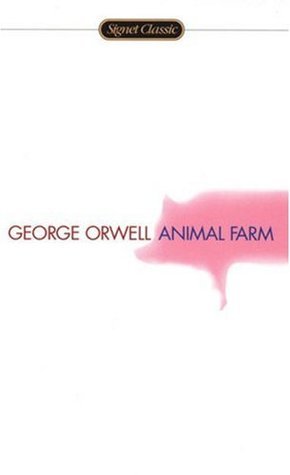
Animal Farm — George Orwell
First published: August 17, 1945 · Secker and Warburg
Pages: 141 (paperback)
Goodreads: 4.02★ (4.65M+ ratings — one of the most-rated books on Goodreads) · view
Audiobook runtime: ~3h 11m · Simon Callow canonical production / Stephen Fry BBC alternative
Commercial scale: 20M+ global sales · 80+ years continuous print · 70+ language translations · universal HS political-literature curriculum
Cultural impact: Defining 20th-century political-allegorical fable · Soviet-satire canonical text · 'All animals are equal but some animals are more equal than others' — permanent English political-idiom · public domain UK/EU as of 2021
The defining 20th-century political-allegorical fable — 80 years of continuous print, 20+ million copies, 4,650,000+ Goodreads ratings (one of the most-rated books on the platform), and the Simon Callow / Stephen Fry canonical audiobooks at compressed 3h 11m runtime. Skip the Libby wait with Kindle + free CastReader AI TTS →
Animal Farm is George Orwell's August 1945 Soviet-allegorical political-fable canonical text — the 141-page novella where the pigs Napoleon (Stalin) and Snowball (Trotsky) lead the animals of Manor Farm in overthrowing human farmer Mr. Jones (Tsar Nicholas II) after the founding revolutionary manifesto of old boar Major (Marx / Lenin), establish Seven Commandments of Animalism, and then gradually corrupt the revolution through pig-intellectual elite privileges, Napoleon's expulsion of Snowball (Stalin's Trotsky purge), propaganda manipulation via Squealer, dog-enforced political purges, alliance-shifts with rival farmers Frederick (Nazi Germany) and Pilkington (Western capitalism), and a final human-pig dinner at which the other animals look through the farmhouse window and 'could not tell which was which.' The progressively-amended Seven Commandments reduce to the single final line: 'ALL ANIMALS ARE EQUAL BUT SOME ANIMALS ARE MORE EQUAL THAN OTHERS.' Animal Farm has sold 20+ million copies globally, has been in continuous print since 1945, is translated into 70+ languages, and is universal high-school political-literature curriculum across English-speaking countries and internationally. The 4,650,000+ Goodreads ratings make it one of the single most-rated books on the platform. Orwell's specific events map onto specific Soviet history: 1917 revolution, 1927 Trotsky expulsion, 1936-1938 Great Purge, 1939 Molotov-Ribbentrop Pact, 1943 Tehran Conference. The novella's phrases — 'All animals are equal, but some are more equal than others', 'Four legs good, two legs bad' — have entered English political-idiom permanently. At 3h 11m with Simon Callow's canonical production, Animal Farm is the genre-defining political-fable primary-source text.
This guide covers the 3h 11m runtime, the Simon Callow and Stephen Fry canonical productions, the Soviet-history allegorical dimension, and every free / paid path.
Why 3h 11m Matters for Political Allegory
Political-allegorical-canon audiobook runtime benchmark.
| Title | Runtime | Year | Goodreads rating |
|---|---|---|---|
| Animal Farm (Orwell) — this book | 3h 11m | 1945 | 4.02★ |
| 1984 (Orwell) | 11h 22m | 1949 | 4.19★ |
| Brave New World (Huxley) | 8h 4m | 1932 | 3.87★ |
| Candide (Voltaire) | 4h 40m | 1759 | 3.82★ |
| Gulliver's Travels (Swift) | 12h 10m | 1726 | 3.63★ |
| Darkness at Noon (Koestler) | 8h 14m | 1940 | 3.97★ |
| One Day in the Life of Ivan Denisovich (Solzhenitsyn) | 4h 39m | 1962 | 4.00★ |
Animal Farm is the shortest canonical political-allegory commitment — a single-afternoon reading that delivers precise 1917-1943 Soviet-history allegorical grammar. At 3h 11m, the novella reads comfortably in a single weekend morning or across 2-3 commutes at 1.5x.
Three Listening Modes
Mode 1 — Canonical Audio (Simon Callow). $14.95 Audible credit or library-borrow via Libby; Audible Plus subscribers check rotating availability. Callow's classical stage-actor background suits Orwell's theatrical fable-voice — his production captures the progressive darkening from revolutionary hope through purges to pig-human indistinguishability.
Mode 2 — AI TTS via CastReader. Free, unlimited re-listens, adjustable speed, pronunciation overrides for Napoleon / Snowball / Boxer / Squealer / Animalism / Beasts of England / Seven Commandments. Particularly valuable for HS-course study or political-current-events re-engagement. See CastReader for Kindle.
Mode 3 — Stephen Fry BBC / LibriVox alternatives. Stephen Fry's BBC production brings distinctive British-literary-comic register to the pig-politicking dialogue. LibriVox volunteer productions (public domain in UK/EU since 2021, varying by jurisdiction in the U.S.) provide free alternatives.
The Simon Callow Canonical Production
Simon Callow (b. 1949, English actor, RSC / National Theatre credits, A Room with a View, Four Weddings and a Funeral) narrates the canonical Audible Studios edition in ~3h 11m. Callow's classical stage-actor background suits Orwell's theatrical fable-voice — he handles the beast-fable voice distinctly from journalist-political-allegory register, gives Napoleon's speeches appropriate authoritarian weight, and captures Squealer's propaganda-rhetoric manipulation with subtle disgust.
Stephen Fry (b. 1957, English actor, QI, Jeeves and Wooster, Harry Potter UK audiobooks narrator) provides the most-widely-loved BBC alternative edition. Fry's distinctive British-literary register and comic timing inflect the pig-politicking dialogue with particular edge — his Squealer propaganda passages and Napoleon decree scenes are particularly well-regarded.
For first-listeners: Callow Audible is the high-craft standard commercial recommendation; Stephen Fry is the British-literary-comic alternative.
The Plot: Seven Stages of Revolutionary Corruption
Stage 1 — Major's speech (prelude). Old boar Major (Marx / Lenin composite) delivers the founding revolutionary manifesto in the barn the night before his death, teaching the animals 'Beasts of England' (the Internationale equivalent) and framing human farmers as exploitative class enemy.
Stage 2 — The revolution (1917). Three months after Major's death, the animals revolt against farmer Mr. Jones, drive him off the farm, rename it 'Animal Farm,' and establish Seven Commandments of Animalism painted on the barn wall ('All animals are equal', 'No animal shall drink alcohol', 'No animal shall sleep in a bed', 'No animal shall kill another animal', etc.).
Stage 3 — Pig intellectual leadership (early 1920s). Pigs Napoleon and Snowball take intellectual leadership. Squealer handles propaganda. Boxer the cart horse (working class) adopts mottos 'I will work harder' and 'Napoleon is always right.' The animals defend against the Battle of the Cowshed (Mr. Jones's attempted return, allegorizing the 1918-1922 Russian Civil War Western intervention).
Stage 4 — Snowball's expulsion (1927 Trotsky purge). Napoleon uses secretly-raised attack dogs to expel Snowball from the farm, revisioning Snowball as retrospective traitor — allegorizing Stalin's 1927 expulsion of Trotsky and ongoing Trotsky-revisionist propaganda. Napoleon centralizes power.
Stage 5 — The Purges (1936-1938 Great Purge). Napoleon's dogs force confessions from and execute chickens, pigs, and sheep accused of Snowball-conspiracy. The Seven Commandments are amended: 'No animal shall kill another animal WITHOUT CAUSE.' Animals are forbidden from singing 'Beasts of England'; Squealer teaches 'Comrade Napoleon' hymn.
Stage 6 — Windmill and shifting alliances (1930s-1940s). The animals build a windmill (Soviet Five-Year Plans); it is destroyed by Mr. Frederick (Hitler) after Napoleon sold timber to him, allegorizing the Molotov-Ribbentrop Pact and Operation Barbarossa. The animals win the Battle of the Windmill at heavy cost. Boxer's 'I will work harder' drives him to collapse; Napoleon sells him to the knacker's yard while telling other animals he died peacefully in hospital.
Stage 7 — Pig-human indistinguishability (1943 Tehran Conference). The pigs now walk on two legs, wear human clothes, drink whisky, sleep in beds with sheets. The Seven Commandments have been reduced to a single line: 'ALL ANIMALS ARE EQUAL BUT SOME ANIMALS ARE MORE EQUAL THAN OTHERS.' Napoleon hosts farmer Pilkington and other human neighbors for dinner. Other animals look through the farmhouse window and 'could not tell which was which.'
Why Animal Farm Is the Defining 20th-Century Political Fable
George Orwell's August 1945 publication — delayed by four publisher rejections over wartime-ally-with-Stalin concerns — reshaped 20th-century political literature by achieving precise Soviet-history allegorical grammar in compressed, universally-accessible fable prose. The novella's foundational contributions:
Beast-fable political allegory. Orwell revived the medieval / Aesopian fable tradition for 20th-century political content. The beast-fable form's apparent simplicity — readable by middle-schoolers, teachable in a single afternoon — enables the form to carry sophisticated political-theory content without either academic density or journalistic flatness.
Specific historical mapping. Unlike Brave New World (abstract consumer-conditioning) or 1984 (composite totalitarianism), Animal Farm is specific Soviet-history allegory. Snowball IS Trotsky; Napoleon IS Stalin; Frederick IS Hitler; Pilkington IS Churchill / Roosevelt. The specificity enables the work to function as precise historical-political pedagogy.
The progressive Seven Commandments. Orwell's craft in the Seven Commandments amendments — 'No animal shall sleep in a bed' becoming 'No animal shall sleep in a bed WITH SHEETS', 'No animal shall kill another animal' becoming 'No animal shall kill another animal WITHOUT CAUSE' — captures the mechanism of revolutionary corruption through rhetorical-legal manipulation. The phrase 'All animals are equal, but some are more equal than others' has become permanent English political-idiom.
The pig-human dinner ending. The final scene — other animals looking through the farmhouse window and unable to tell pigs from humans — is one of the 20th century's most-quoted literary images. Orwell's claim: revolutions that centralize power without structural accountability become indistinguishable from the regimes they replaced.
Film Adaptations and Cultural Legacy
1954 animated film (Halas and Batchelor). The first British feature-length animated film. Produced with CIA funding as Cold War cultural-propaganda (declassified decades later — the CIA financed multiple anti-Soviet cultural productions in the 1950s). Changed the ending to remove Orwell's pig-human indistinguishability (replaced with animal-revolt-against-pigs ending).
1999 TNT live-action film. Jim Henson Creature Shop animatronics. Patrick Stewart voices Napoleon; Kelsey Grammer voices Snowball. Mixed critical reception.
2027 Andy Serkis motion-capture adaptation (announced). In development; expected to use the motion-capture technology Serkis developed for Gollum / Caesar / Snoke performances.
Cultural impact: Animal Farm's phrases have entered permanent English political-idiom — 'Four legs good, two legs bad' used for political-binary critique; 'Some animals are more equal than others' used for hierarchical-hypocrisy critique. The novella is routinely cited in contemporary political commentary on revolutionary corruption, authoritarian consolidation, and elite-class-formation 80 years after publication.
Free and Paid Listening Paths (April 2026)
Free paths:
- LibriVox — multiple volunteer-narrated editions (public-domain UK/EU/Australia/Canada; geo-restricted in U.S. until 2041)
- Project Gutenberg Australia — free ebook (public domain there)
- Libby — commercial audiobooks via U.S. library card, 1-2 week waits
- Hoopla — commercial audiobooks, instant-lend (no wait)
- Audible Plus — rotating included-with-membership productions
- Spotify Premium — 15h monthly audiobook allocation (Animal Farm at 3h 11m = 21% of budget, fits any month)
- CastReader — free AI TTS on any Kindle edition (public-domain UK/EU free editions available)
Paid paths:
- Audible Premium — 1 credit ($14.95) for Simon Callow Audible or purchase $10-15
- Kindle ebook — $6-10 U.S.; $0-2 UK/EU (public-domain editions)
- Physical — Signet Classics paperback $6-10, Harvest Books / Folio illustrated $15-40
Why Kindle + CastReader Wins for Animal Farm
For listeners prioritizing flexible re-engagement over single-narrator craft, Kindle + CastReader free AI TTS is the optimal path:
- Unlimited re-listens — no credit cost per engagement, critical for HS-course study and political-discourse-reference use
- Adjustable pace — particularly valuable through the Seven Commandments progression chapters or the Squealer propaganda-rhetoric passages
- Pronunciation overrides — configure Napoleon, Snowball, Boxer, Squealer, Clover, Benjamin, Old Major, Mollie, Manor Farm, Animalism for consistent AI narration
- Paragraph highlighting — supports comprehension through Orwell's denser allegorical-mapping passages (the Battle of the Cowshed / Windmill / Molotov-Ribbentrop equivalents)
- Public-domain Kindle edition (UK/EU) — often $0, making the total cost of unlimited CastReader listening effectively free
For listeners wanting the Simon Callow or Stephen Fry craft on first listen, use Audible or Libby; then switch to CastReader for re-listens and classroom-study contexts.
Animal Farm and the Orwell Political Canon
Orwell's political-allegorical canon includes two major novels and numerous essays:
- Animal Farm (1945) — compressed beast-fable Soviet allegory
- Nineteen Eighty-Four (1949) — composite totalitarianism dystopia
- Homage to Catalonia (1938) — Spanish Civil War direct-witness memoir
- 'Politics and the English Language' (1946) — craft essay on political writing
- 'Why I Write' (1946) — autobiographical political-writing essay
For listeners building the Orwell political-canon: Animal Farm (3h 11m) → Nineteen Eighty-Four (11h 22m) is the essential two-book-political-allegory commitment, totaling ~14 hours. Add Homage to Catalonia for the memoir-to-allegory arc. Orwell's essays reward re-engagement for their craft and political precision.
Related Reading
For listeners building the political-allegory-canon and dystopian-literature genre library, these CastReader guides pair naturally with Animal Farm:
- 1984 (George Orwell) — TTS & Audiobook Guide · Simon Prebble Blackstone 11h 22m, companion Orwell political-canon text
- The Little Prince (Saint-Exupéry) — TTS & Audiobook Guide · Viggo Mortensen HMH Audio 2h, parallel-compressed philosophical-fable peer
- The Handmaid's Tale (Margaret Atwood) — TTS & Audiobook Guide · Claire Danes Audible Studios 11h 1m, feminist-dystopian peer
- Lord of the Flies (William Golding) — TTS & Audiobook Guide · Martin Jarvis Listening Library 6h 33m, allegorical-political-fable peer
- To Kill a Mockingbird (Harper Lee) — TTS & Audiobook Guide · Sissy Spacek HarperAudio 2007-Audie-winner, post-war-moral-literature peer
Limitations and Honest Notes
- Partial public domain — UK/EU/Australia/Canada since January 2021 (author died 1950, life+70 in those jurisdictions); U.S. remains under copyright until 2041 (95-year post-publication term).
- Compact length — at 3h 11m, Animal Farm is a single-afternoon listen; plan accordingly for HS-class review or single-sitting re-reads.
- Beast-fable register — Orwell's compressed fable voice may feel simpler than literary readers expect; the apparent simplicity is craft, not limitation. Re-listens reveal the allegorical density.
- Specific Soviet-history mapping — the novella rewards reader-knowledge of 1917-1943 Soviet history (Russian Revolution, Trotsky expulsion, Great Purge, Molotov-Ribbentrop, Tehran Conference). First-time readers without this background benefit from a short Soviet-history primer.
- CIA 1954-film-adaptation context — the 1954 animated film's CIA funding and altered ending are documented in declassified records; viewers should watch the film aware that it is Cold War cultural-propaganda production, not a fully faithful adaptation.
Related: Listen to Kindle | Audible Alternative Free | Turn Ebook into Audiobook | Send to Phone | Kindle Audiobook Free
