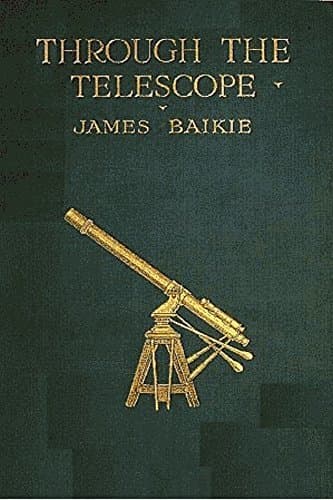
THROUGH THE TELESCOPE
AGENTS
AMERICA . . THE MACMILLAN COMPANY 64 & 66 Fifth Avenue, NEW YORK
CANADA . . THE MACMILLAN COMPANY OF CANADA, LTD. 27 Richmond Street, TORONTO
INDIA . . . MACMILLAN & COMPANY, LTD. 12 Bank Street, BOMBAY 7 New China Bazaar Street, CALCUTTA
PLATE I.
The 40-inch Refractor of the Yerkes Observatory.
THROUGH THE TELESCOPE BY JAMES BAIKIE, F.R.A.S.
WITH 32 FULL-PAGE ILLUSTRATIONS FROM PHOTOGRAPHS AND 26 SMALLER FIGURES IN THE TEXT
LONDON ADAM AND CHARLES BLACK 1906
TO
C. N. B. and H. E. B.
PREFACE
The main object of the following chapters is to give a brief and simple description of the most important and interesting facts concerning the heavenly bodies, and to suggest to the general reader how much of the ground thus covered lies open to his personal survey on very easy conditions. Many people who are more or less interested in astronomy are deterred from making practical acquaintance with the wonders of the heavens by the idea that these are only disclosed to the possessors of large and costly instruments. In reality there is probably no science which offers to those whose opportunities and means of observation are restricted greater stores of knowledge and pleasure than astronomy; and the possibility of that quickening of interest which can only be gained by practical study is, in these days, denied to very few indeed.
Accordingly, I have endeavoured, while recounting the great triumphs of astronomical discovery, to give some practical help to those who are inclined to the study of the heavens, but do not know how to begin. My excuse for venturing on such a task must be that, in the course of nearly twenty years of observation with telescopes of all sorts and sizes, I have made most of the mistakes against which others need to be warned.
The book has no pretensions to being a complete manual; it is merely descriptive of things seen and learned. Nor has it any claim to originality. On the contrary, one of its chief purposes has been to gather into short compass the results of the work of others. I have therefore to acknowledge my indebtedness to other writers, and notably to Miss Agnes Clerke, Professor Young, Professor Newcomb, the late Rev. T. W. Webb, and Mr. W. F. Denning. I have also found much help in the Monthly Notices and Memoirs of the Royal Astronomical Society, and the Journal and Memoirs of the British Astronomical Association.
The illustrations have been mainly chosen with the view of representing to the general reader some of the results of the best modern observers and instruments; but I have ventured to reproduce a few specimens of more commonplace work done with small telescopes. I desire to offer my cordial thanks to those who have so kindly granted me permission to reproduce illustrations from their published works, or have lent photographs or drawings for reproduction—to Miss Agnes Clerke for Plates XXV.-XXVIII. and XXX.-XXXII. inclusive; to Mrs. Maunder for Plate VIII.; to M. Loewy, Director of the Paris Observatory, for Plates XI.-XIV. and Plate XVII.; to Professor E. B. Frost, Director of the Yerkes Observatory, for Plates I., VII., XV., and XVI.; to M. Deslandres, of the Meudon Observatory, for Plate IX., and the gift of several of his own solar memoirs; to the Astronomer Royal for England, Sir W. Mahony Christie, for Plate V.; to Mr. H. MacEwen for the drawings of Venus, Plate X.; to the Rev. T. E. R. Phillips for those of Mars and Jupiter, Plates XX. and XXII.; to Professor Barnard for that of Saturn, Plate XXIV., reproduced by permission from the Monthly Notices of the Royal Astronomical Society; to Mr. W. E. Wilson for Plates XXIX. and XXXII.; to Mr. John Murray for Plates XVIII. and XIX.; to the proprietors of Knowledge for Plate VI.; to Mr. Denning and Messrs. Taylor and Francis for Plate III. and Figs. 6 and 20; to the British Astronomical Association for the chart of Mars, Plate XXI., reproduced from the Memoirs; and to Messrs. T. Cooke and Sons for Plate II. For those who wish to see for themselves some of the wonders and beauties of the starry heavens the two Appendices furnish a few specimens chosen from an innumerable company; while readers who have no desire to engage in practical work are invited to skip Chapters I. and II.
CONTENTS
LIST OF ILLUSTRATIONS
PRINTED SEPARATELY FROM THE TEXT
LIST OF ILLUSTRATIONS
PRINTED IN THE TEXT
THROUGH THE TELESCOPE
CHAPTER I
THE TELESCOPE—HISTORICAL
The claim of priority in the invention of this wonderful instrument, which has so enlarged our ideas of the scale and variety of the universe, has been warmly asserted on behalf of a number of individuals. Holland maintains the rights of Jansen, Lippershey, and Metius; while our own country produces evidence that Roger Bacon had, in the thirteenth century, 'arrived at theoretical proof of the possibility of constructing a telescope and a microscope' and that Leonard Digges 'had a method of discovering, by perspective glasses set at due angles, all objects pretty far distant that the sun shone on, which lay in the country round about.'
All these claims, however, whether well or ill founded, are very little to the point. The man to whom the human race owes a debt of gratitude in connection with any great invention is not necessarily he who, perhaps by mere accident, may stumble on the principle of it, but he who takes up the raw material of the invention and shows the full powers and possibilities which are latent in it. In the present case there is one such man to whom, beyond all question, we owe the telescope as a practical astronomical instrument, and that man is Galileo Galilei. He himself admits that it was only after hearing, in 1609, that a Dutchman had succeeded in making such an instrument, that he set himself to investigate the matter, and produced telescopes ranging from one magnifying but three diameters up to the one with a power of thirty-three with which he made his famous discoveries; but this fact cannot deprive the great Italian of the credit which is undoubtedly his due. Others may have anticipated him in theory, or even to a small extent in practice, but Galileo first gave to the world the telescope as an instrument of real value in research.
The telescope with which he made his great discoveries was constructed on a principle which, except in the case of binoculars, is now discarded. It consisted of a double convex lens converging the rays of light from a distant object, and of a double concave lens, intercepting the convergent rays before they reach a focus, and rendering them parallel again (Fig. 1). His largest instrument, as already mentioned, had a power of only thirty-three diameters, and the field of view was very small. A more powerful one can now be obtained for a few shillings, or constructed, one might almost say, for a few pence; yet, as Proctor has observed: 'If we regard the absolute importance of the discoveries effected by different telescopes, few, perhaps, will rank higher than the little tube now lying in the Tribune of Galileo at Florence.'
FIG. 1.—PRINCIPLE OF GALILEAN TELESCOPE.
Galileo's first discoveries with this instrument were made in 1610, and it was not till nearly half a century later that any great improvement in telescopic construction was effected. In the middle of the seventeenth century Scheiner and Huygens made telescopes on the principle, suggested by Kepler, of using two double convex lenses instead of a convex and a concave, and the modern refracting telescope is still constructed on essentially the same principle, though, of course, with many minor modifications (Fig. 2).