Agate Fossil Beds
Agate Fossil Beds National Monument Nebraska
Produced by the Division of Publications Harpers Ferry Center National Park Service
U.S. Department of the Interior Washington, D.C.
The National Park Handbook Series
National Park Handbooks, compact introductions to the great natural and historic places administered by the National Park Service, are designed to promote understanding and enjoyment of the parks. Each is intended to be informative reading and a useful guide before, during, and after a park visit. More than 100 titles are in print. This is Handbook 107. You may purchase the handbooks through the mail by writing to Superintendent of Documents, U.S. Government Printing Office, Washington DC 20402.
About This Book
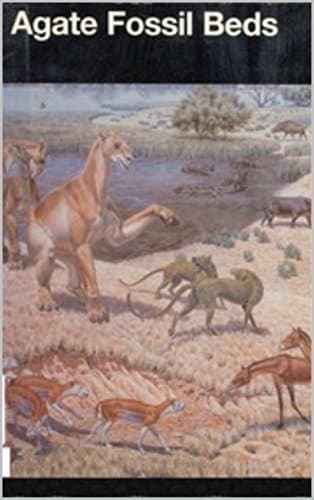
What was life like in North America 20 million years ago? Agate Fossil Beds provides a glimpse of that time, long before the arrival of man, when now-extinct creatures roamed the land which we know today as Nebraska. Part 1 of this handbook introduces you to the park; Part 2 brings life to the fossil specimens and examines the area’s geological and ecological evidence; and Part 3 presents concise guide and reference information.
Library of Congress Cataloging in Publication Data
Contents
1 Welcome to Agate Fossil Beds
James H. Cook examines a fossil fragment at the quarries near Agate Springs Ranch about 1918.
Besides fossils, Cook also collected Indian artifacts and kept many of them on the walls of his study in the ranch house.
Worlds of Past and Present
Imagine that you are a healthy young man, raised conservatively in Michigan several years after the end of the Civil War. You are a skilled all-around hunter and trapper. The railroad has just spanned the continent, and stories of the West, its dangers, its people, and its opportunities come to you frequently. You and a friend decide you must see this land for yourself, and you save your money carefully against the day when you will be ready to go west. Around 1869, at age 12, that day comes.
At Fort Leavenworth, Kansas, you meet several cattlemen who tell you and your friend where to get work as cattle herders. Before many years have passed you have been a cowpuncher in Texas, you have fought Comanches, and you have bossed a ranch crew for a wealthy Englishman. You go on to fight the famous Apache Chieftain Geronimo as a scout with the U.S. Cavalry, and you befriend a famous Sioux chief, Red Cloud. You marry, buy a ranch in western Nebraska, and raise a family. And you become something of a legend in your own time, your ranch known for its hospitality to Indian, scientist, traveler—to one and all, rich or poor.
A movie script? Not at all—these are the essentials of the life of James H. Cook. Known as “Captain,” James Cook became the owner, in 1887, of the Agate Springs Ranch, founded earlier by his father-in-law. Under Cook’s watchful eye, the ranch prospered and became a second home both for the Oglala Sioux and for paleontologists bent on excavating the fossilized remains of the life of 20 million years ago, found here along the Niobrara River in western Nebraska.
This land, now encompassing Agate Fossil Beds National Monument, is punctuated with low bluffs ascending westward toward the Rockies. It is a land of sharp contrasts, of cool, inviting riverbanks and parched ridges, the most famous of which are the fossil-bearing Carnegie and University Hills. The surrounding grassy plains are a tapestry of wild grasses—prairie sandreed, blue grama, little bluestem, and needle-and-thread. The wildflowers lupine, spiderwort, western wallflower, sunflower, and penstemon add touches of blue, purple, orange, yellow, and red to the tapestry. In summer the dark green spears of the small soapweed, a yucca, dot the brown grasses of the hillsides. And just as they did more than 20 million years ago, cottonwoods and willows provide shade and shelter for birds and other animals along the river.
Professor Othniel C. Marsh, back row center, of Yale University and his students look as if they are equipped for a frontier hunting expedition. But instead of looking for live animals in the West, they were hunting for fossilized remains of ancient beasts. Marsh and his crews made many such trips, and it was on one early trip that Cook and Marsh met, in Sioux country.
Professor Marsh and the great Sioux chief Red Cloud greet each other in New Haven in 1880.
Professor Edward Drinker Cope competed with Marsh for the best fossils. He once made the mistake of reconstructing a skeleton hind end foremost; Marsh never let him forget it.
Looking out over the rippling grasses, you grasp the fact that Nebraska is larger than all of New England and feel the awesome spaciousness of the Great Plains. The word “distance” has a different meaning here than it does in the East. When James Cook came to the upper Niobrara River, the closest town was Cheyenne, Wyoming—more than 160 kilometers (100 miles) to the southwest.
It was there, in Cheyenne, that Cook met Dr. Elisha B. Graham in 1879, the year Graham selected this land for a cattle ranch as an investment and as a summer retreat for his family. Graham named the place the 04 Ranch, apparently because it is near the 104th meridian. Cook visited the ranch often in the early 1880s and courted Elisha and Mary Graham’s daughter Kate. They were married in 1886 and lived near Socorro, New Mexico, for a year before returning to Nebraska with their newborn child, Harold, and buying the ranch from Dr. Graham, who moved to California.
Cook began at once to make improvements to the ranch. He planted trees by the hundreds and carried water to them faithfully to get them started. As settlers failed to “prove up” their land claims over the years, he added new lands to the ranch and changed the name to Agate Springs Ranch in recognition of the native moss agates and the many springs in the valley. He and Kate raised fine race horses as well as cattle.
The period in which the Cooks took over the ranch was one of transition from the frontier days of migrations and Indian wars to more settled, orderly lives. Ranching and farming became the dominant mode of life in the eastern approaches to the Rockies. Even oil exploration played a part in the development of the land. The transition was a difficult one for many, Indian and settler alike.
In some ways Kate Cook represented both the old and the new in Nebraska. She was a fine horsewoman; one day she rode a bucking horse through 11 the streets of Cheyenne sidesaddle to win a bet for her husband. She was refined, too, having taught herself French so she could read French literature. Her mother, Mary Graham, became the first postmistress for the small community around Agate.
And James Cook was more than an adventuresome frontiersman. He was actively interested in community and national affairs and in current scientific questions. He became a patient, knowledgeable mediator between the Indians and the settlers, and he was looked upon by the Oglala Sioux as a friend and host, and sometimes employer.
The Cooks became involved in a great scientific enterprise quite accidentally around 1885, the year before their marriage. On a ride up the conical buttes not far from the ranch house, a glitter under a rock shelf caught Cook’s eye. They found fragments of bones scattered on the ground. At first they assumed the bones were those of an Indian. But Cook found instead “a beautifully petrified piece of the shaft of some creature’s leg bone.” They carried it back to the house but didn’t report the find until after they bought the ranch. Erwin Barbour of the University of Nebraska was the first to respond to their reports and in 1892 became the first professional geologist to visit the area and do some prospecting.
The Cooks’ discovery thrust them and their ranch into a subtle battle in the American West, a continuing struggle to find the best fossils with which to reconstruct the ancient past. For centuries it had been thought that life on our planet was only a few thousand years old, but by the late 19th century science had evolved beyond that point of view. Now paleontologists and their excavation teams were scouring the West in search of fossils that might provide clues to the beginnings of life.
The two most noted antagonists in this feverish search were Professors Edward D. Cope of Philadelphia and Othniel C. Marsh of Yale University. Cook knew them both, but the discoveries at Agate would wait for the next generation of scientists.