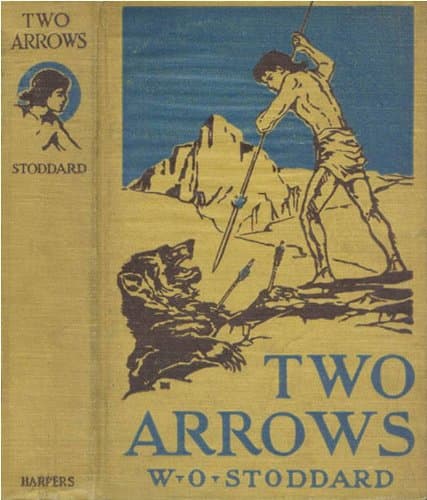
TWO ARROWS
HARPER'S YOUNG PEOPLE'S SERIES New Large-type Edition
HARPER & BROTHERS PUBLISHERS
TWO ARROWS EXPLORES THE RUINSToList
TWO ARROWS
A STORY OF RED AND WHITE
BY
WILLIAM O. STODDARD
Author of "The Talking Leaves"
ILLUSTRATED
NEW YORK AND LONDON HARPER & BROTHERS PUBLISHERS
COPYRIGHT, 1886, BY HARPER & BROTHERS COPYRIGHT, 1914, BY WILLIAM O. STODDARD F.-Y.
CONTENTS
ILLUSTRATIONS
TWO ARROWS
TWO ARROWS
A STORY OF RED AND WHITE
Chapter I
THE HUNGRY CAMP
The mountain countries of all the earth have always been wonder-lands. The oldest and best known of them are to this day full of things that nobody has found out. That is the reason why people are always exploring them, but they keep their secrets remarkably well, particularly the great secret of how they happened to get there in that shape.
The great western mountain country of the United States is made up of range after range of wonderful peaks and ridges, and men have peered in among them here and there, but for all the peering and searching nothing of the wonder to speak of has been rubbed away.
Right in the eastern, edge of one of these mountain ridges, one warm September morning, not long ago, a band of Nez Percé Indians were encamped. It was in what is commonly called "the Far West," because always when you get there the West is as far away as ever. The camp was in a sort of nook, and it was not easy to say whether a spur of the mountain jutted out into the plain, or whether a spur of the plain made a dent in the ragged line of the mountains. More than a dozen "lodges," made of skins upheld by poles, were scattered around on the smoother spots, not far from a bubbling spring of water. There were some trees and bushes and patches of grass near the spring, but the little brook which trickled away from it did not travel a great way into the world, from the place where it was born, before it was soaked up and disappeared among the sand and gravel. Up and beyond the spring, the farther one chose to look, the rockier and the ruggeder everything seemed to be.
Take it all together, it was a forlorn looking, hot, dried-up, and uncomfortable sort of place. The very lodges themselves, and the human beings around them, made it appear pitifully desolate. The spring was the only visible thing that seemed to be alive and cheerful and at work.
There were Indians and squaws to be seen, a number of them, and boys and girls of all sizes, and some of the squaws carried pappooses, but they all looked as if they had given up entirely and did not expect to live any longer. Even some of the largest men had an air of not caring much, really, whether they lived or not; but that was the only regular and dignified way for a Nez Percé or any other Indian warrior to take a thing he can't help or is too lazy to fight with. The women showed more signs of life than the men, for some of them were moving about among the children, and one poor, old, withered, ragged squaw sat in the door of her lodge, with her gray hair all down over her face, rocking backward and forward, and singing a sort of droning chant.
There was not one quadruped of any kind to be seen in or about that camp. Behind this fact was the secret of the whole matter. Those Indians were starving! Days and days before that they had been away out upon the plains to the eastward, hunting for buffalo. They had not found any, but they had found all the grass dry and parched by a long drought, so that no buffalo in his senses was likely to be there, and so that their own ponies could hardly make a living by picking all night. Then one afternoon a great swarm of locusts found where they were and alighted upon them just as a westerly wind died out. The locusts remained long enough to eat up whatever grass there was left. All through the evening the Nez Percés had heard the harsh, tingling hum of those devourers, as they argued among themselves whether or not it were best to stay and dig for the roots of the grass. The wind came up suddenly and strongly about midnight, and the locusts decided to take advantage of it and sail away after better grass, but they did not leave any behind them. They set out for the nearest white settlements in hope of getting corn and apple-tree leaves, and all that sort of thing.
The band of Nez Percés would have moved away the next morning under any circumstances, but when morning came they were in a terribly bad predicament. Not one of them carried a watch, or he might have known that it was about three o'clock, and very dark, when a worse disaster than the visit of the locusts took place. By five or six minutes past three it was all done completely, and it was the work of a wicked old mule.
All but a half a dozen of the ponies and mules of the band had been gathered and tethered in what is called a "corral," only that it had no fence, at a short distance from the lodges. Nobody dreamed of any danger to that corral, and there was none from the outside, even after the boys who were set to watch it had curled down and gone to sleep. All the danger was inside, and it was also inside of that mule. He was hungry and vicious. He had lived in the white "settlements," and knew something. He was fastened by a long hide lariat to a peg driven into the ground, as were all the others, and he knew that the best place to gnaw in two that lariat was close to the peg, where he could get a good pull upon it. As soon as he had freed himself he tried the lariat of another mule, and found that the peg had been driven into loose earth and came right up. That was a scientific discovery, and he tried several other pegs. Some came up with more or less hard tugging, and as fast as they came up a pony or a mule was free. Then he came to a peg he could not pull, and he lost his temper. He squealed, and turned around and kicked the pony that belonged to that peg. Then he stood still and brayed, as if he were frightened to find himself loose, and that was all that was needed.
It was after three o'clock, and in one minute the whole corral was kicking and squealing, braying, biting, and getting free, and joining in the general opinion that it was time to run away.
That is what the western men call a "stampede," and whenever one occurs there is pretty surely a mule or a thief at the bottom of it; but sometimes a hail-storm will do as well, or nearly so. By five or six minutes past three all of that herd were racing westward, with boys and men getting out of breath behind it, and all the squaws in the camp were holding hard upon the lariats of the ponies tethered among the lodges. When morning came there were hardly ponies enough to "pack" the lodges and other baggage and every soul of the band had to carry something as they all set off, bright and early, upon the trail of the stampeded drove of ponies. Some of the warriors had followed it without any stopping for breakfast, and they might have caught up with it, perhaps, but for the good generalship of that old mule. He had decided in his own mind to trot right along until he came to something to eat and drink, and the idea was a persuasive one. All the rest determined to have something to eat and drink, and they followed their leader. It was not easy for men on foot to catch up with them, and before noon the warriors sat down and took a smoke, and held a council as to what it was best to do. Before they finished that council the ponies had gained several miles more the start of them. The next council the warriors held contained but three men, for all the rest had gone back as messengers to tell the band that the ponies had not been recovered. By nightfall the remaining three had faithfully carried back the same news, and were ready for a fresh start.
After that there had been day after day of weary plodding and continual disappointment, with the weather growing hotter and the grass drier, until the trail they were following brought them to the spring in the edge of the mountain range without bringing them to the wicked old mule and his followers.


