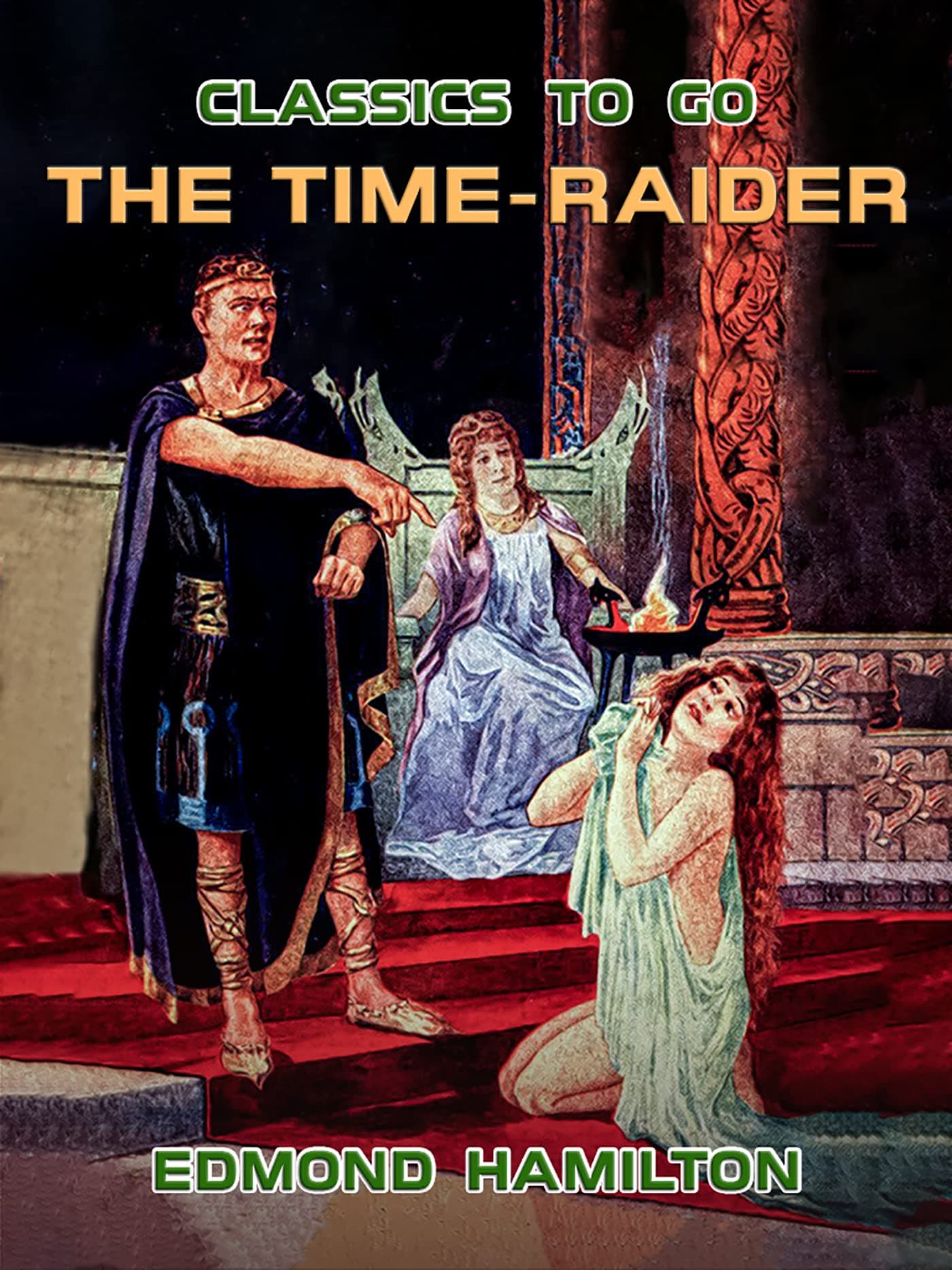
The TIME-RAIDER
By EDMOND HAMILTON
[Transcriber's Note: This etext was produced from Weird Tales October, November December 1927 and January 1928. Extensive research did not uncover any evidence that the U.S. copyright on this publication was renewed.]
"He dangled helplessly in the thing's embrace."
CHAPTER 1
THE CANNELL MYSTERY
In beginning this account of our great adventure, it must be understood that I attempt no complete history of the matter. There will be gaps, many gaps, in the continuity of my story, for that story remains, after all, simply a record of my own contacts with the Raider, and with those people whose lives he entered and darkened. So that my tale here is necessarily one of personal experience, except for a few places where I have summarized general knowledge.
Besides this history of what I may term the more human side of our experience, Dr. Lantin has dealt with its scientific aspects in his epochal work on time-displacement and in our joint monograph on electronic acceleration. Although several salient features of the affair have been omitted, for reasons that will figure later, yet the two works mentioned and the present record give a broad outline of the whole matter, from the beginning.
From the beginning! But where was that beginning? Ages back in the past, or ages ahead in the future? To place the true beginning of it all would be to know much about it that we do not know. So I start at the point where the matter definitely entered my own life and world. And that point, that event, is the Cannell Mystery, as it was then termed.
You will find it in the newspapers of the day, the bare facts wrapped in clouds of speculation. Professor Ferdinand Cannell, of New York, disappearing inexplicably in the jungles of Indo-China, vanishing from the world of men as though blotted out.
At that time, Cannell was undoubtedly one of the very greatest of living archeologists. Nominally attached to a great New York museum, he was really a free-lance student and excavator, roaming about the world in search of proof for his numerous and startling theories. His first fame had been established by his researches into the Dravidian remnants in lower India, and he had followed that brilliant achievement by another as great, the monumental Warren Society investigation into the walled ruins of Zimbabwe, in South Africa.
With two such successes behind him, Cannell then boldly proposed to make the subject of his next researches the mighty ruined city of Angkor, in the heart of the Cambodian jungle. Angkor has long been a colossal challenge to modern wisdom, a gigantic, towered metropolis of gray stone, once noisy with the life of swarming millions, but silent and dead now, unutterably dead. A thousand years the huge ruin has lain in the jungle, wrapped in silence, inhabited only by snakes and bats and tigers. Its past, the history of its builders, has been a vast enigma always, which Cannell had determined to solve.
So he sailed for Hongkong, and Dr. Lantin and I were on the dock when his ship cleared. My own acquaintance with Cannell was recent, but Lantin and he had been close friends for years. Their friendship dated back to their university days, and had continued after they diverged into different lines of work, Cannell's taking him to the remnants of past peoples, while Lantin's interest in radio-chemistry had brought him to the great New York laboratories of the Downe Foundation, with myself as his laboratory assistant.
For all their warm friendship, there was a strong contrast between the two men. Cannell was the younger by a few years, a blond giant of thirty-five or thirty-six, with snapping blue eyes and a habit of talking with machine-gun rapidity. Altogether the antithesis of Dr. Lantin, who was dark, medium of stature and quiet of manner, with friendly gray eyes that could take on the glint of steel, at times.
Together we had waved farewell to Cannell and a few weeks later had received a cable from Saigon, in Indo-China, briefly announcing his arrival. He had then proceeded up the Mekong River into the wilderness of the interior, and finally over a network of winding creeks to Angkor itself. The latter stage of the journey was made in canoes, some seven or eight natives poling along Cannell and his outfit, but no other white man was in the party.
No more was heard of the venture until a week later, when the natives of Cannell's party straggled into a little up-river village, without him. They explained, volubly, that on the third night after reaching Angkor, the white man had been seized and carried away by the devils of the ruins. None of them had actually seen this but they had heard his scream, from a distance, and when they conquered their fears enough to search the ruins, had found no trace of him. It was clear that the powerful spirits of the dead city were angered, and had snatched away the white man who dared to disturb them, so the terror-stricken natives had at once fled from the place with all speed.
On hearing this tale, several French planters made their way to Angkor, forcing the unwilling natives to accompany them, but they found no trace of Cannell, who seemed to have vanished completely. His tent and outfit were found, quite undisturbed, which tended to corroborate the natives' story regarding their sudden flight.
So when the little search-party returned, it was advanced as its opinion that Cannell had been seized and carried away by a roving tiger, his scream and disappearance being interpreted by the natives as a visitation of demons, since they were known to be extremely superstitious in regard to the dead city. While this explanation was faulty enough, it seemed the only rational one available, and was accepted by the authorities at Saigon.
And so the matter rested. Cannell's only relatives had been distant connections, and except for Lantin he had had scarcely one intimate friend, so after the first shock of surprize his passing caused little stir. The newspapers speculated briefly, and the archeological journals expressed regrets, referring to his splendid achievements. But that was all. New stars soon rose to fill his place in the scientific firmament. And Cannell was forgotten.
Time drove on. Days ... months ... years....
CHAPTER 2
CANNELL'S STORY
I pass to that June night, over three years after Cannell's disappearance, when my own part in the drama may be said to begin. Lantin and I were working late in our laboratory at the Foundation, when we were interrupted by the telephone bell. We had reached a critical point in our experiment, and as Lantin hurried over to the instrument, I heard him muttering threats to have it removed. I did not catch his first answer, but after a minute's silence he flung out a single word, in a strange voice, that startled me.
"Cannell!"
At once I hastened over to his side, and as I did so, he turned toward me a face eloquent of astonishment, still holding the receiver to his ear. "I'll be there in ten minutes!" he shouted into the instrument, then hung up and turned to face my excited questions.
"Good God, Wheeler," he cried, "it's Cannell!"
"What?" I asked, stupidly, dumfounded by the assertion.
"Cannell," he repeated, "at my apartment. He says to meet him there at once. Where could he have been, these three years?"
But I was already reaching for my hat and a moment later we were on the street outside, hailing a cruising taxi. Lantin's bachelor home was in the west 70's, a little roof-bungalow set on top of a big apartment building, and we sped up the avenue toward it with the highest legal speed.
Lantin did not speak at all, on the way. He was plainly highly excited, but my own agitation was fast calming. After all, I thought, the thing might be a stupid practical joke, though an unforgivable one to perpetrate. Still, if Lantin had recognized the voice—Before I could ask him about that, the cab stopped, and we hastened into the building, to the elevator.