The Story of the Amulet
by E. Nesbit
Contents
TO Dr Wallis Budge of the British Museum as a small token of gratitude for his unfailing kindness and help in the making of it
CHAPTER I. THE PSAMMEAD
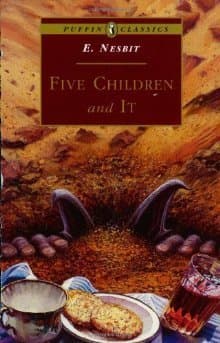
There were once four children who spent their summer holidays in a white house, happily situated between a sandpit and a chalkpit. One day they had the good fortune to find in the sandpit a strange creature. Its eyes were on long horns like snail’s eyes, and it could move them in and out like telescopes. It had ears like a bat’s ears, and its tubby body was shaped like a spider’s and covered with thick soft fur—and it had hands and feet like a monkey’s. It told the children—whose names were Cyril, Robert, Anthea, and Jane—that it was a Psammead or sand-fairy. (Psammead is pronounced Sammy-ad.) It was old, old, old, and its birthday was almost at the very beginning of everything. And it had been buried in the sand for thousands of years. But it still kept its fairylikeness, and part of this fairylikeness was its power to give people whatever they wished for. You know fairies have always been able to do this. Cyril, Robert, Anthea, and Jane now found their wishes come true; but, somehow, they never could think of just the right things to wish for, and their wishes sometimes turned out very oddly indeed. In the end their unwise wishings landed them in what Robert called “a very tight place indeed”, and the Psammead consented to help them out of it in return for their promise never never to ask it to grant them any more wishes, and never to tell anyone about it, because it did not want to be bothered to give wishes to anyone ever any more. At the moment of parting Jane said politely—
“I wish we were going to see you again some day.”
And the Psammead, touched by this friendly thought, granted the wish. The book about all this is called Five Children and It, and it ends up in a most tiresome way by saying—
“The children did see the Psammead again, but it was not in the sandpit; it was—but I must say no more—”
The reason that nothing more could be said was that I had not then been able to find out exactly when and where the children met the Psammead again. Of course I knew they would meet it, because it was a beast of its word, and when it said a thing would happen, that thing happened without fail. How different from the people who tell us about what weather it is going to be on Thursday next, in London, the South Coast, and Channel!
The summer holidays during which the Psammead had been found and the wishes given had been wonderful holidays in the country, and the children had the highest hopes of just such another holiday for the next summer. The winter holidays were beguiled by the wonderful happenings of The Phœnix and the Carpet, and the loss of these two treasures would have left the children in despair, but for the splendid hope of their next holiday in the country. The world, they felt, and indeed had some reason to feel, was full of wonderful things—and they were really the sort of people that wonderful things happen to. So they looked forward to the summer holiday; but when it came everything was different, and very, very horrid. Father had to go out to Manchuria to telegraph news about the war to the tiresome paper he wrote for—the Daily Bellower, or something like that, was its name. And Mother, poor dear Mother, was away in Madeira, because she had been very ill. And The Lamb—I mean the baby—was with her. And Aunt Emma, who was Mother’s sister, had suddenly married Uncle Reginald, who was Father’s brother, and they had gone to China, which is much too far off for you to expect to be asked to spend the holidays in, however fond your aunt and uncle may be of you. So the children were left in the care of old Nurse, who lived in Fitzroy Street, near the British Museum, and though she was always very kind to them, and indeed spoiled them far more than would be good for the most grown-up of us, the four children felt perfectly wretched, and when the cab had driven off with Father and all his boxes and guns and the sheepskin, with blankets and the aluminium mess-kit inside it, the stoutest heart quailed, and the girls broke down altogether, and sobbed in each other’s arms, while the boys each looked out of one of the long gloomy windows of the parlour, and tried to pretend that no boy would be such a muff as to cry.
I hope you notice that they were not cowardly enough to cry till their Father had gone; they knew he had quite enough to upset him without that. But when he was gone everyone felt as if it had been trying not to cry all its life, and that it must cry now, if it died for it. So they cried.
Tea—with shrimps and watercress—cheered them a little. The watercress was arranged in a hedge round a fat glass salt-cellar, a tasteful device they had never seen before. But it was not a cheerful meal.
After tea Anthea went up to the room that had been Father’s, and when she saw how dreadfully he wasn’t there, and remembered how every minute was taking him further and further from her, and nearer and nearer to the guns of the Russians, she cried a little more. Then she thought of Mother, ill and alone, and perhaps at that very moment wanting a little girl to put eau-de-cologne on her head, and make her sudden cups of tea, and she cried more than ever. And then she remembered what Mother had said, the night before she went away, about Anthea being the eldest girl, and about trying to make the others happy, and things like that. So she stopped crying, and thought instead. And when she had thought as long as she could bear she washed her face and combed her hair, and went down to the others, trying her best to look as though crying were an exercise she had never even heard of.
She found the parlour in deepest gloom, hardly relieved at all by the efforts of Robert, who, to make the time pass, was pulling Jane’s hair—not hard, but just enough to tease.
“Look here,” said Anthea. “Let’s have a palaver.” This word dated from the awful day when Cyril had carelessly wished that there were Red Indians in England—and there had been. The word brought back memories of last summer holidays and everyone groaned; they thought of the white house with the beautiful tangled garden—late roses, asters, marigold, sweet mignonette, and feathery asparagus—of the wilderness which someone had once meant to make into an orchard, but which was now, as Father said, “five acres of thistles haunted by the ghosts of baby cherry-trees”. They thought of the view across the valley, where the lime-kilns looked like Aladdin’s palaces in the sunshine, and they thought of their own sandpit, with its fringe of yellowy grasses and pale-stringy-stalked wild flowers, and the little holes in the cliff that were the little sand-martins’ little front doors. And they thought of the free fresh air smelling of thyme and sweetbriar, and the scent of the wood-smoke from the cottages in the lane—and they looked round old Nurse’s stuffy parlour, and Jane said—
“Oh, how different it all is!”
It was. Old Nurse had been in the habit of letting lodgings, till Father gave her the children to take care of. And her rooms were furnished “for letting”. Now it is a very odd thing that no one ever seems to furnish a room “for letting” in a bit the same way as one would furnish it for living in. This room had heavy dark red stuff curtains—the colour that blood would not make a stain on—with coarse lace curtains inside. The carpet was yellow, and violet, with bits of grey and brown oilcloth in odd places. The fireplace had shavings and tinsel in it. There was a very varnished mahogany chiffonier, or sideboard, with a lock that wouldn’t act. There were hard chairs—far too many of them—with crochet antimacassars slipping off their seats, all of which sloped the wrong way. The table wore a cloth of a cruel green colour with a yellow chain-stitch pattern round it. Over the fireplace was a looking-glass that made you look much uglier than you really were, however plain you might be to begin with. Then there was a mantelboard with maroon plush and wool fringe that did not match the plush; a dreary clock like a black marble tomb—it was silent as the grave too, for it had long since forgotten how to tick. And there were painted glass vases that never had any flowers in, and a painted tambourine that no one ever played, and painted brackets with nothing on them.
“And maple-framed engravings of the Queen, The Houses of Parliament, the Plains of Heaven, And of a blunt-nosed woodman’s flat return.”
There were two books—last December’s Bradshaw, and an odd volume of Plumridge’s Commentary on Thessalonians. There were—but I cannot dwell longer on this painful picture. It was indeed, as Jane said, very different.
“Let’s have a palaver,” said Anthea again.
“What about?” said Cyril, yawning.
“There’s nothing to have anything about,” said Robert kicking the leg of the table miserably.
“I don’t want to play,” said Jane, and her tone was grumpy.
Anthea tried very hard not to be cross. She succeeded.
“Look here,” she said, “don’t think I want to be preachy or a beast in any way, but I want to what Father calls define the situation. Do you agree?”
“Fire ahead,” said Cyril without enthusiasm.
“Well then. We all know the reason we’re staying here is because Nurse couldn’t leave her house on account of the poor learned gentleman on the top-floor. And there was no one else Father could entrust to take care of us—and you know it’s taken a lot of money, Mother’s going to Madeira to be made well.”
Jane sniffed miserably.
“Yes, I know,” said Anthea in a hurry, “but don’t let’s think about how horrid it all is. I mean we can’t go to things that cost a lot, but we must do something. And I know there are heaps of things you can see in London without paying for them, and I thought we’d go and see them. We are all quite old now, and we haven’t got The Lamb—”