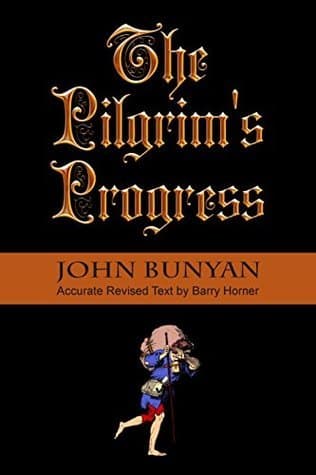
The Pilgrim's Progress
By JOHN BUNYAN
EVERY CHILD CAN READ
EDITED BY REV. JESSE LYMAN HURLBUT, D.D. ILLUSTRATED
EVERY CHILD'S LIBRARY
THE JOHN C. WINSTON CO. PHILADELPHIA
Copyright, 1909, by The John C. Winston Co.
PREFACE
It may seem a very bold undertaking to change even a word of the book which, next to the Bible, has been read by more people, old and young, than any other book in the English language.
But, it must be remembered that, although the Pilgrim's Progress has come to be a children's book, and is read more often by young people than by those who are older, it was not in the purpose of John Bunyan to write a book for children or even for the young.
The Pilgrim's Progress was a book for men and women; and it was aimed to teach the great truths of the gospel. Hence while most of it is written in a simple style,—as all books should be written,—it contains much that a child cannot understand; not often in the story, but in the conversations and discussions between the different persons. Some of these conversations are in reality short sermons on doctrines and teachings which Bunyan believed to be of great importance. But these are beyond the minds of children and give them great trouble when the book is read. They do not like to have them left out of the reading, thinking that they may lose something interesting. Many a young person has stumbled through the dull, doctrinal parts of the book, without understanding them; and even grown people find them in our time somewhat of a blemish upon the wonderful story, valuable as they were supposed to be in Bunyan's own time.
For many years it has been in my mind, not to re-write the Pilgrim's Progress, for that would destroy its greatest charm, but to change the words here and there to simpler ones, and to omit all the conversations and arguments concerning subjects belonging to the field of doctrine; in other words to place the story of the Pilgrim's Progress in such a form that every child ten years old can understand it. My purpose is to make it plain and interesting to children, leaving the older form of the book to be read by them when they become older.
Perhaps a short account of Bunyan's own life may add to the interest of his book. John Bunyan was born in 1628 at Elstow, a small village near Bedford, which is in the heart of England. His father was a poor man, traveling on foot from place to place mending pots and pans and the simple furniture of country kitchens, and the son followed the same trade, and was known as a "tinker." He tells us that he lived a wild life, and was especially known as one of the worst swearers in the region.
When the great Civil War broke out in England, in 1642, between King Charles the First and the Parliament, Bunyan became a soldier on the side of the Commonwealth, as the party against the king was called. He served in the army between 1644 and 1646.
In 1648, at the age of twenty years, he married a good young woman, who led him to prayer and to a new life. But it was hard for one who had led such a life as his had been to turn to God, and it cost the young man a great struggle. It seemed to him that his past sins were like a load upon his back, just as he afterward wrote of his "pilgrim," and it was long before he found peace.
He became a member of a little Baptist society, and soon began to preach. Crowds came to hear him, drawn by his earnest spirit and his quaint striking manner. But when Charles the Second became king, no religious services were allowed except those of the Church of England, and all other meetings were forbidden. Bunyan however went on preaching, until he was sent to prison in Bedford. In Bedford jail he stayed twelve years. To find a means of living in jail, he made lace, and sold it as a support for himself and his blind daughter.
If the prison was hard for Bunyan his sufferings were made a blessing to untold millions, for while in Bedford jail he wrote the Pilgrim's Progress. This story was intended to be a parable, like many of our Saviour's teachings; that is, it put into the form of a story the life of one who turns from sin, finds salvation through Christ, and in the face of many difficulties makes his way through this world to heaven. Even a child who reads or listens to the book will see this meaning in part; and he will understand it better as he grows older.
In 1672 Bunyan was set free, and allowed to begin again his work as a Baptist minister, and he soon became one of the most popular preachers in all England. He died quite suddenly in 1688, when he was sixty years old, and is buried in an old graveyard now near the center of London, called Bunhill Fields Burial-ground. In the same ground is buried another great writer, Daniel DeFoe, whose story of "Robinson Crusoe" ranks next to the Pilgrim's Progress in the number of its readers; also Isaac Watts, the author of many hymns sung in all the churches, and Mrs. Susanna Wesley, the mother of the great John Wesley. Four people who have left a deep mark upon the world, all lie near together in this small cemetery in London.
Every child should read the Pilgrim's Progress as a story if no more than a story; should read it until he knows it by heart. And the older he grows the deeper will be the meaning that he will see in it.
Jesse Lyman Hurlbut.
LIST OF ILLUSTRATIONS.
THE PILGRIM'S PROGRESS
PART I
CHAPTER I.
As I walked through the wilderness of this world, I lighted on a certain place where was a den,[1] and laid me down in that place to sleep; and as I slept, I dreamed a dream. I dreamed, and behold, I saw a man clothed with rags, standing in a certain place, with his face from his own house, a book in his hand, and a great burden upon his back. I looked, and saw him open the book, and read therein; and as he read, he wept and trembled; and, not being able longer to contain, he brake out with a lamentable cry, saying, "What shall I do?"
In this plight, therefore, he went home, and restrained himself as long as he could, that his wife and children should not perceive his distress; but he could not be silent long, because that his trouble increased. Wherefore at length he brake his mind to his wife and children; and thus he began to talk to them: "Oh my dear wife," said he, "and you my sweet children, I, your dear friend, am in myself undone by reason of a burden that lieth hard upon me; moreover, I am told to a certainty that this our city will be burned with fire from heaven; in which fearful overthrow, both myself, with thee, my wife, and you, my sweet babes, shall miserably come to ruin, except some way of escape can be found whereby we may be delivered." At this all his family were sore amazed; not for that they believed that what he had said to them was true, but because they thought that some frenzy or madness had got into his head; therefore, it drawing towards night, and they hoping that sleep might settle his brain, with all haste they got him to bed. But the night was as troublesome to him as the day; wherefore, instead of sleeping, he spent it in sighs and tears. So when the morning was come, they would know how he did. He told them, Worse and worse: he also set to talking to them again; but they began to be hardened. They also thought to drive away his madness by harsh and surly treatment of him: sometimes they would ridicule, sometimes they would chide, and sometimes they would quite neglect him. Wherefore he began to retire himself to his chamber, to pray for and pity them, and also to sorrow over his own misery; he would also walk solitary in the fields, sometimes reading, and sometimes praying; and thus for some days he spent his time.
Now, I saw, upon a time, when he was walking in the fields, that he was (as he was wont) reading in his book, and greatly distressed in his mind; and as he read, he burst out as he had done before, crying, "What shall I do to be saved?"
I saw also that he looked this way and that way, as if he would run; yet he stood still, because (as I perceived) he could not tell which way to go. I looked then, and saw a man named Evangelist coming to him, who asked, "Wherefore dost thou cry?"
He answered, "Sir, I read in the book in my hand, that I am condemned to die, and after that to come to judgment; and I find that I am not willing to do the first, nor able to do the second."
Then said Evangelist, "Why not willing to die, since this life is troubled with so many evils?" The man answered, "Because I fear that this burden that is upon my back will sink me lower than the grave, and I shall fall into Tophet.[2] And, sir, if I be not fit to go to prison, I am not fit to go to judgment, and from thence to death; and the thoughts of these things make me cry."