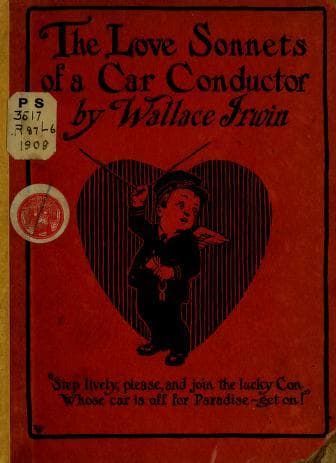
The Love Sonnets of a Hoodlum
by
Wallace Irwin
With an Introduction by Gelett Burgess
Showing how Vanity is still on Deck, & humble Virtue gets it in the Neck!
"A Leaden Heart I wear since she forsook me."
The Love Sonnets of a Hoodlum
Introduction
"Tell me, ye muses, what hath former ages Now left succeeding times to play upon, And what remains unthought on by those sages Where a new muse may try her pinion?"
So Complained Phineas Fletcher in his Purple Island as long ago as 1633. Three centuries have brought to the development of lyric passion no higher form than that of the sonnet cycle. The sonnet has been likened to an exquisite crystal goblet that holds one sublimely inspired thought so perfectly that not another drop can be added without overflow. Cast in the early Italian Renaissance by Dante, Petrarch and Camoens, it was chased and ornamented during the Elizabethan period by Shakespere, and filled with its most stimulating draughts of song and love during the Victorian era by Rossetti, Browning and Meredith. And now, in this first year of the new century, the historic cup is refilled and tossed off in a radiant toast to Erato by Wallace Irwin.
The attribute of modernity is not given to every new age. The cogs in the wheels of time slip back, at times. The classic revival may be permeated with enthusiasm, but it is a second edition of an old work—not a virile essay at expression of living thought. The later Renaissance was but half modern in its spirit; the classic period of the eighteenth century in England was half ancient in its mood. But the twentieth century breaks with a new promise of emancipation to English Literature, for a new influence has freshened the blood of conventional style that in the decadence of the End of the Century had grown dilute. This adjuvant strain is found in the enthusiasm of Slang. Slowly its rhetorical power has won foothold in the language. It has won many a verb and substantive, it has conquered idiom and diction, and now it is strong enough to assault the very syntax of our Anglo-Saxon tongue.[*]
[*] Note, for instance, the potential mood used indicatively in the current colloquial, "Wouldn't that jar you!"
Slang, the illegitimate sister of Poetry, makes with her a common cause against the utilitarian economy of Prose. They both stand for lavish luxuriance in trope and involution, for floriation and adornment of thought. It is their boast to make two words bloom where one grew before. Both garb themselves in Metaphor, and the only complaint of the captious can be that whereas Poetry follows the accepted style, Slang dresses her thought to suit herself in fantastic and bizarre caprices, that her whims are unstable and too often in bad taste.
But this odium given to Slang by superficial minds is undeserved. In other days, before the language was crystallized into the idiom and verbiage of the doctrinaire, prose, too, was untrammeled. Indeed, a cursory glance at the Elizabethan poets discloses a kinship with the rebellious fancies of our modern colloquial talk. Mr. Irwin's sonnets may be taken as an indication of this revolt, and how nearly they approach the incisive phrases of the seventeenth century may easily be shown in a few exemplars. For instance, in Sonnet XX, "You're the real tan bark!" we have a close parallel in Johnson's Volpone, or The Fox:
"Fellows of outside and mere bark!"
And this instance is an equally good illustration also of that curious process which, in the English language, has in time created for a single word ("cleave," for instance) two exactly opposite meanings. A line from John Webster's Appius and Virginia might be cited as showing how near his diction approached modern slang:
"My most neat and cunning orator, whose tongue is quicksilver;"
and, for an analogy similar, though elaborate, compare lines 5-8 in Sonnet XI. In Beaumont and Fletcher's Philaster,
"A pernicious petticoat prince"
is as close to "Mame's dress-suit belle" of No. VII as modern costume allows, and
"No, you scarab!"
from Ben Jonson's Alchemist gives a curious clue to the derivation of the popular term "scab" found in No. VI. Webster's forcible picture in The White Devil—
"Fate is a spaniel; we cannot beat it from us!"
finds a rival in Mr. Irwin's strong simile—"O Fate, thou art a lobster!" in No. IV. And, to conclude, since such similarities might be quoted without end, note this exclamation from Beaumont and Fletcher's Woman's Prize, written before the name of the insect had achieved the infamy now fastened upon it by the British Matron:
"These are bug's words!"
Not only does this evidently point out the origin of "Jim-jam bugs" in No. IX, and the better known modern synonym for brain, "bug-house," but it indicates the arbitrary tendency of all language to create gradations of caste in parts of speech. It is to this mysterious influence by which some words become "elegant" or "poetic," and others "coarse" or "unrefined," that we owe the contempt in which slang is held by the superficial Philistine.
In Mr. Irwin's sonnet cycle, however, we have slang idealized, or as perhaps one might better say, sublimated. Evolution in the argot of the streets works by a process of substitution. A phrase of two terms goes through a system of permutation before it is discarded or adopted into authorized metaphor. "To take the cake," for instance, a figure from the cake-walk of the negroes, becomes to "capture" or "corral" the "bun" or "biscuit." Nor is this all, for in the higher forms of slang the idea is paraphrased in the most elaborate verbiage, an involution so intricate that, without a knowledge of the intervening steps, the meaning is often almost wholly lost. Specimens of this cryptology are found in many of Mr. Irwin's sonnets, notably in No. V:
"My syncopated con-talk no avail."
We trace these synonyms through "rag-time," etc., to an almost subliminal thought—an adjective resembling "verisimilitudinarious," perhaps, qualifying the "con" or confidential talk that proved useless to bring Mame back to his devotion.
In the masterly couplet closing the sestet of No. XVIII, Mr. Irwin's verbal enthusiasm reaches its highest mark in an ultra-Meredithian rendition of "I am an easy mark," an expression, by the way, which would itself have to be elaborately translated in any English edition.