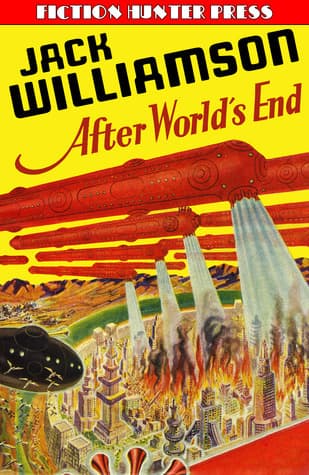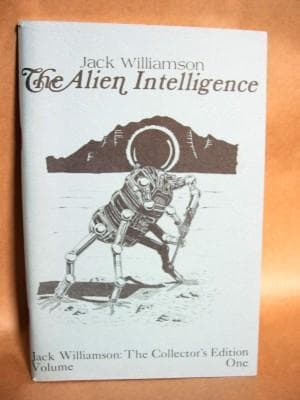
The Alien Intelligence
By Jack Williamson
JACK WILLIAMSON
Not since the famous "Moon Pool" by A. Merritt, have we read such a remarkable story as the present one, by the well-known author.
We are quite certain that this story will be one of the outstanding science fiction achievements of the year. It will be discussed and re-discussed time and again. In a way it is a little classic and stands in a place by itself.
The author has a knack, not only to arouse your curiosity, but to keep it at a high pitch throughout the entire story, but best of all, his science while fantastic is always within the realms of possibility and there is no reason why the astounding things which he paints so vividly, could not be true, either now or in the future.
Do not, by any means, fail to read this outstanding story.
[Transcriber's Note: This etext was produced from Science Wonder Stories July, August 1929. Extensive research did not uncover any evidence that the U.S. copyright on this publication was renewed.]
I fired on the instant and had the luck to shatter the vessel, splashing the liquid over his person. His purple robe was eaten away; his flesh was dyed a deep purple and partially consumed.
CHAPTER I
The Mountain of the Moon
Before me, not half a mile away, rose the nearest ramparts of the Mountain of the Moon. It was after noon, and the red sun blazed down on the bare, undulating sandy waste with fearful intensity. The air was still and intolerably hot. Heat waves danced ceaselessly over the uneven sand. I felt the utter loneliness, the wild mystery, and the overwhelming power of the desert. The black cliffs rose cold and solid in the east—a barrier of dark menace. Pillars of black basalt, of dark hornblende, and of black obsidian rose in a precipitous wall of sharp and jagged peaks that curved back to meet the horizon. Needle-like spires rose a thousand feet, and nowhere was the escarpment less than half that high. It was with mingled awe and incipient fear that I first looked upon the Mountain of the Moon.
It was a year since I had left medical college in America to begin practise in Perth, Australia. There I had an uncle who was my sole surviving relative. My companion on the voyage had been Dr. Horace Austen, the well-known radiologist, archeologist, and explorer. He had been my dearest friend. That he was thirty years my senior, had never interfered with our comradeship. It was he who had paid most of my expenses in school. He had left me at Perth, and went on to investigate some curious ruined columns that a traveler had reported in the western part of the Great Victoria Desert. There Austen had simply vanished. He had left Kanowna, and the desert had swallowed him up. But it was his way, when working on a problem, to go into utter seclusion for months at a time.
My uncle was an ardent radio enthusiast, and it was over one of his experimental short wave sets that we picked up the remarkable message from my lost friend that led me to abandon my practise, and, heeding the call of adventure that has always been strong in those of my blood, to seek the half mythical Mountain of the Moon, in the heart of the unexplored region of the Great Victoria Desert of Western Australia.
The message was tantalizingly brief and hard to interpret. We picked it up five times, over a period of two weeks, always just after sunset. Evidently it was sent by one who had not recently practised his knowledge of code, and it seemed that the sender was always in a great hurry, or under a considerable nervous tension, for minor errors and omissions were frequent. The words were invariably the same. I copy them from an old notebook.
"To Winfield Fowler, physician, Perth, Australia: I, Horace Austen, am lost in an unknown new world, where alien terrors reign, that lies in a crater in the Mountain of the Moon. I implore you to come to my aid, for the sake of mankind. Bring arms, and my equipment—the Rontgen tubes and coils, and the spectrometer. Ascend ladder at west pinnacle. Find my friend Melvar, maiden of the crystal city, whom I left beyond the Silver Lake. Come, for the sake of civilization, and may whoever hears this forward it with all dispatch."
My uncle was inclined to suspect a hoax. But after the message had come over twice I received telegrams from several other radio amateurs who had heard it, and were forwarding it to me. We took the direction of the third call and had amateurs in Adelaide do the same. The lines intersected in the Great Victoria Desert, at a point very near that at which Wellington located the Mountain of the Moon, when he sighted it and named it in 1887.
Knowing Austen, as I did, to be intensely human as a man, but grave and serious as a scientist, it was impossible for me to take the message as a practical joke, as my uncle, deriding the possibility of my friend's being imprisoned in "an unknown new world," insisted it was. It was equally impossible for one of my impetuous and adventurous disposition to devote himself to any prosaic business when so attractive a mystery was beckoning him away. Then I would never, in any case, have hesitated to go to Austen's aid, if I knew him to be in need.
I got together the apparatus he had mentioned—it was some equipment he happened to have left with me as he went on—as well as my emergency medicine kit, a heavy rifle, two .45 Colt automatics, and a good supply of ammunition; and waited for more explicit signals. But the calls had never come regularly, and after the fifth no more were heard. Having waited another irksome week, I bade my uncle farewell and got on the train. I left the railway at Kanowna, and bought three ponies. I rode one and packed provisions, equipment, and water bottles on the other two. Nothing need be said of the perils of the journey. Three weeks later I came in sight of the mountain.
Wellington had christened it as he did because of an apparent similarity to the strange cliff-rimmed craters of the moon, and the appellation was an apt one. The crags rose almost perpendicularly from the sand to the jagged rim. To climb them was clearly out of the question. The rock was polished slick by wind-blown sands for many feet, but rough and sharp above. To my left, at the extreme west point of the great curve, was a dark needle spire that towered three hundred feet above its fellows. I knew that it must be Austen's "west pinnacle." What sort of ladder I was to ascend, I had little idea.
As the sun sank back of the rolling sea of sand, dark purple shadows rose about the barrier, and I was struck with deep forebodings of the evil mystery that lay beyond it. The gold of the desert changed to silver gray, and the gray faded swiftly, while the deep purple mantle swept up the peaks, displacing even the deep red crowns that lay like splashes of blood upon the summits. Still I felt, or fancied, a strange spirit of terror that lurked behind the mountain, even in the night.
Quickly I made camp. Just two of the ponies were left, and they were near death (I have passed over the hardships of my trip). I hobbled them on a little patch of grass and brush that grew where water had run from the cliff; pitched my little tent, and found brush to start a tiny fire. I ate supper, with but a scanty cup of water; then, oppressed by the vast mysterious peaks that loomed portentously in the east, shutting out the starlight, I went in the tent and sought my blanket. Then came the first of those terrible and inexplicable occurrences that led up to the great adventure.
CHAPTER II
The Abyss of the Terror-light
First I heard a faint whispering sound, or rather a hiss, infinitely far away, and up, I thought, over the cliffs. Then the cloth of the tent was lighted by a faint red glow thrown on it from above. I shivered and the strange spell of the mountain and the desert fell heavier upon me. I wanted to go out and investigate; but unfamiliar terror held me powerless. I gripped my automatic and waited tensely. The scarlet radiance shone ever brighter through the cloth. The sound turned to a hissing, shrieking scream. It was deafening, and it plunged straight down. It seemed to pause, to hover overhead. The red glare was almost blinding. Abruptly the tent was blown down by a sudden tempest of wind. For perhaps a minute the terror hung about me. I lay there in a strange paralysis of fear, while a hurricane of wind tore at the canvas upon me. I heard upon the tempest, above that awful whistling, a wild mad laugh that rang against the cliff, weirdly appalling. It was utterly inhuman, not even the laugh of a madman. Just once it rang out, and afterwards I imagined it had been my fancy.
Then the light and the sound swept up and away. With belated courage I tore my way from under the cloth. The stars were like jewels in the westward sky, where the zodiacal light was still visible. The ominous blackness of the mountain blotted out the eastern stars; and the peaks were lighted by a vague and flickering radiance of scarlet, like the reflection of unpleasant fires beyond. Strange pulsing, exploring fingers of red seemed to thrust themselves up from behind the cliff. Somehow they gave me the feeling that an incredibly great, incredibly evil personality lurked beyond. The crimson light shone weirdly on the wild summits of the mountain, as if they were smeared with blood.
I threw more brush on the fire, and crouched over it, feeling uncomfortably alone and terrified. When the flames had flared up I looked about for the ponies, seeking companionship even in them. They were gone! At first I thought they had broken their hobbles and run off, but I could neither see nor hear them, and they had been in no condition to run far. I walked about a little, to look for them, and then went back to the fire. I sat there and watched the eerie, unwholesome glare that shone over the mountain. No longer did I doubt the existence of Austen's "world where alien terrors reign." I knew, even as I had felt when I first saw the mountain, that strange life and power lurked beyond it.
The Ladder Found
Presently I stretched the tent again, and lay down, but I did not sleep.
At dawn I got up and went to look for the ponies. I climbed one of the low dunes and gazed over the gray infinity of sand, but not a sign of them rewarded my look. I tried to trail them. I found where they had been hobbled, and followed the tracks of each to a place where the hoofs had cut deep in the sandy turf. Beyond there was no trace. Then I was certain of what I had already known, that the Thing had carried them away.