THE SIREN OF OUR STREET.
“OUR STREET.”
BY
MR. M. A. TITMARSH.
LONDON: CHAPMAN AND HALL, 186 STRAND. MDCCCXLVIII.
OUR STREET.
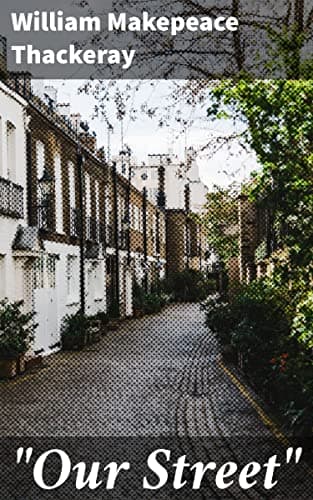
Our Street, from the little nook which I occupy in it, and whence I and a fellow-lodger and friend of mine cynically observe it, presents a strange motley scene. We are in a state of transition. We are not as yet in the town, and we have left the country where we were when I came to lodge with Mrs. Cammysole, my excellent landlady. I then took second-floor apartments at No. 17 Waddilove Street, and since, although I have never moved (having various little comforts about me), I find myself living at No. 46 A Pocklington Gardens.
Why is this? Why am I to pay eighteen shillings instead of fifteen? I was quite as happy in Waddilove Street; but the fact is, a great portion of that venerable old district has passed away, and we are being absorbed into the splendid new white-stuccoed Doric-porticoed genteel Pocklington quarter. Sir Thomas Gibbs Pocklington, M.P. for the borough of Lathanplaster, is the founder of the district and his own fortune. The Pocklington Estate Office is in the Square, on a line with Waddil—with Pocklington Gardens, I mean. The old inn, the Ram and Magpie, where the market-gardeners used to bait, came out this year with a new white face and title, the shield, &c. of the Pocklington Arms. Such a shield it is! Such quarterings! Howard, Cavendish, De Ros, De la Zouche, all mingled together.
Even our house, 46 A, which Mrs. Cammysole has had painted white in compliment to the Gardens of which it now forms part, is a sort of impostor, and has no business to be called Gardens at all. Mr. Gibbs, Sir Thomas’s agent and nephew, is furious at our daring to take the title which belongs to our betters. The very next door (No. 46, the Honourable Mrs. Mountnoddy) is a house of five stories, shooting up proudly into the air, thirty feet above our old high-roofed low-roomed old tenement. It belongs to Captain Bragg, not only the landlord but the son-in-law of Mrs. Cammysole, who lives a couple of hundred yards down the street, at “The Bungalow.” He was the Commander of the Ram Chunder East Indiaman, and has quarrelled with the Pocklingtons ever since he bought houses in the parish.
He it is who will not sell or alter his houses to suit the spirit of the times. He it is who, though he made the widow Cammysole change the name of her street, will not pull down the house next door, nor the baker’s next, nor the iron-bedstead and feather warehouse ensuing, nor the little barber’s with the pole, nor, I am ashamed to say, the tripe shop, still standing. The barber powders the heads of the great footmen from Pocklington Gardens; they are so big that they can scarcely sit in his little premises. And the old tavern, The East Indiaman, is kept by Bragg’s ship steward, and protests against the Pocklington Arms.
Down the road is Pocklington Chapel, Rev. Oldham Slocum—in brick, with arched windows and a wooden belfry; sober, dingy, and hideous. In the centre of Pocklington Gardens rises St. Waltheof’s, the Rev. Cyril Thuryfer and assistants—a splendid Anglo-Norman edifice, vast, rich, elaborate, bran new, and intensely old. Down Avemary Lane you may hear the clink of the little Romish Chapel bell. And hard by is a large broad-shouldered Ebenezer (Rev. Jonas Gronow), out of the windows of which the hymns come booming all Sunday long.
Going westward along the line we come presently to Comandine House (on a part of the gardens of which Comandine Gardens is about to be erected by his lordship); farther on, “The Pineries,” Mr. and Lady Mary Mango; and so we get into the country, and out of Our Street altogether, as I may say. But in the half mile, over which it may be said to extend, we find all sorts and conditions of people—from the Right Honourable Lord Comandine down to the present topographer; who, being of no rank, as it were, has the fortune to be treated on almost friendly footing by all, from his lordship down to the tradesman.
OUR HOUSE IN OUR STREET.
We must begin our little descriptions where, they say, Charity should begin—at home. Mrs. Cammysole, my landlady, will be rather surprised when she reads this, and finds that a good-natured tenant, who has never complained of her impositions for fifteen years, understands every one of her tricks, and treats them, not with anger, but with scorn—with silent scorn.
On the 18th of December, 1837, for instance, coming gently down stairs, and before my usual wont, I saw you seated in my arm-chair, peeping into a letter that came from my aunt in the country, just as if it had been addressed to you, and not to “M. A. Titmarsh, Esq.” Did I make any disturbance? far from it; I slunk back to my bed-room (being enabled to walk silently in the beautiful pair of worsted slippers Miss Penelope J——s worked for me; they are worn out now, dear Penelope!), and then, rattling open the door with a great noise, descended the stairs, singing “Son vergin vezzosa” at the top of my voice. You were not in my sitting-room, Mrs. Cammysole, when I entered that apartment.
You have been reading all my letters, papers, manuscripts, brouillons of verses, inchoate articles for the Morning Post and Morning Chronicle, invitations to dinner and tea—all my family letters, all Eliza Townley’s letters, from the first, in which she declared that to be the bride of her beloved Michelagnolo was the fondest wish of her maiden heart, to the last, in which she announced that her Thomas was the best of husbands, and signed herself “Eliza Slogger;” all Mary Farmer’s letters, all Emily Delamere’s; all that poor foolish old Miss MacWhirter’s, whom I would as soon marry as——; in a word, I know that you, you hawk-beaked, keen-eyed, sleepless, indefatigable, old Mrs. Cammysole, have read all my papers for these ten years.
I know that you cast your curious old eyes over all the manuscripts which you find in my coat pockets and those of my pantaloons, as they hang in a drapery over the door-handle of my bed-room.
I know that you count the money in my green and gold purse, which Lucy Netterville gave me, and speculate on the manner in which I have laid out the difference between to-day and yesterday.
I know that you have an understanding with the laundress (to whom you say that you are all-powerful with me), threatening to take away my practice from her, unless she gets up gratis some of your fine linen.
I know that we both have a pennyworth of cream for breakfast, which is brought in in the same little can; and I know who has the most for her share.
I know how many lumps of sugar you take from each pound as it arrives. I have counted the lumps, you old thief, and for years have never said a word, except to Miss Clapperclaw, the first-floor lodger. Once I put a bottle of pale brandy into that cupboard, of which you and I only have keys, and the liquor wasted and wasted away, until it was all gone. You drank the whole of it, you wicked old woman. You a lady, indeed!
I know your rage when they did me the honour to elect me a member of the Poluphloisboiothalasses Club, and I ceased consequently to dine at home. When I did dine at home, on a beefsteak, let us say, I should like to know what you had for supper? You first amputated portions of the meat when raw; you abstracted more when cooked. Do you think I was taken in by your flimsy pretences? I wonder how you could dare to do such things before your maids (you, a clergyman’s daughter and widow, indeed!), whom you yourself were always charging with roguery.
Yes, the insolence of the old woman is unbearable, and I must break out at last. If she goes off in a fit at reading this, I am sure I shan’t mind. She has two unhappy wenches, against whom her old tongue is clacking from morning till night; she pounces on them at all hours. It was but this morning at eight, when poor Molly was brooming the steps, and the baker paying her by no means unmerited compliments, that my landlady came whirling out of the ground-floor front, and sent the poor girl whimpering into the kitchen.
Were it but for her conduct to her maids I was determined publicly to denounce her. These poor wretches she causes to lead the lives of demons; and not content with bullying them all day, she sleeps at night in the same room with them, so that she may have them up before daybreak, and scold them while they are dressing.
Certain it is, that between her and Miss Clapperclaw, on the first floor, the poor wenches led a dismal life. My dear Miss Clapperclaw, I hope you will excuse me for having placed you in the title-page of my little book, looking out of your accustomed window, and having your eye-glasses ready to spy the whole street, which you know better than any inhabitant of it.
It is to you that I owe most of my knowledge of our neighbours; from you it is that most of the facts and observations contained in these brief pages are taken. Many a night, over our tea, have we talked amiably about our neighbours and their little failings; and as I know that you speak of mine pretty freely, why let me say, my dear Bessy, that if we have not built up Our Street between us, at least we have pulled it to pieces.
A STREET COURTSHIP.
THE BUNGALOW—CAPTAIN AND MRS. BRAGG.
Long, long ago, when Our Street was the country—a stagecoach between us and London passing four times a-day—I do not care to own that it was a sight of Flora Cammysole’s face, under the card of her mamma’s “Lodgings to Let,” which first caused me to become a tenant of Our Street. A fine good-humoured lass she was then; and I gave her lessons (part out of the rent) in French and flower-painting. She has made a fine rich marriage since, although her eyes have often seemed to me to say, “Ah, Mr. T., why didn’t you, when there was yet time, and we both of us were free, propose—you know what?” “Psha! Where was the money, my dear madam?”
Captain Bragg, then occupied in building Bungalow Lodge—Bragg, I say, living on the first floor, and entertaining sea-captains, merchants, and East Indian friends with his grand ship’s plate, being disappointed in a project of marrying a director’s daughter, who was also a second-cousin once removed of a peer, sent in a fury for Mrs. Cammysole, his landlady, and proposed to marry Flora off-hand, and settle four hundred a-year upon her. Flora was ordered from the back parlour (the Ground-floor occupies the Second-floor bed-room), and was on the spot made acquainted with the splendid offer which the First-floor had made her. She has been Mrs. Captain Bragg these twelve years.