Lee Mansion NATIONAL MEMORIAL Arlington National Cemetery
VIRGINIA
DEPARTMENT OF THE INTERIOR March 3, 1849
UNITED STATES DEPARTMENT OF THE INTERIOR Douglas McKay, Secretary
NATIONAL PARK SERVICE Conrad L. Wirth, Director
Reprint 1953 16—52238-7 U. S. GOVERNMENT PRINTING OFFICE
Lee Mansion National Memorial
In this Mansion, which became his home when he married Mary Custis, Robert E. Lee wrote his resignation from the United States Army in April 1861, to join the cause of Virginia and the South.
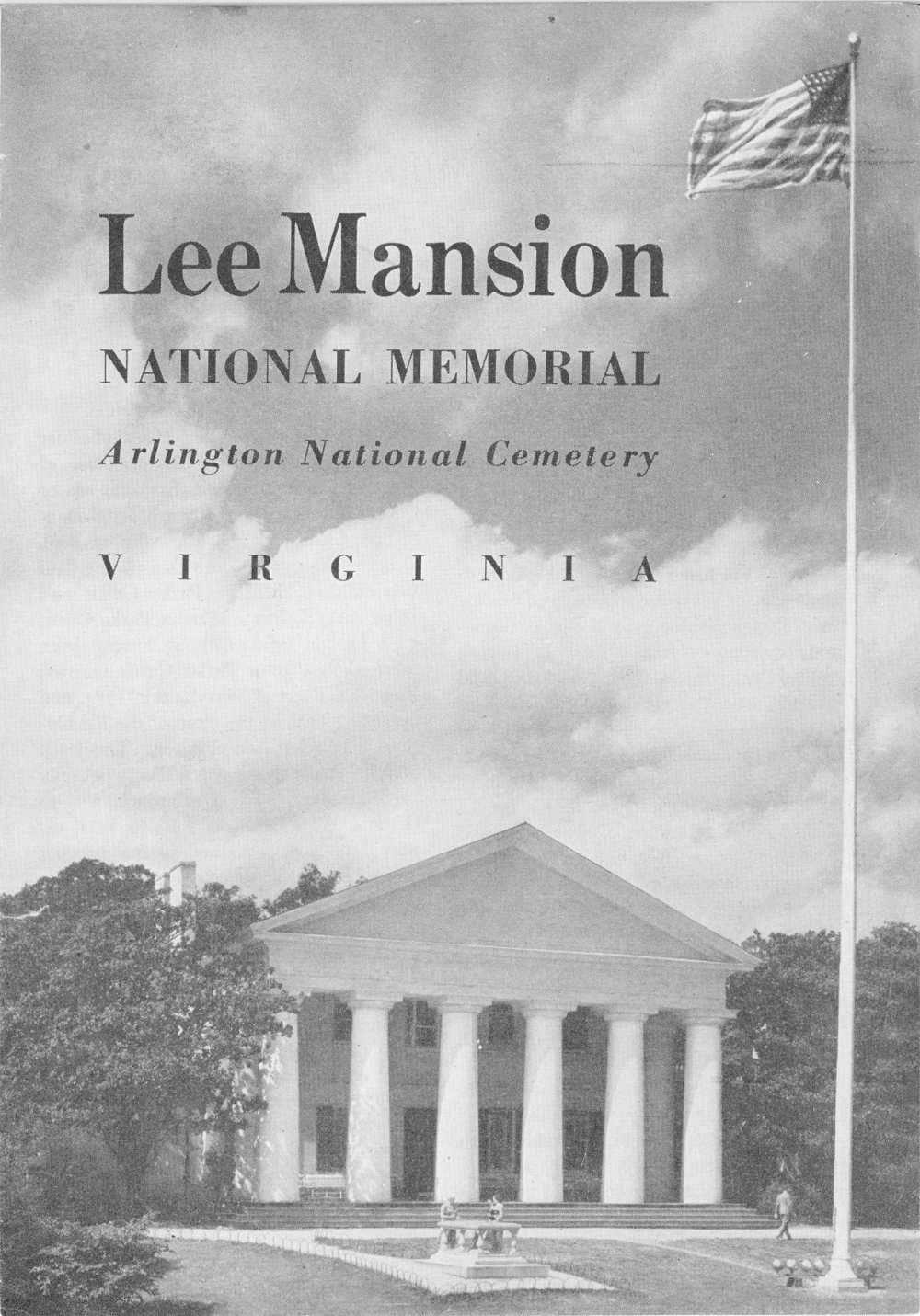
The Lee Mansion National Memorial, or Arlington House, as it was formerly known, distinctive through its associations with the families of Custis, Washington, and Lee, stands within the Nation’s most famous cemetery on the Virginia side of the Potomac opposite Washington. This house of the foster son of the First President was for years the treasury of both the Washington heirlooms and the Washington tradition. Here Robert E. Lee, a young lieutenant in the U. S. Army, and Mary Custis, the great-granddaughter of Martha Washington, were married and reared a family. Here, also, Col. Robert E. Lee, torn between devotion to his country and to his native State, made his fateful decision, the substance of which he had written to his son a few months before: “It is the principle I contend for.... But I can anticipate no greater calamity for the country than a dissolution of the Union.... Still, a Union that can only be maintained by swords and bayonets ... has no charm for me. I shall mourn for my country and for the welfare and progress of mankind. If the Union is dissolved ... I shall return to my native State ... and save in defence will draw my sword on none.” Today Arlington House, furnished with appointments of its early period, preserves for posterity the atmosphere of gracious living, typical of a romantic age of American history.
Early History
George Washington Parke Custis, builder of Arlington House, was the grandson of Martha Washington and the foster son of George Washington. When Martha Dandridge Custis became the wife of Col. George Washington she was a widow with two children, Martha Parke Custis and John Parke Custis. Martha Parke Custis died in her teens without having been married, but John Parke Custis married Eleanor Calvert of Maryland in 1774, and upon his death at the close of the Revolutionary War left four children. The death of John Parke Custis was a shock, not only to his mother, Mrs. Washington, but to General Washington as well, as he is reported to have remarked to the grieving mother at the deathbed, “I adopt the two youngest children as my own.” Their names were Eleanor Parke Custis (Nellie) and George Washington Parke Custis. They were reared at Mount Vernon and are often referred to as the “Children of Mount Vernon.”
In 1802, the year his grandmother, Mrs. Washington, died, George Washington Parke Custis began building Arlington House on the estate of 1,100 acres which his father had purchased from the Alexander family in 1778. He named the estate “Arlington” and the home “Arlington House” in honor of the ancestral homestead of the Custis family on the Eastern 2 Shore of Virginia. The house was to receive the legacy of his grandmother—furniture and pictures, plate and china from Mount Vernon, and more precious still, personal effects of Washington. Two years later, at the age of 23, he was married to Mary Lee Fitzhugh of Chatham.
Portrait of Robert E. Lee, about 1850 (G. Louvrie)
It is believed that Mr. Custis designed and supervised the original building and that its remodeling about 1820 was under the direction of the architect, George Hadfield. The foundation stone and timber came from the estate. The bricks with which the house was built were burned from native clay by slaves.
Arlington
The extent of the front of the Mansion, with its two wings, is 140 feet. The wings are identical, except that in the north wing the space corresponding to the state dining room in the south wing was divided into small rooms for the temporary accommodation of Mr. and Mrs. Custis while the house was being built and was never changed. The central portion is divided by a wide central hall. A large formal drawing room with two fine marble fireplaces lies south of this hall, while to the north of it can be seen the family dining room and family parlor separated by a north and south partition broken by three graceful arches. The second story is also divided by a central hall on either side of which there are two bedrooms and accompanying dressing rooms. A small room used as a linen closet is at the end of this hall. The third floor was used only for storage purposes and remained an unfinished attic. The grand portico facing the Potomac, with its eight massive Doric columns, was modeled after the Temple of Theseus at Athens. At the rear, two outhouses used as servants’ quarters, smokehouse, workroom, and summer kitchen form a courtyard.
The family dining room
General Lafayette Visits Arlington
One of the most pleasant incidents in the history of Arlington House was the visit in 1824 of General Lafayette, whose reverence for the memory of Washington matched that of his host. It is related that on entering he commented on the iron lantern in the hall, which he remembered at 3 Mount Vernon. The view from the portico he pronounced unrivaled, entreating Mrs. Custis never to sacrifice any of the fine trees. General Lafayette returned again to Arlington House in 1825 as the guest of the Custises for several weeks.
Lt. Robert E. Lee’s Marriage
On June 30, 1831, Mary Ann Randolph Custis, only child of the Custis family at Arlington, became the wife of Robert E. Lee, a young lieutenant in the U. S. Army, just 2 years out of West Point. The ceremony took place under a floral bell hung in the archway between the family dining room and parlor. The wedding party remained at Arlington in festivity and merriment until July 5, when the groom’s fellow officers, their leaves ending, were forced to say good-by. Some of the bridesmaids lingered until the end of the week.
Mrs. Lee Inherits Arlington
Much of Mrs. Lee’s married life was spent at the home of her girlhood, sometimes with her husband, sometimes awaiting his return from the Mexican War, or other distant tours of duty. Six of the seven Lee children were born here. By the will of George Washington Parke Custis, who died in 1857, the estate of Arlington was bequeathed to his daughter for her lifetime, and afterward to his eldest grandson and namesake, George Washington Custis Lee.
The state drawing room
Never a thrifty farmer and an easygoing master, requiring little of his slaves, Mr. Custis’ death found the Arlington plantation sadly run down. Robert E. Lee as executor felt that his presence at Arlington was necessary if he was to give proper attention to the estate. He, therefore, obtained extended leave and settled down to the life of a farmer. Three years elapsed before he rejoined his regiment. During this period, the traditions of Arlington House were maintained. Situated on the main-traveled road from the South, Arlington was a favorite stopping place for relatives and friends. Its hospitable doors were always open to such guests.
The Lees Leave Arlington
Following the news of the secession of Virginia, news which he had hoped never to hear, Colonel Lee, on April 20, 1861, 4 resigned his commission in the U. S. Army. Monday morning, April 22, at the request of the Governor of Virginia, he departed for Richmond. Mrs. Lee remained at Arlington engaged in the work of dismantling her home and sending family possessions to a place of safety. She had not completed this task, when, on May 24, the seizure of lands between Washington and Alexandria by Federal troops caused her to abandon everything. The remaining family possessions were later taken from Arlington and locked up in the old Patent Office in Washington, but not before many things, including some of the Mount Vernon heirlooms, had been carried away.
The United States Acquires Arlington
Situated on the line of fortifications guarding Washington, Arlington estate soon became an armed camp, and, after the First Battle of Bull Run in July 1861, was used as a field hospital. In 1864, at a tax sale, the United States acquired title to Arlington for $26,800. Upon the death of Mrs. Lee in 1873—General Lee having died in 1870—Custis Lee took steps to recover his property, as under the will of his grandfather, George Washington Parke Custis, he became entitled to Arlington. His case was carried to the United States Supreme Court, where a decision favorable to Mr. Lee was obtained. He then consented to give the United States a clear title to the property for $150,000, and Congress in 1883 appropriated the necessary funds.