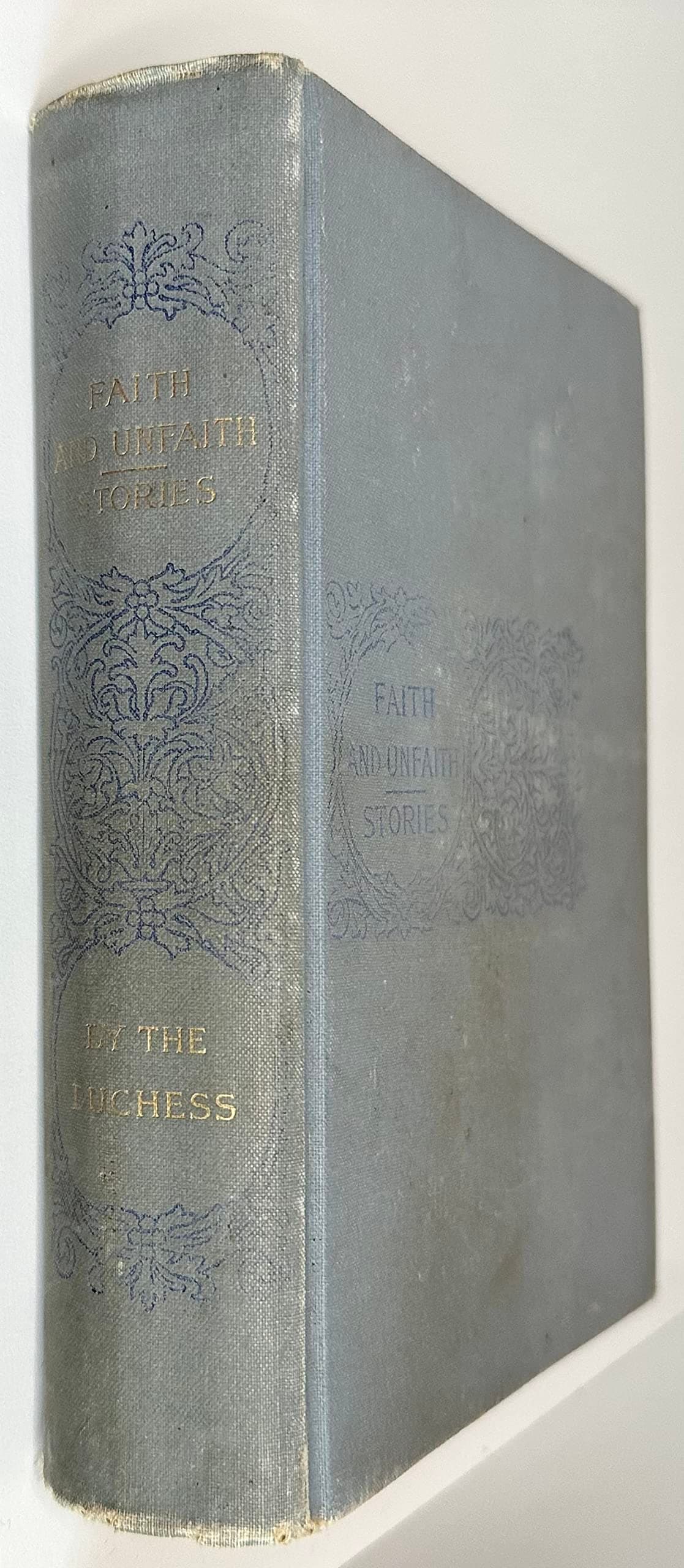
FAITH AND UNFAITH
A NOVEL
BY THE AUTHOR OF "PHYLLIS," "MOLLY BAWN," "AIRY FAIRY LILLIAN," "BEAUTY'S DAUGHTERS," "MRS. GEOFFREY," ETC.
NEW YORK AND CHICAGO BUTLER BROTHERS
TROW'S PRINTING AND BOOKBINDING COMPANY, NEW YORK.
FAITH AND UNFAITH.
CHAPTER I.
In an upper chamber, through the closed blinds of which the sun is vainly striving to enter, Reginald Branscombe, fifth Earl of Sartoris, lies dead. The sheet is reverently drawn across the motionless limbs; the once restless, now quiet, face is hidden; all around is wrapt in solemn unutterable silence,—the silence that belongs to death alone!
A sense of oppressive calm is upon everything,—a feeling of loneliness, vague and shadowy. The clock has ticked its last an hour ago, and now stands useless in its place. The world without moves on unheeding; the world within knows time no more! Death reigns triumphant! Life sinks into insignificance!
Once, a little flickering golden ray, born of the hot sun outside, flashes in through some unknown chink, and casts itself gleefully upon the fair white linen of the bed. It trembles vivaciously now here, now there, in uncontrollable joyousness, as though seeking in its gayety to mock the grandeur of the King of Terrors! At least so it seems to the sole watcher in the lonely chamber, as with an impatient sigh he raises his head, and, going over to the window, draws the curtains still closer to shut out the obnoxious light; after which he comes back to where he has been standing, gazing down upon, and thinking of, the dead.
He is an old man, tall and gaunt, with kind but passionate eyes, and a mouth expressive of impatience. His hands—withered but still sinewy—are clasped behind his back; every feature in his face is full of sad and anxious thought.
What changes the passing of a few short hours have wrought—so he muses. Yesterday the man now chilled and silent for evermore was as full of animation as he—his brother—who to-day stands so sorrowfully beside his corpse. His blood had run as freely in his veins, his pulses throbbed as evenly, his very voice had been sounding strong and clear and hearty, when Death, remorseless, claimed him for his own.
Poor Reginald! Had he known of the fell disease that had nestled so long within his heart?—or had no symptoms ever shown themselves to give him kindly warning? Certainly no hint of it had ever passed his lips, even to those most near and dear to him. He had lived apparently free from care or painful forebodings of any kind,—a good and useful life too, leaving nothing for those behind (who loved him) to regret. Indeed, of late he had appeared even gayer, happier, than before; and now—
It seems such a little time ago since they both were lads together. A tiny space taken from the great eternity, when all is told. How well the living man remembers at this moment many a boyish freak and light-hearted jest, many a kindness shown and gift bestowed by the dead, that until now had wellnigh been forgotten!
He thinks of the good old college days, when they worked little, and fought hard, and trained their fresh young limbs to mighty deeds, and walked, and rode, and held their own with the best, and showed open defiance of dons and deans and proctors; he lingers, too, on the day still farther on, when Reginald, having attained to his kingdom, lavished with no meagre hand upon his more extravagant brother the money so sorely needed.
Now Reginald is gone, and he, Arthur, reigns in his stead, and——Alas! alas! poor Reggy!—Poor, dear old fellow!
He rouses himself with an effort, and, going very softly to a small door that opens from the apartment, beckons gently to somebody beyond.
An old woman, dressed in deepest mourning, and of the housekeeper type, answers his summons, her eyes red with excessive weeping.
"I am going now," Lord Sartoris whispers to her in a low tone. "I have finished everything. You will remain here until my return."
"Yes, Mr. Arthur,—yes, my Lord," she answers, nervously; and then, as she gives the old title for the first time to the man before her, she bursts out crying afresh, yet silently, in a subdued fashion, as though ashamed of her emotion.
Sartoris pats her shoulder kindly, and then with a sigh turns away, and passes from the room with bent head and hands still clasped behind him, as has become a habit with him of late years.
Down the stairs and along the hall he goes, until, reaching a door at the lower end, he pauses before it, and, opening it, enters a room, half library, half boudoir, furnished in a somewhat rococo style.
It is a room curiously built, being a complete oval, with two French windows opening to the ground, and a glass door between them—partly stained—that leads to the parterre outside. It is filled with mediæval furniture, uncompromising and as strictly uncomfortable as should be, and has its walls (above the wooden dado) covered with a high-art paper, on which impossible storks, and unearthly birds of all descriptions, are depicted as rising out of blue-green rushes.
This room is known as "my lady's chamber,"—having ever been the exclusive property of the mistress of the house, until Mrs. Dorian Branscombe, in default of any other mistress, had made her own of it during her frequent visits to Hythe, and had refurnished it to suit her own tastes, which were slightly Æsthetic.
Now, she too is dead and gone, and the room, though never entirely closed or suffered to sink into disrepair, is seldom used by any of the household.
As Lord Sartoris goes in, a young man, who has been standing at one of the windows, turns and comes quickly to meet him. He is of good height, and is finely formed, with brown hair cut closely to his head, a brown moustache, and deep-blue eyes. His whole appearance is perhaps more pleasing and aristocratic than strictly handsome, his mouth being too large and his nose too pronounced for any particular style of beauty.
Yet it is his eyes—perfect as they are in shape and color—that betray the chief faults of his disposition. He is too easy-going, too thoughtless of consequences, too much given to letting things go,—without consideration or fear of what the end may bring; too full of life and spirits to-day, to dream of a sadder morrow;—so happy in the present that the future troubles him not at all.
"How ill you look!" he says, anxiously, addressing his uncle. "My dear Arthur, you have been overdoing it. You should not have remained so long in that room alone."
"Well, it is all over now," Sartoris says, wearily, sinking into a chair near him. "I was glad to finish it once for all. Those private papers he kept in his own room should be examined sooner or later; and now my task is at an end I feel more contented."
"Was there anything beyond?——"