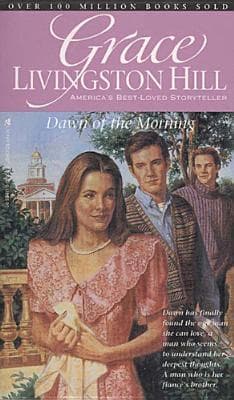
Dawn of the Morning
BY GRACE LIVINGSTON HILL
AUTHOR OF MARCIA SCHUYLER, PHOEBE DEANE, ETC.
NEW YORK GROSSET & DUNLAP PUBLISHERS
Made in the United States of America
COPYRIGHT, 1911 BY J. B. LIPPINCOTT COMPANY
Wings of the Morning
Dawn of the Morning
CHAPTER I
In the year 1824, in a pleasant town located between Schenectady and Albany, stood the handsome colonial residence of Hamilton Van Rensselaer. Solemn hedges shut in the family pride and hid the family sorrow, and about the borders of its spacious gardens, where even the roses seemed subdued, there played a child. The stately house oppressed her, and she loved the sombre garden best.
Her only friend in the old house seemed a tall clock that stood on the stairs and told out the hours in the hopeless tone that was expected of a clock in such a house, though it often took time to wink pleasantly at the child as she passed by, and talk off a few seconds and minutes in a brighter tone.
But the great clock on the staircase ticked awesomely one morning as the little girl went slowly down to her father's study in response to his bidding.
She did not want to go. She delayed her steps as much as possible, and looked up at the kindly old clock for sympathy; but even the round-eyed sun and the friendly moon that went around on the clock face every day as regularly as the real sun and moon, and usually appeared to be bowing and smiling at her, wore solemn expressions, and seemed almost pale behind their highly painted countenances.
The little girl shuddered as she gave one last look over her shoulder at them and passed into the dim recesses of the back hall, where the light came only in weird, half-circular slants from the mullioned window over the front door. It was dreadful indeed when the jolly sun and moon looked grave.
She paused before the heavy door of the study and held her breath, dreading the ordeal that was to come. Then, gathering courage, she knocked timidly, and heard her father's instant, cold "Come."
With trembling fingers she turned the knob and went in.
There were heavy damask curtains at the windows, reaching to the floor, caught back with thick silk cords and tassels. They were a deep, sullen red, and filled the room with oppressive shadows in no wise relieved by the heavy mahogany furniture upholstered in the same red damask.
Her father sat by his ponderous desk, always littered with papers which she must not touch.
His sternly handsome face was forbidding. The very beauty of it was hateful to her. The look on it reminded her of that terrible day, now nearly three years ago, when he had returned from a journey of several months abroad in connection with some brilliant literary enterprise, and had swept her lovely mother out of his life and home, the innocent victim of long-entertained jealousy and most unfounded suspicion.
The little girl had been too young to understand what it was all about. When she cried for her she was forbidden even to think of her, and was told that her mother was unworthy of that name.
The child had declared with angry tears and stampings of her small foot, that it was not true, that her mother was good and dear and beautiful; but they had paid no heed to her. The father had sternly commanded silence and sent her away; and the mother had not returned.
So she had sobbed her heart out in the silence of her own room, where every object reminded her of the lost mother's touch and voice and presence, and had gone about the house in a sullen silence unnatural to childhood, thereby making herself more enemies than friends.
Of her father she was afraid. She shrank into terrified silence whenever he approached, scarcely answering his questions, and growing farther away from him every day, until he instinctively knew that she hated him for her mother's sake.
When a year had passed he procured a divorce without protest from the innocent but crushed wife, this by aid of a law that often places "Truth forever on the scaffold, Wrong forever on the throne." Not long after, he brought to his home as his wife a capable, arrogant, self-opinionated woman, who set herself to rule him and his household as it should be ruled.
The little girl was called to audience in the gloomy study where sat the new wife, her eyes filled with hostility toward the other woman's child, and was told that she must call the lady "Mother."
Then the black eyes that held in their dreamy depths some of the gunpowder flash of her father's steely ones took fire; the little face darkened with indignant fury; the small foot came down with fierce determination on the thick carpet, and the child declared:
"I will never call her mother! She is not my mother! She is a bad woman, and she has no right here. She cannot be your wife. It is wicked for a man to have two wives. I know, for I heard Mary Ann and Betsey say so this morning in the kitchen. My mother is alive yet. She is at Grandfather's. I heard Betsey say that too. You are a wicked, cruel man, and I hate you. I will not have you for a father any more. I will go away and stay with my mother. She is good. You are bad! I hate you! I hate you! I hate you! And I hate her!"—pointing toward the new wife, who sat in horrified condemnation, with two fiery spots upon her outraged cheeks.
"Jemima!" thundered her father in his angriest tone.
But the little girl turned upon him furiously.
"My name is not Jemima!" she screamed. "I will not let you call me so. My name is Dawn. My mother called me Dawn. I will not answer when you call me Jemima."


