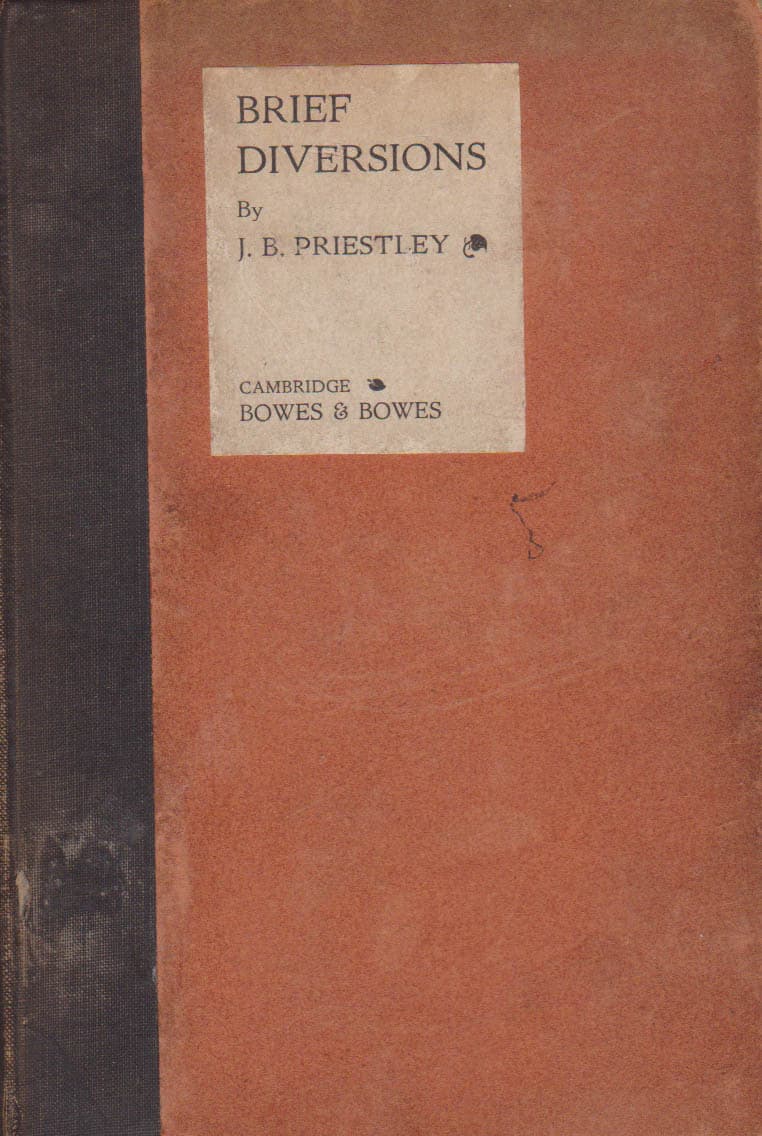
BRIEF DIVERSIONS
BRIEF DIVERSIONS being Tales Travesties and Epigrams by J. B. P R I E S T L E Y
Cambridge Bowes & Bowes 1922
NOTE
NEARLY all these pieces have appeared in the Cambridge Review, and I thank the Editor for his courtesy in allowing me to reprint them. A few travesties and epigrams have been added, and others have been revised. Most of the tales were written during the War, many of them while I was in Flanders, and at that time, being away from books, I imagined I was doing something new, being either ignorant or forgetful of the work of better men, such as Lord Dunsany and Mr T. W. H. Crosland, in a very similar form. To such gentlemen, I can only offer an apology if I seem to enter their little pleasaunces and tread clumsily where they who went before me stepped so lightly and delicately.
J. B. P.
CONTENTS
TALES
THE IMPOSSIBILITY OF KNOWING EVERYONE
A PROFITEER, a Priest of Nebt-het, from Heliopolis, and a Fool were walking together one day, when they met the grim figure of War belching flame and fury.
‘Who is that?’ asked the fool and the priest of each other, quickening their pace. But the profiteer raised his hat, bowed humbly, and stayed to chat for a few moments with the terrible figure, before rejoining his companions.
Presently, they came upon Death, mumbling to himself by the roadside. The fool and the profiteer raised their eyebrows, and passed on, but the priest of Nebt-het touched his forehead and made certain strange signs with his hands, to which Death replied in like manner.
Then the three spied a beautiful woman who sat among the wildflowers. It was Love, combing her hair and singing all the love-songs of the world. ‘That is a fine woman,’ said the profiteer, staring hard.
‘I do not know her,’ said the priest, somewhat sadly. But the fool ran forward and caught her hands in his, and they laughed together. So the priest and the profiteer walked on, but when they had gone a little way, they turned round, and there was the fool sitting at her feet and looking into her eyes as she sang and combed her hair.
‘The fool has all the luck,’ they grumbled.
A MOVING STORY OF REAL LIFE
THERE was at one time upon the earth a Mr S. L. Binkle, who always spoke of himself as a Business Expert. He would, from time to time, scatter broadcast little sheets of paper, on which was printed: ‘Efficiency! What does it mean to you?’ and many other dark sayings.
This Binkle was a middle-aged man who lived strangely: he never laughed or sang or ate heartily, though some have said that he had a weakness for tapioca pudding.
It chanced that one afternoon when he was sitting in his office, there was some noisy music in the street near by, so Binkle put small pieces of cotton-wool in his ears. Far away, the gods laughed.
A few minutes later, the office door was flung open, and a red-faced man rushed in, crying: ‘You Mister Binkle?... come down to Balham ... next Tuesday evening ... talk on Business Efficiency ... no time to stop ... train ... ask for Mechanics Institute ... five guineas.’ After which, the stranger departed noisily.
These loose fragments of speech were quite intelligible and, indeed, welcome to Binkle, who made a note in a little book and smiled with satisfaction.
But alas—who can foresee what the gods have decreed? For, with the cotton-wool in his ears, Binkle had not heard the stranger rightly; and on the Tuesday following, instead of going to Balham, he went to Barham, which is full of poets and wild lovers, and there he perished miserably.
THE TRUE ACCOUNT OF A QUARREL BETWEEN A MAN WE ALL KNOW AND A VERY OLD FAMILY
THE Man who thought about Proteids sat by the roadside, writing with an indelible pencil in a little notebook. And Spring, all in pink and white, came tripping by, and cried to him: ‘I will dance for you! Watch me dance!’ She danced very prettily, but the Man went on writing, and never looked at her once. So Spring, being young, burst into tears, and told her sister, Summer.
Summer said to herself: ‘Spring is very foolish to cry. Probably he does not like dancing. I will sing to him.’ She sang a beautiful sleepy song to him, but he never listened, being busy writing in his little note-book. Summer was indignant, and told her sister, Autumn.
Autumn said: ‘There are many good men who do not like dancing. I will give him some of my wine.’ So she went to the Man and offered him her purple wine, but he merely said, ‘I do not drink wine,’ and resumed his writing. Then Autumn was very angry indeed, and told her big brother, Winter, all that had passed.
Winter was an enormous fellow, with a dreadful roar and howl, and every time he moved, snowflakes came whirling from his flowing robes. ‘Show me the fellow,’ he bellowed, puffing out his cheeks. Then he saw the Man who thought about Proteids, still sitting by the roadside.
‘Do you know me?’ roared Winter, and the Man looked and his teeth chattered like dead men’s bones.
Then Winter seized him by the neck and whirled him round and round, and finally flung him over his left shoulder into space.
And the Man who thought about Proteids has not been seen since, but, the other day, a boy found the little note-book lying by the roadside.