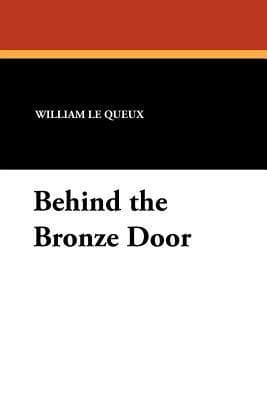
BEHIND THE BRONZE DOOR
Thoroughly frightened, she turned away as the sound of the weird knocker shattered the ghostly stillness.
BEHIND THE BRONZE DOOR
BY
WILLIAM LE QUEUX
AUTHOR OF “THE VOICE FROM THE VOID”
FRONTISPIECE BY G. W. GAGE
NEW YORK THE MACAULAY COMPANY
Copyright, 1923, By THE MACAULAY COMPANY
PRINTED IN THE U. S. A.
CONTENTS
BEHIND THE BRONZE DOOR
BEHIND THE BRONZE DOOR
CHAPTER I.
THE EPIDEMIC OF MYSTERY.
“Isn’t this terrible, Henry? Where is it going to end?”
“Isn’t what terrible?—and where is what going end?”
“Why! Haven’t you read to-night’s paper?”
“No.”
“Here it is; read that!” and handing her husband the Evening Herald Mrs. Hartsilver indicated with her finger a paragraph in the “stoppress” headed: “Another Society Tragedy,” and stated that a well-known baronet had been found shot in his bedroom in circumstances of great mystery.
Certainly the series of tragedies which had taken place during the past eight months in what is called “Society,” had been most puzzling.
First, Lord Hope-Cooper, the fifth peer, held in high esteem by all his friends and acquaintances, owner of Cowrie Park in Perthshire, Leveden Hall in Warwickshire, and one of the finest houses in Grosvenor Square, had drowned himself in the beautiful lake at Cowrie, apparently for no reason and without leaving even a note of farewell for Lady Hope-Cooper, with whom he was known to be on the best of terms—they had been married eight years.
Then Viscount Molesley, a rich bachelor of three-and-twenty, an owner of thoroughbreds and well-known about town and in sporting circles, had been found shot in his bedroom one morning, an automatic pistol on the floor beside him, and in the grate the ashes of some burnt papers; apparently he had shot himself after receiving his morning letters.
Following close upon these tragedies had come the sudden death of the Honorable Vera Froissart, Lord Froissart’s younger daughter, in mysterious circumstances. She had been found dead in the drawing-room in her father’s house in Queen Anne’s Gate, and at the inquest the jury had returned a verdict of “death due apparently to shock.” Then the death of a rather notorious ex-Society woman, Madame Leonora Vandervelt, who had been divorced by three husbands—she had thrown herself out of a fourth-floor window at a fashionable West End hotel. Then the death by poisoning of an extremely prosperous stockbroker of middle-age, owner of two financial journals. And after that four or five more tragedies of the same nature, the victim in nearly every case being a man or woman of high social standing and large income.
“Exactly the way Molesley made away with himself,” Henry Hartsilver observed dryly as he laid down the paper after reading the report of the discovery of Sir Stephen Lethbridge’s body in his bedroom at Abbey Hall in Cumberland.
He shrugged his shoulders.
“You may think me hard and unsympathetic, my dear,” he went on, addressing his wife, “but these people who make away with themselves leave me cold. Such tragedies don’t excite my pity—they arouse in me only a feeling of contempt.”
He paused, then continued:
“Now, look at me. You know how I began life, though I sometimes try to forget it, as I hope others do. My parents were poor, and I received only a moderate education; but I had grit and determination and I won through. And look at me to-day. All who know me look up to and respect me. I’m a self-made man and not ashamed to own it, though I don’t crow about it on the housetops as some of these plebeians do. Though I come of the people, I pride myself on being one of Nature’s gentlemen, and what can you want more than that—eh? We can’t choose our parents, or I might have chosen parents like yours, my dear—blue blood through and through. And that was one reason why I married you. I think I have told you this before. I made up my mind when I was still a lad that the woman I made my wife should be a lady in the true acceptation of that often misapplied word, and the first time I met you—you remember that day, eh, my dear?—I recognized the type, and then and there I decided that you were the lady for me!”
He lay back in the big arm-chair, slipped his thumbs into the armholes of his waistcoat, and looked at his young wife with an expression of extreme self-satisfaction.