AN EEL BY THE TAIL
By Allen K. Lang
Mr. Tedder was quite sure that a strip tease dancer had no place in his physics classroom. But what bothered him more was how she got there!
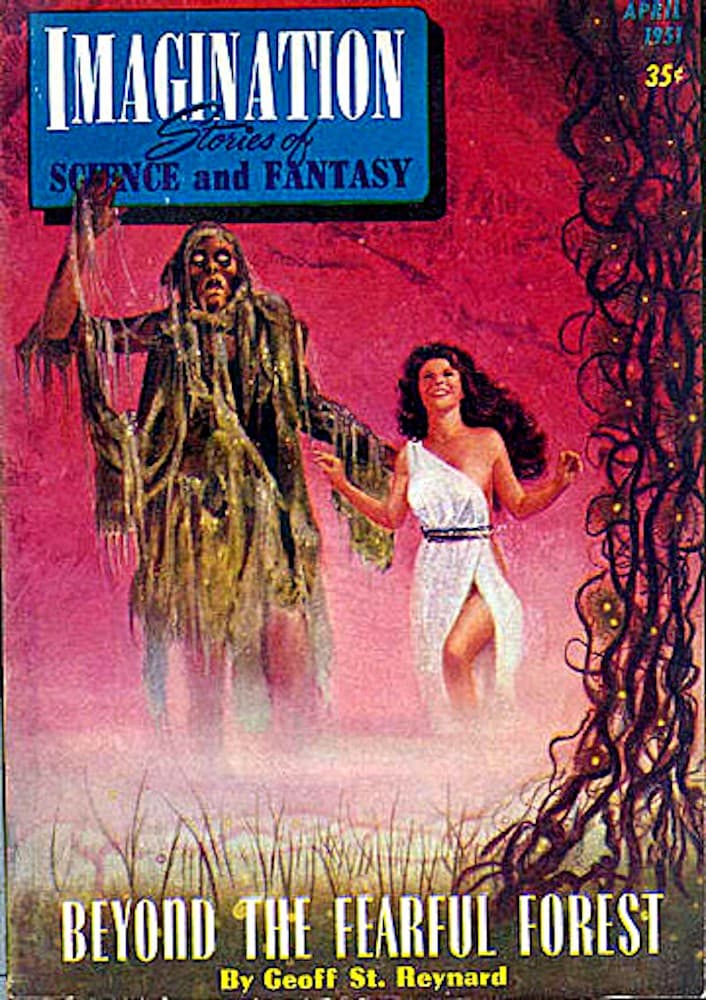
[Transcriber's Note: This etext was produced from Imagination Stories of Science and Fantasy April 1951 Extensive research did not uncover any evidence that the U.S. copyright on this publication was renewed.]
The strip teaser materialized in the first period physics class at Terre Haute's Technical High School.
It all happened just because Mr. Tedder was fresh out of college, and anxious to make good in his first teaching job. He'd been given Physics II, a tough class for a new teacher. His pupils, a set of hardened II-A boys, were sure of themselves and so were the few girls in the class. It was with hopes of shaking that assurance that Mr. Tedder had spent a month of after-school hours studying an article on Ziegler's effect. He also hoped, but with less faith than wistfulness, that a demonstration of Ziegler's effect might shock his class into staying awake. Above all, Mr. Tedder felt that his Junior boys might be considerably edified by an electrical phenomenon that was not yet understood by the best physical theorists of three planets.
Mr. Tedder wanted to give his class a good show. So, with more feeling for dramatic effect than for scientific good sense, he'd wound the three solenoids with heavy insulated silver wire rather than with the light copper wire Ziegler had reported using. On the theory that, if he were to demonstrate the Ziegler effect it would be best to demonstrate a whole lot of it, Mr. Tedder contrived a battery of the new lithium-reaction cells. The direct current from this powerful battery was transformed by an antique, but workable, automotive spark coil.
The bell rang as usual that morning, marking the beginning of the first class. Twenty pupils filed into the physics classroom and took their seats. Eighteen of them slumped down in an attitude which suggested that, although they were prepared to accept stoically the hour's ordeal, they weren't going to allow themselves to be taught anything. After all, Tech had lost last night's game to Walbash: what physical phenomenon could hope to shake off that grim memory? There was a shuffling of papers as the boys in the back seats pulled comic books from their notebooks. Guenther and Stetzel, sitting up front, pulled sheets of paper from notepads and headed them, "The Ziegler Effect."
The classroom settled into an uneasy silence. Mr. Tedder waved an instructive hand toward the apparatus set up on the marble top of the demonstration bench. "As you can see, I have a set of three solenoids, or coils of insulated wire, connected to a source of alternating current. A sudden surge of this current through the outermost solenoid will give an iron-cerium alloy bar placed at the center of the apparatus an impetus toward horizontal motion." Stetzel and Guenther, who were conscientious, took rapid notes. The rest of the class was divided between those students who were surreptitiously catching up on the adventures of "The Rocket Patrol" and those who were quietly sinking into sleep.
Mr. Tedder continued. "The alloy bar's initial movement will be frustrated, as it were, by the action of a second solenoid placed within and at right angles to the first. A third coil, within and at right angles to each of the outer two, completes the process. The winding ratios of the three solenoids are 476:9:34." Stetzel and Guenther scribbled the numbers rapidly; Ned Norcross, in the back row, stirred in his sleep, and two members of the Class of '95 who shared a volume of the Rocket Patrol's exploits agreed to turn the page.
"What happens to the bar of iron-cerium at this point is a matter of conjecture. All observers are agreed only in that it disappears. Perhaps it leaves the coils so rapidly that it neither injures the wires nor can it be seen. Perhaps the bar passes through a temporary fissure in the three-dimensional system we perceive, falling into some yet-unconceivable other dimension. Doctor Ziegler, who first observed this effect, inclines to this latter belief." Mr. Tedder placed his fingers on the telegraph key he'd rigged up to close the circuit through his apparatus. "Watch closely," he cautioned, tapping down on the key.
On the twenty-third planet at a distant sun—a planet called by its inhabitants a name for which there are no equivalents in human phonetics—a Young Being in the early stages of pre-maturity tangled the minds of his elders with feelings of anguish. His teacher had disappeared!
Ned Norcross, who was taking Junior Physics II for the third time, had his mind on neither the Ziegler Effect nor the tragic results of last night's basketball game. He was slumped at his desk, dreamily rehearsing the topography of one Honey LaRue, a strip teaser who nightly practiced her art at the Club Innuendo. Norcross pried himself up on one elbow to glance toward the clock above the demonstration bench, then slumped forward on his desk in a faint. Up on the marble top of the demonstration bench, pulling off a right silk glove in time to the lazy ripple of a snare-drum, danced Honey LaRue.
Mr. Tedder felt an embarrassed flush coloring his cheeks as the figure of the girl undulated before his eyes....
Mr. Tedder yelped, and immediately regretted it. He'd had two beers three days before; could that bring on hallucination at this late date? But Honey had gone, taking the Ziegler coils with her. One terminal of the telegraph key was still connected to the plate on the spark coil, the other wire ended in a little knot of fused silver. No, this wasn't the effect that Doctor Ziegler had reported, not at all!
To cover his confusion Mr. Tedder began to talk. "There, you've just seen the Ziegler effect in action. Explain what you've just seen and you'll be famous among men." Indeed, the cerium-iron alloy bar had disappeared; but so had 20,000 cm. of No. 40 silver wire, silk-insulated. But the boys—except, of course, Stetzel and Guenther—hadn't noticed. Mr. Tedder glanced over his shoulder to the clock, saw that it would be fifteen minutes before the class would end, and made a quick decision in the interest of his sanity. "Class dismissed!" he said.
There was a stupefied second while the news soaked into dormant nervous systems. Then the boys were shouting across the room, grabbing up books, and hurrying out into the hall to take noisy advantage of their moment of freedom. Stetzel and Guenther, as behooved the top pupils of the Class of '95, hurried up to Mr. Tedder to check their notes.
"The symbol for cerium is 'Ce,' isn't it?" Stetzel asked.
"Yes. But now...."
"How did you do that, Mr. Tedder?" Guenther interrupted.
"Do what?" Mr. Tedder glanced suspiciously at Guenther. Perhaps it hadn't been those two beers.
"You had a woman dancing, right up where those solenoids were," Guenther said.
"That's what I saw," Stetzel substantiated. "What a movie! She sure looked three-dimensional to me. Wow!"
"Yes," Mr. Tedder said, canceling his decision of a moment before, to lay off beer. "That was just a little stunt I thought up to see how many of you were paying attention. New optical principle, you know. Now if you'll excuse me, I've got to get things ready for the next class. And wake up Norcross on your way out, will you?"
Stetzel jarred Norcross from unconsciousness and walked out into the hall, talking and gesturing significantly with Guenther. Norcross unfolded himself slowly, glanced with a furtive eye toward Mr. Tedder and the empty bench-top, and walked rapidly out of the room, down the stairs, and into the school physician's office.
Alone, Mr. Tedder frowned at the bereft lithium battery and telegraph key. He had pressed the key, closing the circuit, and there'd been a spurt of flame. A strange girl had appeared, dancing on the marble top of the demonstration bench. He'd never seen the woman before; a tall blonde wearing very little.... What the devil! There she was again.
Mr. Coar, principal of Tech, walked toward the door to the physics classroom, rehearsing the speech he was going to deliver upon Tedder. "Young man, Tech does not approve of the practice of letting students out into the halls before the end of the period. Their racket has shaken the walls of classrooms on three floors. What have you to say for yourself, Mr. Tedder?" Yes, that would do nicely. Mr. Coar opened the door.
Mr. Tedder was leaning against a front-row desk, nodding appreciatively as a sketchily-clad young lady danced for him. "TEDDER!" the principal bellowed. "Stop that!"
Honey LaRue faded, and the space between telegraph key and lithium battery was empty again.
"Stop what?" Mr. Tedder inquired, wide-eyed with innocence.