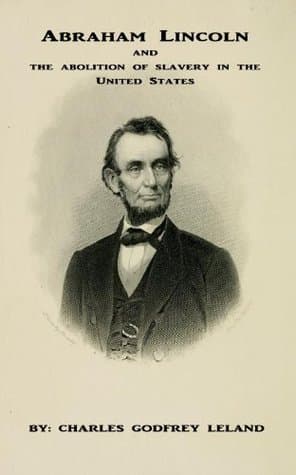
A. Lincoln
Makers of History. ABRAHAM LINCOLN AND THE ABOLITION OF SLAVERY IN THE UNITED STATES BY CHARLES GODFREY LELAND AUTHOR OF “HANS BREITMANN’S BALLADS,” “THE EGYPTIAN SKETCH BOOK,” ETC., ETC. NEW YORK H. M. CALDWELL COMPANY PUBLISHERS
COPYRIGHT BY G. P. PUTNAM’S SONS. 1879
PUBLISHERS’ NOTE.
In issuing this second edition of Mr. Leland’s biography, the publishers have taken occasion to correct a few errors in dates and proper names, and in citations from documents, that had crept into the first edition.
The book was prepared during the author’s residence abroad, where he did not have at hand for reference all the authorities needed, and as it was stereotyped in London the above oversights were not at once detected.
PREFACE.
I make no apology for adding another “Life of Abraham Lincoln” to the many already written, as I believe it impossible to make such an example of successful perseverance allied to honesty, as the great President gave, too well known to the world. And as I know of no other man whose life shows so perfectly what may be effected by resolute self-culture, and adherence to good principles in spite of obstacles, I infer that such an example cannot be too extensively set before all young men who are ambitious to do well in the truest sense. There are also other reasons why it should be studied. The life of Abraham Lincoln during his Presidency is simply that of his country—since he was so intimately concerned with every public event of his time, that as sometimes happens with photographs, so with the biography of Lincoln and the history of his time, we cannot decide whether the great picture was enlarged from the smaller one, or the smaller reduced from a greater. His career also fully proves that extremes meet, since in no despotism is there an example of any one who ever governed so great a country so thoroughly in detail as did this Republican of Republicans, whose one thought was simply to obey the people.
It is of course impossible to give within the limits of a small book all the details of a busy life, and also the history of the American Emancipation and its causes; but I trust that I have omitted little of much importance. The books to which I have been chiefly indebted, and from which I have borrowed most freely, are the lives of Lincoln by W. H. Lamon, and by my personal friends H. J. Raymond and Dr. Holland; and also the works referring to the war by I. N. Arnold, F. B. Carpenter, L. P. Brockett, A. Boyd, G. W. Bacon, J. Barrett, Adam Badeau, and F. Moore.
C. G. L.
June, 1879.
CONTENTS.
Birth of Abraham Lincoln—The Lincoln Family—Abraham’s first Schooling—Death of Mrs. Lincoln, and the new “Mother”—Lincoln’s Boyhood and Youth—Self-Education—Great Physical Strength—First Literary Efforts—Journey to New Orleans—Encouraging Incident,
Lincoln’s Appearance—His First Public Speech—Again at New Orleans—Mechanical Genius—Clerk in a Country Store—Elected Captain—The Black Hawk War—Is a successful Candidate for the Legislature—Becomes a Storekeeper, Land Surveyor, and Postmaster—His First Love—The “Long Nine”—First Step towards Emancipation,
Lincoln settles at Springfield as a Lawyer—Candidate for the office of Presidential Elector—A Love Affair—Marries Miss Todd—Religious Views—Exerts himself for Henry Clay—Elected to Congress in 1846—Speeches in Congress—Out of Political Employment until 1854—Anecdotes of Lincoln as a Lawyer,
Rise of the Southern Party—Formation of the Abolition and the Free Soil Parties—Judge Douglas and the Kansas-Nebraska Bill—Douglas defeated by Lincoln—Lincoln resigns as Candidate for Congress—Lincoln’s Letter on Slavery—The Bloomington Speech—The Fremont Campaign—Election of Buchanan—The Dred-Scott Decision,
Causes of Lincoln’s Nomination to the Presidency—His Lectures in New York, &c.—The First Nomination and the Fence Rails—The Nomination at Chicago—Elected President—Office-seekers and Appointments—Lincoln’s Impartiality—The South determined to Secede—Fears for Lincoln’s Life,
A Suspected Conspiracy—Lincoln’s Departure for Washington—His Speeches at Springfield and on the road to the National Capital—Breaking out of the Rebellion—Treachery of President Buchanan—Treason in the Cabinet—Jefferson Davis’s Message—Threats of Massacre and Ruin to the North—Southern Sympathisers—Lincoln’s Inaugural Address—The Cabinet—The Days of Doubt and of Darkness,
Mr. Seward refuses to meet the Rebel Commissioners—Lincoln’s Forbearance—Fort Sumter—Call for 75,000 Troops—Troubles in Maryland—Administrative Prudence—Judge Douglas—Increase of the Army—Winthrop and Ellsworth—Bull Run—General M‘Clellan,
Relations with Europe—Foreign Views of the War—The Slaves—Proclamation of Emancipation—Arrest of Rebel Commissioners—Black Troops,
Eighteen Hundred and Sixty-two—The Plan of the War, and Strength of the Armies—General M‘Clellan—The General Movement, January 27th, 1862—The brilliant Western Campaign—Removal of M‘Clellan—The Monitor—Battle of Fredericksburg—Vallandigham and Seymour—The Alabama—President Lincoln declines all Foreign Mediation,
Eighteen Hundred and Sixty-three—A Popular Prophecy—General Burnside relieved and General Hooker appointed—Battle of Chancellorsville—The Rebels invade Pennsylvania—Battle of Gettysburg—Lincoln’s Speech at Gettysburg—Grant takes Vicksburg—Port Hudson—Battle of Chattanooga—New York Riots—The French in Mexico—Troubles in Missouri,
Proclamation of Amnesty—Lincoln’s Benevolence—His Self-reliance—Progress of the Campaign—The Summer of 1864—Lincoln’s Speech at Philadelphia—Suffering in the South—Raids—Sherman’s March—Grant’s Position—Battle of the Wilderness—Siege of Petersburg—Chambersburg—Naval Victories—Confederate Intrigues—Presidential Election—Lincoln Re-elected—Atrocious Attempts of the Confederates,
The President’s Reception of Negroes—The South opens Negotiations for Peace—Proposals—Lincoln’s Second Inauguration—The Last Battle—Davis Captured—End of the War—Death of Lincoln—Public Mourning,
President Lincoln’s Characteristics—His Love of Humour—His Stories—Pithy Sayings—Repartees—His Dignity,
Life of Abraham Lincoln.
CHAPTER I.
Birth of Abraham Lincoln—The Lincoln Family—Abraham’s first Schooling—Death of Mrs. Lincoln, and the new “Mother”—Lincoln’s Boyhood and Youth—Self-Education—Great Physical Strength—First Literary Efforts—Journey to New Orleans—Encouraging Incident.
Abraham Lincoln was born in Kentucky, on the 12th day of February, 1809. The log-cabin which was his birth-place was built on the south branch of Nolin’s Creek, three miles from the village of Hodgensville, on land which was then in the county of Hardin, but is now included in that of La Rue. His father, Thomas Lincoln, was born in 1778; his mother’s maiden name was Nancy Hanks. The Lincoln family, which appears to have been of unmixed English descent, came to Kentucky from Berks County, Pennsylvania, to which place tradition or conjecture asserts they had emigrated from Massachusetts. But they did not remain long in Pennsylvania, since they seem to have gone before 1752 to Rockingham, County Virginia, which state was then one with that of Kentucky. There is, however, so much doubt as to these details of their early history, that it is not certain whether they were at first emigrants directly from England to Virginia, an offshoot of the historic Lincoln family in Massachusetts, or of the highly respectable Lincolns of Pennsylvania.1 This obscurity is plainly due to the great poverty and lowly station of the Virginian Lincolns. “My parents,” said President Lincoln, in a brief autobiographic sketch,2 “were both born of undistinguished families—second families, perhaps, I should say.” To this he adds that his paternal grandfather was Abraham Lincoln, who migrated from Rockingham, County Virginia, to Kentucky, “about 1781 or 2,” although his cousins and other relatives all declare this grandsire’s name to have been Mordecai—a striking proof of the ignorance and indifference of the family respecting matters seldom neglected.
This grandfather, Abraham or Mordecai, having removed to Kentucky, “the dark and bloody ground,” settled in Mercer County. Their house was a rough log-cabin, their farm a little clearing in the midst of the forest. One morning, not long after their settlement, the father took Thomas, his youngest son, and went to build a fence a short distance from the house, while the other brothers, Mordecai and Josiah, were sent to a field not far away. They were all intent upon their work, when a shot from a party of Indians in ambush was heard. The father fell dead. Josiah ran to a stockade, or settlement, two or three miles off; Mordecai, the eldest boy, made his way to the house, and, looking out from a loop-hole, saw an Indian in the act of raising his little brother from the ground. He took deliberate aim at a silver ornament on the breast of the Indian, and brought him down. Thomas sprang towards the cabin, and was admitted by his mother, while Mordecai renewed his fire at several other Indians who rose from the covert of the fence, or thicket. It was not long before Josiah returned from the stockade with a party of settlers; but the Indians had fled, and none were found but the dead one, and another who was wounded, and had crept into the top of a fallen tree. Mordecai, it is said, hated the Indians ever after with an intensity which was unusual even in those times. As Allan Macaulay, in “Waverley,” is said to have hunted down the Children of the Mist, or as the Quaker Nathan, in Bird’s romance of “Nick of the Woods,” is described as hunting the Shawnese, so we are told this other avenger of blood pursued his foes with unrelenting, unscrupulous hatred. For days together he would follow peaceable Indians as they passed through the settlements, in order to get secret shots at them.3


