Listen to Science Papers
Turn any science.org article into audio. Open the paper in Chrome, click CastReader, and listen through the abstract and body — with paragraph highlighting. Handles Science's dense Atypon template cleanly.
Why Listen to Science with CastReader?
Science.org packs a lot of UI into every article page. CastReader finds the paper underneath.
AAAS Journals
Works on Every Science Title
Science (main), Science Advances (fully open access), Science Translational Medicine, Science Immunology, Science Signaling, and Science Robotics. One extractor — they share the same Atypon/AAAS rendering.

Clean Audio
Skips Newsletter CTAs and Nav Chrome
Science.org splices newsletter sign-up forms into the middle of the article (eTOC, Adviser, etc.) and stacks header chrome above the title. CastReader ignores the signup widgets and starts at the title — not at the breadcrumb, not at a newsletter CTA, not at the journal name banner.
Follow Along
Paragraph Highlighting
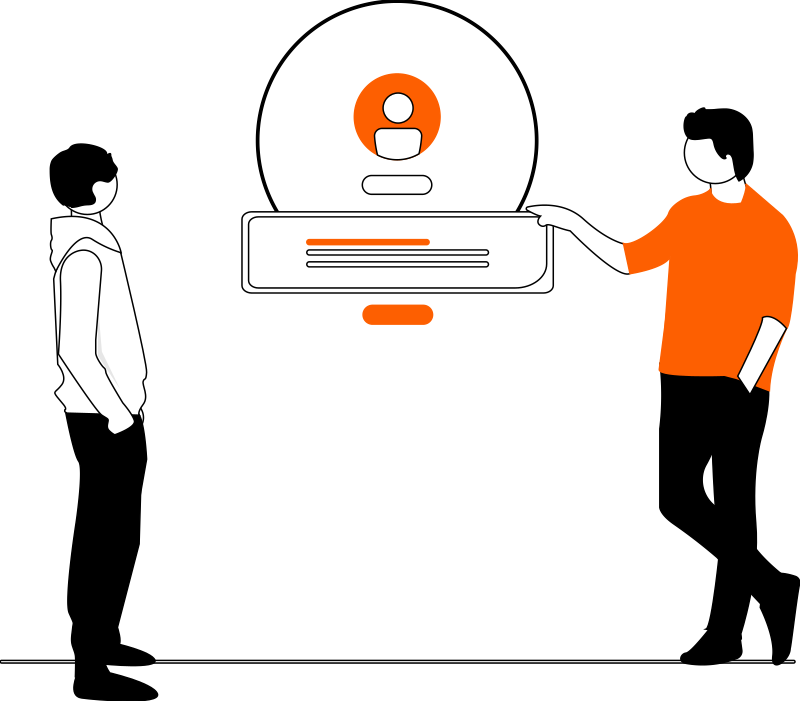
Each paragraph highlights as the voice reads. When a claim catches your attention, one glance shows exactly where in the paper the voice is.
100% Free
Audio Triage for Science Alerts
Completely free. No signup, no subscription, no quota. Turn your Science eTOC alert into 40 minutes of commute audio and decide which papers are worth desk time.

Frequently Asked Questions
Everything about listening to Science papers with CastReader
How do I listen to a Science paper?
Open the article page on science.org in Chrome (URL looks like science.org/doi/10.1126/science.XXXX). Click the CastReader icon. It reads from the title through the abstract and body.
Does it work on Science papers behind a paywall?
CastReader reads the HTML in your browser. Science Advances is fully open-access (no paywall). Science main and sibling journals are subscription — if you have access and the body is loaded, we read it. If you only see the abstract, we read the abstract. We don't bypass paywalls.
Which Science journals are supported?
All AAAS journals on science.org — Science, Science Advances, Science Translational Medicine, Science Immunology, Science Signaling, and Science Robotics. They share the same Atypon rendering.
Why did older versions read 'SIGN UP FOR THE SCIENCE ADVISER NEWSLETTER'?
Because earlier extraction treated those mid-article newsletter widgets as part of the paper. We now detect them precisely: any inline <form> whose class contains 'newsletter' or that holds a text-capture input is skipped, while the outer article-wrapper <form> (which legitimately holds the abstract) is preserved.
What about Editor's Summary, figures, and references?
Editor's Summary is read if it's above or alongside the abstract. Figure captions are read inline (they're prose). Figure images and table data are skipped — audio can't represent those. References and inline citation markers are stripped for clean flow.
Can I adjust reading speed?
Yes. 0.5x through 3x. 1.5x is comfortable for Science News pieces, 1.1x for dense research articles.
Is it free? Any limits?
Completely free. No page or character limits. No account needed. CastReader is a free browser extension for Chrome and Edge.
Does it work on Science News articles too?
Yes. Science News pieces and research articles share most of the same template, and CastReader reads both. News pieces tend to be shorter and play great at 1.5x–1.8x.
Start Listening to Science
Completely free. No signup. No limits. Install CastReader and open any science.org paper.
★★★★★ 4.7 · Free · No login · No limits