Slaughterhouse-Five Text to Speech: Free Audio for Kurt Vonnegut's Time-Displaced Anti-War Masterwork
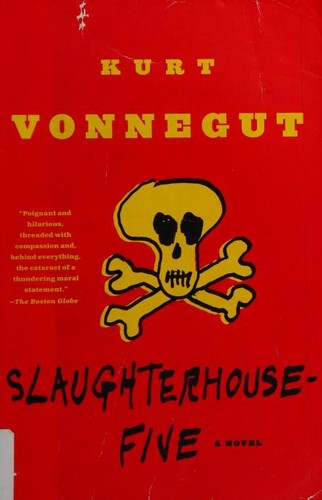
Author: Kurt Vonnegut Jr. (1922-2007, 14 novels + 200+ short stories + 12 essay collections, PFC 106th Infantry Division POW Dresden 1944-1945 witnessed firebombing, Indianapolis Indiana born / Cape Cod Massachusetts + NYC-based) Published: March 31, 1969 (Delacorte Press · Jonathan Cape UK 1970) Pages: 275 · Goodreads: 4.09★ / 1.4M ratings Audiobook: Ethan Hawke · Simon & Schuster Audio 2014 · 5h 13m (canonical) · James Franco · Audible Studios 2012 · 5h 13m (original) Awards: 1970 Hugo Award Best Novel finalist · 1969 Nebula Award Best Novel finalist · 1970 National Book Award Arts & Letters finalist · Time 100 Best English-Language Novels 1923-2005 · Modern Library 100 Best Novels 20th Century #18 · BBC 100 Novels That Shaped Our World · Harold Bloom Western Canon · Le Monde 100 Books of the Century #78 · AP English Literature + AP US History curriculum canonical · 5M+ copies global · 30+ language translations Adaptations: 1972 Universal film (George Roy Hill directing, Michael Sacks as Billy Pilgrim + Ron Leibman as Paul Lazzaro + Valerie Perrine as Montana Wildhack + Eugene Roche as Edgar Derby + Sharon Gans + Roberts Blossom, 104 minutes, 1972 Cannes Jury Prize winner + 1973 Hugo Award Best Dramatic Presentation winner + 1973 Saturn Award Best SF Film winner) · 1996 Hans Hartlap German opera (Theater Erfurt) · 2008 New York Stage Works theatrical adaptation · 1990 Vonnegut Academy Award Best Documentary nominee (Kurt Vonnegut: So It Goes)
Kurt Vonnegut's Slaughterhouse-Five is the definitive 20th-century anti-war novel. Published March 1969 by Delacorte Press and selling 5 million copies across 30 languages, its 1972 George Roy Hill film won the Cannes Jury Prize, the Hugo Award, and the Saturn Award — a rare triple-genre-award. The novel cemented Vonnegut as canonical American literary fiction, culminating 23 years of post-Dresden writing struggle. If you own the Kindle or EPUB copy and want to hear the canonical 5-hour Ethan Hawke narration while you commute, garden, or cook, use CastReader AI TTS to convert your copy to unabridged audio for free →.
The novel opens with Chapter 1 — unusually, an autobiographical non-fiction framing chapter where Vonnegut himself addresses the reader: "All this happened, more or less." He explains that he is Kurt Vonnegut, age 46, living in Barnstable Massachusetts, a novelist, and this is his long-delayed Dresden book. He recounts his 23-year writer's block trying to write the firebombing, his trip to Dresden with fellow POW-survivor Bernard V. O'Hare, and his promise to O'Hare's wife Mary that this wouldn't be a John-Wayne-Frank-Sinatra-glorifying-war book. From Chapter 2 onward the novel follows Billy Pilgrim — a fictional Ilium New York optometrist, 1944 Infantry Division PFC captured at the Battle of the Bulge, transported to Dresden as POW, survivor of the February 13-15 1945 Allied firebombing by sheltering in underground meat-locker Schlachthof-fünf. But Billy is "unstuck in time" — the novel jumps non-linearly: 1944 WWII POW chapters, 1945 Dresden firebombing aftermath, 1948 Ilium optometry-school, 1958 suburban-family life, 1967 Tralfamadorian abduction and zoo exhibit with Montana Wildhack, 1976 death (Billy foresees his own assassination by Paul Lazzaro on February 13 1976, thirty-one years exactly after Dresden). "So it goes" follows every death — 106 occurrences. The novel ends with a Dresden-April birdsong: "Poo-tee-weet?"
Vonnegut completed the manuscript 1968 after 23 years of Dresden-block, publishing it to coincide with peak Vietnam War casualties and American-soldier-PTSD public attention. The Tralfamadorian frame was his literary solution to trauma incomprehensibility — if all moments of time coexist, Billy is simultaneously always in Dresden-1945 and always in 1967 and always in 1976. "There is no why," the Tralfamadorians tell Billy; the firebombing happened because that moment always existed. Critics debate whether Tralfamadore is "real" in the novel or Billy's PTSD-coping delusion — Vonnegut deliberately leaves it ambiguous.
Why 5 Hours 13 Minutes Matters
Slaughterhouse-Five is short for major literary canon — Vonnegut deliberately wrote in spare, fragmentary paragraphs. He famously advised young writers: "Pity the reader. She has to identify thousands of little marks on paper, and make sense of them immediately." The canonical Ethan Hawke edition handles the "So it goes" refrain with subtle vocal restraint — 106 repetitions that could feel heavy-handed are instead elegiac. James Franco's 2012 edition was controversial (Franco's pronunciation choices), withdrawn, restored, and remains available. CastReader's AI narration is cleaner for first-pass classroom use; Hawke is recommended for re-listen with literary nuance.
| Book | Audiobook Length | Goodreads | Why Listeners Compare |
|---|---|---|---|
| Slaughterhouse-Five · Vonnegut | 5h 13m | 4.09★ / 1.4M | Time-displaced Dresden-firebombing anti-war novel |
| Catch-22 · Heller | 19h 58m | 3.99★ / 850K | 1961 WWII Air Corps satirical bureaucracy novel |
| Cat's Cradle · Vonnegut | 7h 11m | 4.18★ / 470K | Vonnegut's 1963 ice-nine apocalypse satire |
| The Things They Carried · O'Brien | 7h 47m | 4.18★ / 270K | Vietnam War connected story-cycle |
| A Farewell to Arms · Hemingway | 9h 15m | 3.83★ / 380K | WWI Italian-front romance |
| All Quiet on the Western Front · Remarque | 7h 12m | 4.04★ / 500K | 1928 WWI German-perspective classic |
What Happens in Chapter 1 (The Autobiographical Frame)
The novel's structural innovation opens chapter 1, running roughly 40 minutes of audio. Vonnegut writes directly to the reader — breaking the fourth wall from sentence one. He tells us he is the author, he is 46, he lives in Barnstable Massachusetts, he works for Delacorte Press on advance to write his Dresden book, he has been trying to write Dresden since 1945, he has made false starts, he took a trip to Dresden in 1967 with his fellow-POW Bernard V. O'Hare to refresh memories, he discusses with Harrison Starr ("It must be raining" — a reference to rain as the only thing slower than war), he quotes the Mary O'Hare promise ("Please don't write a John Wayne film"), he reads aloud Francisco Tárrega's "Lagrima" on his guitar. This direct-address autobiographical framing contextualizes everything that follows — the Billy Pilgrim fiction is Vonnegut's 23-year-delayed solution to the impossibility of writing Dresden directly. Chapter 1 is why readers keep returning to the novel; it's also why the 1972 film adaptation omits it entirely. Listen at 1× — do not skip.
Classroom & Book-Club Use
Standard on AP English Literature, AP US History (for WWII/Vietnam), AP European History (for Dresden/WWII-Europe), and IB English A:HL curricula since the 1970s. Common pairings: Catch-22 (Heller — 1961 WWII Air Corps satirical companion), The Things They Carried (O'Brien — 1990 Vietnam connected-story-cycle), All Quiet on the Western Front (Remarque — 1928 WWI German soldier), A Farewell to Arms (Hemingway — 1929 WWI Italian front), Dispatches (Herr — 1977 Vietnam journalism), The Naked and the Dead (Mailer — 1948 WWII Pacific front), The Red Badge of Courage (Crane — 1895 Civil War). Book-club discussion guides focus on: (1) "So it goes" as detachment-vs-elegy debate (106 repetitions track every death), (2) Tralfamadore as PTSD coping vs. real frame, (3) chapter 1's autobiographical framing and its absence from 1972 film adaptation, (4) Dresden historical accuracy (Vonnegut cited 135,000 civilian deaths — later historians revised to 25,000; Vonnegut acknowledged the revision in his 2005 A Man Without a Country), (5) 1973 Drake Iowa book-burning and the ironic self-reference to Fahrenheit 451.
Pairs Well With
- Fahrenheit 451 Text to Speech — Bradbury's 1953 book-burning dystopia
- Catch-22 Text to Speech — Heller's 1961 satirical WWII masterwork
- A Clockwork Orange Text to Speech — Burgess's 1962 Nadsat-ultraviolence dystopia
- The Hitchhiker's Guide to the Galaxy Text to Speech — Adams's 1979 comic SF masterwork
- 1984 Text to Speech — Orwell's 1949 totalitarian dystopia
How to Listen on CastReader
- Open the Kindle/EPUB copy you already own (Amazon purchase or library-borrowed DRM-free)
- Upload to CastReader at castreader.ai/listen-to-kindle — the in-browser TTS reads instantly with no account
- Select a voice — CastReader offers 20+ AI voices; Adam or Daniel work well for Vonnegut's first-person narrator voice; use a consistent voice throughout — resist the temptation to change voices across time-jumps
- Adjust speed — 1× for Chapter 1 (autobiographical frame), the Dresden firebombing chapters, and the Tralfamadorian-philosophy dialogues; 1.5× for the Billy/Montana zoo-scenes; 2× for re-listen
- Bookmark Chapter 1 (Vonnegut's autobiographical frame), Chapter 5 (Dresden firebombing aftermath Edgar Derby execution), and the final 'Poo-tee-weet?' birdsong ending — these are the book's three structural peaks and benefit from re-listen
Why This Works for Slaughterhouse-Five Specifically
Vonnegut's prose is famously spare and accessible — he advised young writers to "pity the reader" with clarity. No Byatt structural experimentation, no Zafón gothic ornamentation. His sentences are short, declarative, fragmentary. This is ideal TTS territory: AI narration doesn't struggle with tangled grammar, and Vonnegut's invented vocabulary (Tralfamadorian, unstuck-in-time, "So it goes", Ilium, Schlachthof-fünf, Poo-tee-weet, Kilgore Trout) reads cleanly because Vonnegut defines each term in-line. 5 million readers and 30 languages have returned to the audiobook repeatedly since 1969 — the text rewards second and third listens as the Tralfamadorian philosophy and the "So it goes" count (106 occurrences) reveal new dimensions each pass. CastReader makes that repeat-listen frictionless.
Start converting your Kindle copy →
About CastReader — CastReader is a free in-browser AI TTS built for Kindle/EPUB owners who want canonical audiobook-quality listening without Audible subscription lock-in. Upload the copy you own; listen immediately with 20+ voices, 0.5×–3× speed, Chrome/Safari/mobile support. Learn more →
