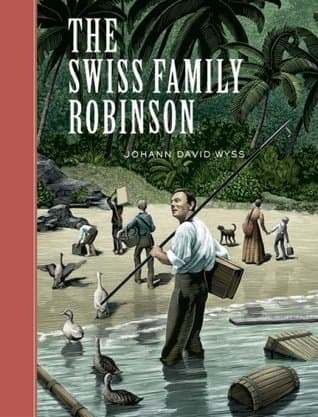
Produced by Anne Wingate
Swiss Family Robinson, by Johann David Wyss
This edition (c)2000 by Pink Tree Press PO Box 16536 Salt Lake City, Utah 84116 ISBN 1-930860-50-1
[Portions of this header are copyright (C) 2001 by Michael S. Hart and may be reprinted only when these Etexts are free of all fees.] [Project Gutenberg is a TradeMark and may not be used in any sales of Project Gutenberg Etexts or other materials be they hardware or software or any other related product without express permission.]
This Gutenberg Edition of <The Swiss Family Robinson> is a gift from the Editor's Cut imprint of Pink Tree Press, www.pink-tree-press.com. All Editor's Cut(tm) editions are free except for handling charges necessary to provide the book in your preferred format.
This Editor's Cut(tm) edition brings you Johann David Wyss's classic <Swiss Family Robinson> as you've never read it before! It is Volume One of <The Castaways Collection>.
The Editor's Cut(tm) imprint always provides the best, up-to-date, re-edited texts of the most beloved family classics, suitable for personal reading or homeschool.
This edition (c)2000 by Pink Tree Press PO Box 16536 Salt Lake City, Utah 84116 ISBN 1-930860-50-1
Foreword
No unabridged edition of <Swiss Family Robinson> exists in English. Indeed, the book has been rewritten so many times, by so many editors, that it can legitimately be said that that no complete edition of the book exists in <any> language.
Johann David Wyss, a Swiss pastor, originally wrote this book to entertain and instruct his four sons. Years later, his son Johann (or Jean—accounts differ) Rudolf Wyss, by then a professor of philosophy, persuaded his father to allow him to complete and edit the unfinished manuscript. It was published in two volumes in Zurich in 1812-1813.
Its French translator, Mme de Montholieu, obtained permission to greatly enlarge the book. It was published in five volumes from 1824 through 1826. The first English edition, abridged, was published in 1814; it was followed by several other English translations of varying quality. In 1849 W. H. G. Kingston re-translated, and greatly abridged, Mme. De Montholieu's version. Most English versions are based on Kingston's abridged version.
Despite a vast number of amusing errors in flora and fauna, the book has entertained, and warmed the hearts of, many generations. However, most modern editions omit an incredible amount even of Kingston's translation by making small cuttings here and there, some of them maddeningly inept. The Editor's Cut edition from Pink Tree Press has been based on, and compared with, no fewer than five previous editions, all of them out of copyright. Most, though not all, of the cuttings have been restored. The material that continues to be omitted is of little imaginable interest to anyone other than a scholar of nineteenth century literature.
Paragraphing has been redone in order to facilitate ease of reading. Some archaic spelling and grammar have been retained, as they are part of the flavor of the book; they have been changed where necessary for clarity. The British-style punctuation has been retained. The lengthy and unnecessary chapter headings have been omitted. Some parenthetical information is provided, most often to define words no longer to be found in many English dictionaries.
Anne Wingate, Ph.D. Editor-in-Chief Pink Tree Press
Chapter 1
For many days we had been tempest-tossed. Six times had the darkness closed over a wild and terrific scene, and returning light as often brought but renewed distress, for the raging storm increased in fury until on the seventh day all hope was lost.
We were driven completely out of our course; no conjecture could be formed as to our whereabouts. The crew had lost heart, and were utterly exhausted by incessant labour. The riven masts had gone by the board, leaks had been sprung in every direction, and the water, which rushed in, gained upon us rapidly.
Instead of reckless oaths, the seamen now uttered frantic cries to God for mercy, mingled with strange and often ludicrous vows, to be performed should deliverance be granted. Every man on board alternately commended his soul to his Creator, and strove to bethink himself of some means of saving his life.
My heart sank as I looked round upon my family in the midst of these horrors. Our four young sons were overpowered by terror. `Dear children,' said I, `if the Lord will, He can save us even from this fearful peril; if not, let us calmly yield our lives into His hand, and think of the joy and blessedness of finding ourselves for ever and ever united in that happy home above. Even death is not too bitter, when it does not separate those who love one another.'
At these words my weeping wife looked bravely up, and, as the boys clustered round her, she began to cheer and encourage them with calm and loving words. I rejoiced to see her fortitude, though my heart was ready to break as I gazed on my dear ones.
We knelt down together, one after another praying with deep earnestness and emotion. Fritz, in particular, besought help and deliverance for his dear parents and brothers, as though quite forgetting himself. Our hearts were soothed by the never- failing comfort of child-like confiding prayer, and the horrors of our situation seemed less overwhelming. `Ah,' thought I, `the Lord will hear our prayer! He will help us.'
Amid the roar of the thundering waves I suddenly heard the cry of `Land! land!', while at the same instant the ship struck with a frightful shock, which threw everyone to the deck, and seemed to threaten her immediate destruction. Dreadful sounds betokened the breaking up of the ship, and the roaring waters poured in on all sides.
Then the voice of the captain was heard above the tumult, shouting, `Lower away the boats! We are lost!'
`Lost!' I exclaimed, and the word went like a dagger to my heart; but seeing my children's terror renewed, I composed myself, calling out cheerfully, `Take courage, my boys! We are all above water yet. There is the land not far off, let us do our best to reach it. You know God helps those that help themselves! Remain with your mother, while I go on deck to see what is best to be done now.' With that, I left them and went on deck.
A wave instantly threw me down; another followed, and then another, as I contrived to find my footing. The ship was shattered on all directions, and on one side there was a large hole in the hull.
Forgetting the passengers, the ship's company crowded into the lifeboats, and the last who entered cut the davit ropes to cast each boat into the sea.
What was my horror when through the foam and spray I beheld the last remaining boat leave the ship, the last of the seamen spring into her and push off, regardless of my cries and entreaties that we might be allowed to share their slender chance of preserving their lives. My voice was drowned in the howling of the blast, and even had the crew wished it, the return of the boat was impossible, for the waves were mountain-high.
Casting my eyes despairingly around, I became gradually aware that our position was by no means hopeless, inasmuch as the stern of the ship containing our cabin was jammed between two high rocks, and was partly raised from among the breakers which dashed the fore-part to pieces. As the clouds of mist and rain drove past, I could make out, through rents in the vaporous curtain, a line of rocky coast, and, rugged as it was, my heart bounded towards it as a sign of help in the hour of need.
Yet the sense of our lonely and forsaken condition weighed heavily upon me as I returned to my family, constraining myself to say with a smile, `Courage, dear ones! Although our good ship will never sail more, she is so placed that our cabin will remain above water, and tomorrow, if the wind and waves abate, I see no reason why we should not be able to get ashore.'


