CL
COPYRIGHT, 1924, BY
DOUBLEDAY & COMPANY
ALL RIGHTS RESERVED
PRINTED IN THE UNITED STATES OF AMERICA
WOODCUTS
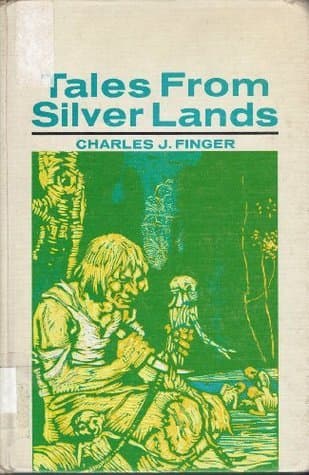
TALES FROM SILVER LANDS
A TALE OF THREE TAILS
OWN in Honduras there is a town called Pueblo de Chamelecón which is not much of a town after all. There is only one street in it, and the houses are like big beehives that have been squared up, and the roofs are of straw. There is no sidewalk, no roadway, and the houses are unfenced, so that you step from the room into the sandy street and, because of the heat, when you are inside you wish that you were out, and when you are outside you wish that you were in. So the children of the place spend much time down at the little river. At least they did when I was there.
I rode there on a donkey and, the day being hot, let the animal graze, or sleep, or think, or dream, or work out problems—or whatever it is that a donkey does with his spare time—and I watched the children in the water. There was one, a little baby just able to toddle around, who crawled down to the water’s edge, rolled in and swam about like a little dog, much as the babies of Tierra del Fuego will swim in the icy waters of the Far South. He came out on my side of the water, as lively as a grig, smiling every bit as friendly as any other little chap of his age, white, brown, or yellow.
I stayed there that night because the day did not get cool and in the evening the people sat outside of their houses and played the guitar and sang. Now I had with me a little musical instrument like a tiny organ, which I bought in France, and it was so compact and handy that I could carry it everywhere as easily as I could a blanket. In fact, I used to ride with it behind my saddle, wrapped in my bedding. Well, as the people seemed to like their music, I brought out mine, so we had a very jolly concert, in spite of my poor voice, which they politely pretended not to notice. Then later, from curiosity, the children came about me and, to amuse them as well as myself, having done so badly at the singing, I did a few tricks with wads of rolled paper and a couple of tin cups, and the little boy who had swum across the pond laughed as loudly as any one there. That pleased his father mightily, so much indeed that he brought me a cup of goat’s milk and some cassava bread and told me that I was a fine fellow. To please me further, he sang a very, very long song. It was all about the parrot and the wonderful things it did, a parrot that had lived long among people and learned their songs, and when the bird flew back to the forest, it still sang, and so well that all the other parrots in the forest learned to sing the song from beginning to end. But what was curious was that at the end of every other verse, there was this line:
When the rat had a tail like a horse.
So when he had done I asked him about that, for all the rats I had seen had tails which were far from beautiful, according to my notion.
The man listened gravely, then said: “But certainly, once the rat had a tail like a horse.”
“When was that?” I asked.
“When the rabbit had a tail like a cat,” he said.
“But I am still puzzled,” I told him. “Was it long ago?”
“It was when the deer’s tail was plumed like the tail of a dog,” he told me.
As we talked, a kind of polite silence was upon all the people gathered about us; then a very, very old woman who was smoking a cigar nodded her head and said: “But Tio Ravenna is right. It was in the days of Hunbatz, who lived on beetles and spiders, and I heard it from my mother’s mother, and she from the mother of her mother.” Then the old woman went on smoking with her eyes closed, and all who were there nodded at one another, thinking, I suppose, that the old grandmother would presently tell the story. But of course, they who knew her well were wiser than to ask her to tell the Tale of Three Tails, so every one waited.
Presently, a little girl gave the old grandmother a piece of sugar and asked: “Was it two brothers, or three, who had to clear the great forest? I am not sure.”
At that the little old lady’s eyes were bright and she threw away her cigar and said:
“Two brothers. That I have told you before.” After a little sigh, which was only pretending that she was weary of telling the tale, she said: “You know that I have told it to you before, and it is wrong that I should have to tell it so often. But you see this.”
So saying, she took from her bosom, where she had it fastened to a silk thread, a little piece of jade and let us see it. It was broken from a larger piece, but we could make out on it a carving which I saw to be a deer with a tail like a sheep dog’s. We passed it about and every one looked at it carefully, although certainly all of them must have seen it time and time again, and when it came to the old grandmother again she replaced it and told us the Tale of Three Tails, just as I have written it here.
Once, long ago, the rat had a beautiful tail like a horse, with long sweeping hairs, though it was before my time of life. It was in the days of old Hunbatz, and he was a wizard who lived in the dark of the great forest that used to be on the other side of the big river. In those days things were not as now and animals were different; some larger, some smaller. The deer, as you have seen on the stone I showed you, had a tail like a dog, and the rabbit’s tail was long and furry like the tail of a cat.
Now in that land there was a hunter with whom neither lasso nor arrow ever failed, and he had two sons, beautiful to look at and brave of heart, stout and quick of foot. Not only did the brothers work better than any men had ever worked, but they could play ball and sing, throwing the ball higher than birds could fly, and singing in a way that brought the wild things to hear them. Nor was there living creature able to run as swiftly as the two brothers. The birds alone could outrace them.
The brothers being grown, their father thought that it was time for them to make a home for themselves, so chose a place on the farther side of the forest, and told them to clear it, which, he said, could be done in seven days. It was no little forest, you must remember, but a vast place, where sunlight never pierced, and the roots of trees were like great ropes; a jungle that stretched for miles and miles and the tangle in it was so thick that a monkey could barely get through without squeezing. Deep in the forest there was a blackness like the blackness of night. The trunks of the trees were so large that three men holding hands could not circle them and where there were no trees, there were vines and snakelike lianas and thorn-bushes and flowers so great that a man could lie down to sleep in the shade of them.
The first day the brothers took a great space, piling the trees at one corner, clearing the tangle and leaving all as smooth as the water of a lake. They sang as they worked, and they sang as they rested in the heat of the day, and the organ bird and the flute bird answered them from the gold-green shade. So pleasant was their music that the old iguana, though he was as big as a man, came from his resting place in the trees to listen.
Seeing how things were going, old Hunbatz in the dark of the forest grew very angry, fearing that his hiding place would soon dwindle and vanish. So he went to the great gray owl, his friend, and they talked the matter over between them. The owl told Hunbatz that he must set the father’s heart against the brothers, telling him that the boys were lazy and instead of working spent their time in playing with the ball and in singing.
“Go,” said the owl, “to their father, and when he asks how the lads fare with their work, say to him:
They sing and they play