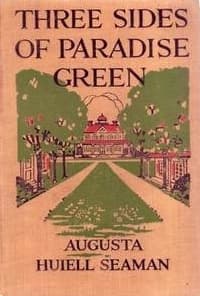
The Project Gutenberg eBook, Three Sides of Paradise Green, by Augusta Huiell Seaman, Illustrated by C. M. Relyea
"I'll tell you after we've had our swim," said the Imp
THREE SIDES OF PARADISE GREEN
BY
AUGUSTA HUIELL SEAMAN
Author of "The Girl Next Door," "The Sapphire Signet," ETC.
ILLUSTRATED BY C. M. RELYEA
NEW YORK THE CENTURY CO.
Copyright, 1918, by The Century Co. —— Published, October, 1918
Printed in U. S. A.
TO THE REAL HELEN ROBERTA
CONTENTS
THREE SIDES OF PARADISE GREEN
THREE SIDES OF PARADISE GREEN
CHAPTER I THE JOURNAL IS BEGUN
November 22, 1913. It's all on account of Miss Cullingford that I'm beginning this journal. I never would have thought of such a thing by myself. Neither would Carol. Now we've both begun one, and it's just because Miss Cullingford is so sweet and lovely, and all the girls at Bridgeton High School want to please her,—Carol and myself most of all.
Miss Cullingford is our English literature instructor, and we all simply adore her. She's the sweetest thing! She's little and slight, with fluffy light hair and dark blue eyes. And she's such an inspiration about literature and English composition! She makes it seem actually like a romance. They always seemed terribly dull, those subjects, when we had Miss Trotter last year. But now we're just crazy about them.
Well, one of the things she said yesterday in composition class was that every one of us ought to keep a journal, not the kind of diary affair that some people keep,—all about the weather and the number of jars of jam they put up, and how Cousin Hannah called that day!—but an occasional record, only written when we felt like it, of the things that happen around us and our ideas about people and so on. She said that the greatest minds of the ages had generally kept such a record, and that they had proved a big addition to history and literature, too.
Then, right there, I raised my hand and said that it was fine, of course, for the great minds to do it, especially when they lived in stirring times and had lots interesting to write about; but what was the use of just plain, ordinary people, as young as we were, doing it, especially when there wasn't anything going on that was interesting at all,—just the same old thing every day?
Miss Cullingford answered that I mustn't make the mistake of thinking any life uninteresting, no matter how quiet and ordinary it might appear to be. You can always find something interesting to write about any kind of life, if you try hard enough. And that was where the advantage of a journal came in,—it made you look around hard to find what was worth while, and you always found it. Also, it was a great help to your style in writing. Then she asked if any of the girls would promise to keep a journal faithfully for a year. Carol and I promised.
Well, now I'm going to see. No life could possibly be more uninteresting than mine, here in quiet little Stafford where nothing ever happens or ever has happened that I know of, and in a family that's awfully nice, of course, but as plain and uninteresting and ordinary as all the rest of the families around here.
Carol doesn't feel the same as I do about it. She's more hopeful. That's because she has lots of imagination and is always romancing about people and thinking there's some story back of their lives that we don't know. I suppose her journal will be awfully different from mine. Well, anyhow, we've both begun, and now we'll see what happens.
November 23. I had to stop short last night because I suddenly got so sleepy. Now I'll go on. I do wish we lived in Bridgeton, for things surely happen once in a while in a big town like that. Or even down in our own village of Stafford itself, and not way out, a mile off on the main road, on this silly little triangle called Paradise Green. Even the trolley doesn't run up this way; that would be something! But there's nothing in the world around here except this little triangle of a green, formed by the turning off of Cranberry Bog Road from the River Road, and the short road that connects the two at the head of the green. I'm sure I don't know why it was ever called Paradise Green. I suppose if I were Carol, I'd find out. She probably will. She's always hunting up historical facts.
Even the automobiles don't come along this way. Nearly all of them keep to the State road over on the other side of the river. There are just three houses around the Green, one on each side, and not another dwelling anywhere within half a mile. So we haven't many near neighbors.
Our house stands at the head of the Green. It's a big square house, with a cupola on top and a veranda around all four sides. Father's father built it when that style of house was just beginning to be popular, and everybody thought it very grand. I hate it myself, because it seems so old-fashioned and dreary compared to those pretty new bungalows they are putting up in Bridgeton. Mother and Father and the Imp and I live here. Father does intensive farming,—he is just crazy about it,—and every one comes to Birdsey's for ideas on the subject.
Dave is my brother. He's seventeen and a half, and a very quiet and thoughtful sort of person. All the same, he can do his own share of teasing in a quiet way. He left high school this year because his health wasn't very good, and is helping Father with the farming. Next year he's going to study scientific agriculture at one of the big colleges. I'm secretly awfully fond of Dave, but just at present he pretends to look down on girls as entirely unnecessary articles in the general scheme of things, so Carol and I are letting him severely alone.
The Imp is my sister. She's twelve years old and a perfect nuisance. Carol and I have named her "The Imp" because she acts just like one. She likes to trot around with us all the time, but we won't have it. It's impossible to have a child of twelve continually hanging on to girls of fifteen or sixteen, and Carol and I simply won't stand it. The Imp is fearfully miffed about this and spends her time thinking up revengeful things to do to us. She makes our lives perfectly miserable sometimes, though we wouldn't let her know it for the world.
Carol's house is on the River Road side of the Green. She lives there with just her mother and her Aunt Agatha. The Fayres are distant relatives of ours, so Carol and I are really cousins. Their house is one of the old style, a real New England farmhouse, and they have a glorious big barn in the back, where we've all played ever since we were babies. One little room off the haymow Carol and I have fixed up as our private den and study. We keep our books and our fancywork there, and her mother gave us an old desk where we do our school work. We always keep the den locked with a padlock, because the Imp would like to get in and rummage around. She's as mad as a hatter because she can't. She threatens to climb in the window sometime, but I don't believe she could possibly. If she did, she'd probably break her neck.
Carol is fifteen years old, and I'm sixteen. Her name is really Caroline, but she hates it and wants to be called "Carol" instead. She says it's so much prettier. And mine is even worse—Susan! Could anything be more dreadful? I've insisted on being called "Susette," which at least is a prettier French form. But no one except Carol will ever call me that. Every one calls me either "Susie" or "Sue," that is, all but the Imp. She, of course, knowing how much I detest it, will say nothing but "So-o-san" on all occasions. Carol she addresses by the horrible nickname of "Cad." Why are some children so irritating, I wonder? The infuriating part is that the Imp's own name is really lovely—Helen Roberta—and she knows it, little torment that she is!
Well, I haven't yet told about the third house on the Green, so now I come to that. It's the one on the Cranberry Bog Road side. It's by far the most interesting of the three,—a long, rambling colonial farmhouse, built, they say, way back in seventeen hundred and something. It has the most fascinating additions in all directions from the main part, and queer little back stairways and old slave quarters, and I don't know what else. But the people who live in it are the interesting part.