Transcriber’s Note
A larger version of the Frontispiece may be seen by right-clicking it and selecting an option to view it separately, or by double-tapping and/or stretching it.
THE WAYS OF WAR
Lafayette, Dublin, photographers.
Emery Walker phot.
Thos M. Kettle
THE WAYS OF WAR
BY PROFESSOR T. M. KETTLE LIEUT. 9TH DUBLIN FUSILIERS
WITH A MEMOIR BY HIS WIFE MARY S. KETTLE
NEW YORK CHARLES SCRIBNER’S SONS 1917
TO MY DEAR WIFE AND COMRADE EX UMBRIS ET IMAGINIBUS IN VERITATEM
PREFATORY NOTE
Perhaps the order of the chapters in the present book requires a word of explanation. They have a natural sequence as the confessions of an Irish man of letters as to why he felt called upon to offer up his life in the war for the freedom of the world. Kettle was one of the most brilliant figures both in the Young Ireland and Young Europe of his time. The opening chapters reveal him as a Nationalist concerned about the liberty not only of Ireland—though he never for a moment forgot that—but of every nation, small and great. He hoped to make these chapters part of a separate book, expounding the Irish attitude to the war; but unfortunately, as one must think, the War Office would not permit an Irish Officer to put his name to a work of the kind. After the chapters describing the inevitable sympathy of an Irishman with Serbia and Belgium—little nations attacked by two Imperial bullies—comes an account of the tragic scenes Kettle himself witnessed in Belgium, where he served as a war-correspondent in the early days of the war. “Silhouettes from the Front,” which follow, describe what he saw and felt later on, when, having taken a commission in the Dublin Fusiliers, he accompanied his regiment to France in time to take part in the Battle of the Somme. Then some chapters containing hints of that passion for France which was one of the great passions of his life. One of these, entitled “The New France,” was written before the war had made the world realise that France is still the triumphant flag-bearer of European civilisation. Then, in “The Gospel of the Devil,” we have an examination of the armed philosophies that have laid so much of France and the rest of Europe desolate. The book closes with “Trade or Honour?”—an appeal to the Allies to preserve high and disinterested motives in ending the war as in beginning it, and to turn a deaf ear to those political hucksters to whom gain means more than freedom. Thus “The Ways of War” is a book, not only of patriotism, but of international idealism. Above all, it is a passionate human document—the “apologia pro vita sua” of a soldier who died for freedom.
L.
Many of the chapters in this book have already appeared in various newspapers and magazines, to the editors and proprietors of which thanks are due for permission to reprint them here. The sources of the chapters referred to are as follows—
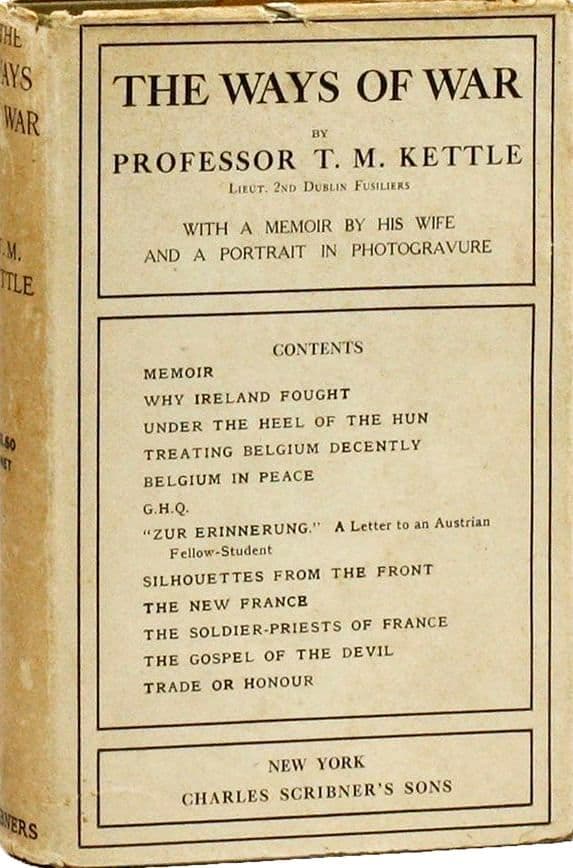
CONTENTS
THE WAYS OF WAR
MEMOIR
My husband in his last letter to his brother, written on the 8th of September, 1916, on the battlefield, expressed the wish that I should write a memoir of him as a preface to his war book. It is only at his express instance that I would have undertaken the writing of such a memoir, as there are many obvious reasons—notably two—why I am unfitted for that high duty. I have not the literary gifts of many of his distinguished friends, who in writing of him would have exercised their powers of sympathetic understanding and appreciation to the uttermost. But the personal relationship is an even greater handicap. If the reader will accept me as his comrade—since he has honoured me with the proud distinction—I shall do my best to interpret the “soul-side” with which he “faced the world.” For my shortcomings, I must crave indulgence. I only bring to this task the vision of love.
I shall give hereafter a biographical sketch, but first I wish to deal with his attitude to the war and a few points which he desired to be emphasised.
What urged him—the scholar, the metaphysician, the poet, above all the Irishman, irrevocably and immutably Irish, the man of peace, who had nothing of the soldier except courage—to take a commission in the British Army and engage in the cruel and bloody business of war? His motives for taking this step, he wished to be made clear beyond misrepresentation. It should be unnecessary to do this, as he proclaimed them on many platforms and in many papers. His attitude and action are the natural sequence and logic of his character and ideals. Since I first knew him, he loved to call himself a “capitaine routier” of freedom, and that is the alpha and omega of his whole personality. As Mr. Lynd has said, he was not a Nationalist through love of a flag, but through love of freedom. It was this love of freedom that made him in his student days in the Royal University lead the protest against the playing of “God Save the King” at the conferring of Degrees. The words of the Students’ manifesto went, “We desire to protest against the unjust, wasteful and inefficient Government of which that air is a symbol.” It was the same love of freedom that made him during the Boer War distribute in the streets of Dublin anti-recruiting leaflets. The Tom Kettle who did these things, who said in an election speech in 1910 that “for his part he preferred German Invasion to British Finance,” was the same Tom Kettle who believed it Ireland’s duty in 1914 to take the sword against Germany as the Ally of England.
“This war is without parallel,” he wrote in August, 1914; “Britain, France, Russia, enter it, purged from their past sins of domination. France is right now as she was wrong in 1870, England is right now as she was wrong in the Boer War, Russia is right now as she was wrong on Bloody Sunday.”
In August and September, he acted as war correspondent for the Daily News, and in this capacity was a witness of the agony of Belgium. He returned to Ireland burning with indignation against Prussia. He referred to Germany as “the outlaw of Europe.” “It is impossible not to be with Belgium in this struggle,” he wrote to the Daily News; “it is impossible any longer to be passive. Germany has thrown down a well-considered challenge to all the forces of our civilisation. War is hell, but it is only a hell of suffering, not of dishonour, and through it, over its flaming coals, Justice must walk, were it on bare feet.”
It was as an Irish soldier in the army of Europe and civilisation that he entered the war. “He was horrified,” said Mr. Lynd very truly, “by the spectacle of a bully let loose on a little nation. He was horrified, too, at the philosophic lie at the back of all this greed of territory and power. He was horrified at seeing the Europe he loved going down into brawling and bloody ruin. Not least—and no one can understand contemporary Ireland who does not realise this—he was horrified by the thought that if Germany won, Belgium would be what he had mourned in Ireland—a nation in chains. An international Nationalist—that was the mood in which he offered his services to the War Office.”
I think the chief reason his motives have been misunderstood is that few have gone to the trouble of understanding his wide outlook. He was a European. He was deeply steeped in European culture. He was au courant with European politics. He knew his France, his Germany, his Russia as well as we know our Limerick, Cork and Belfast. Mr. Healy once said his idea of a nation ended with the Kish lightship. Tom Kettle’s ideal was an Ireland identified with the life of Europe. “Ireland,” he wrote, “awaits her Goethe who will one day arise to teach her that, while a strong nation has herself for centre, she has the universe for circumference.... My only programme for Ireland consists in equal parts of Home Rule and the Ten Commandments. My only counsel to Ireland is, that to become deeply Irish, she must become European.”
That counsel was given six years before the war. It was acting on that counsel that he deemed it right to make the final sacrifice, and in a European struggle sign his ideal with the seal of his blood. England and English thought had nothing to do with his attitude to the war. England happened to be on the side of Justice. He acknowledges that, but says rather bitterly, “England goes to fight for liberty in Europe but junkerdom in Ireland.” Mr. Shane Leslie is absolutely right when he says, “He died for no Imperialistic concept, no fatuous Jingoism.”
“Let this war go forward,” he wrote to the Daily News in 1914, “on its own merits and its own strong justice. After the war of the peoples, let us have the peoples’ peace. Let us drop statecraft and return to the Ten Commandments—now that we have got such a good bit of the way back.”
Mr. Padraic Colum, in a memoir of my husband in the Irish-American paper, Ireland, says: “When the Germans broke into Belgium, he advised the Irish to join the British Army and to fight for the rights of small nationalities. Had death found him in those early days he would at least have died for a cause he believed in.” I think Mr. Colum, if only for the sake of an old friendship, might have troubled to understand the idea for which Tom Kettle died, and in which he believed to the end. Does Mr. Colum mean to suggest that my husband no longer believed in the maintenance of the rights of small nationalities? Was his enthusiasm for Belgium quenched—Belgium the heroic who preferred to lose all that she might gain her own soul? Is not Belgium still an invaded country? And even if England juggles with Ireland’s liberty, is not the fight for truth and justice to go on? As my husband says in this volume, “Ireland had a duty not only to herself but to the world... and whatever befell, the path taken by her must be the path of honour and justice.”
In one of my last letters from him, he speaks his faith, even if it is the faith of a sad and burdened soul: “It is a grim and awful job, and no man can feel up to it. The waste—the science of waste and bloodshed! How my heart loathes it and yet it is God’s only way to Justice.”
Mr. Colum proceeds: “He knew by the dreams he remembered that his place should have been with those who died for the cause of Irish Nationality.” I postulate that Tom Kettle died most nobly for the cause of Irish Nationality, in dying for the cause of European honour.