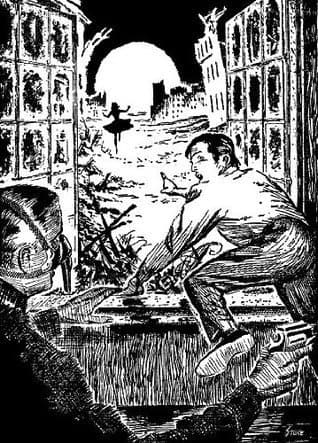
THE MOON IS GREEN
By FRITZ LEIBER
Anybody who wanted to escape death could, by paying a very simple price—denial of life!
Illustrated by DAVID STONE
"Effie! What the devil are you up to?"
Her husband's voice, chopping through her mood of terrified rapture, made her heart jump like a startled cat, yet by some miracle of feminine self-control her body did not show a tremor.
Dear God, she thought, he mustn't see it. It's so beautiful, and he always kills beauty.
"I'm just looking at the Moon," she said listlessly. "It's green."
Mustn't, mustn't see it. And now, with luck, he wouldn't. For the face, as if it also heard and sensed the menace in the voice, was moving back from the window's glow into the outside dark, but slowly, reluctantly, and still faunlike, pleading, cajoling, tempting, and incredibly beautiful.
"Close the shutters at once, you little fool, and come away from the window!"
"Green as a beer bottle," she went on dreamily, "green as emeralds, green as leaves with sunshine striking through them and green grass to lie on." She couldn't help saying those last words. They were her token to the face, even though it couldn't hear.
"Effie!"
She knew what that last tone meant. Wearily she swung shut the ponderous lead inner shutters and drove home the heavy bolts. That hurt her fingers; it always did, but he mustn't know that.
"You know that those shutters are not to be touched! Not for five more years at least!"
"I only wanted to look at the Moon," she said, turning around, and then it was all gone—the face, the night, the Moon, the magic—and she was back in the grubby, stale little hole, facing an angry, stale little man. It was then that the eternal thud of the air-conditioning fans and the crackle of the electrostatic precipitators that sieved out the dust reached her consciousness again like the bite of a dentist's drill.
"Only wanted to look at the Moon!" he mimicked her in falsetto. "Only wanted to die like a little fool and make me that much more ashamed of you!" Then his voice went gruff and professional. "Here, count yourself."
She silently took the Geiger counter he held at arm's length, waited until it settled down to a steady ticking slower than a clock—due only to cosmic rays and indicating nothing dangerous—and then began to comb her body with the instrument. First her head and shoulders, then out along her arms and back along their under side. There was something oddly voluptuous about her movements, although her features were gray and sagging.
The ticking did not change its tempo until she came to her waist. Then it suddenly spurted, clicking faster and faster. Her husband gave an excited grunt, took a quick step forward, froze. She goggled for a moment in fear, then grinned foolishly, dug in the pocket of her grimy apron and guiltily pulled out a wristwatch.
He grabbed it as it dangled from her fingers, saw that it had a radium dial, cursed, heaved it up as if to smash it on the floor, but instead put it carefully on the table.
"You imbecile, you incredible imbecile," he softly chanted to himself through clenched teeth, with eyes half closed.
She shrugged faintly, put the Geiger counter on the table, and stood there slumped.
He waited until the chanting had soothed his anger, before speaking again. He said quietly, "I do suppose you still realize the sort of world you're living in?"
She nodded slowly, staring at nothingness. Oh, she realized, all right, realized only too well. It was the world that hadn't realized. The world that had gone on stockpiling hydrogen bombs. The world that had put those bombs in cobalt shells, although it had promised it wouldn't, because the cobalt made them much more terrible and cost no more. The world that had started throwing those bombs, always telling itself that it hadn't thrown enough of them yet to make the air really dangerous with the deadly radioactive dust that came from the cobalt. Thrown them and kept on throwing until the danger point, where air and ground would become fatal to all human life, was approached.
Then, for about a month, the two great enemy groups had hesitated. And then each, unknown to the other, had decided it could risk one last gigantic and decisive attack without exceeding the danger point. It had been planned to strip off the cobalt cases, but someone forgot and then there wasn't time. Besides, the military scientists of each group were confident that the lands of the other had got the most dust. The two attacks came within an hour of each other.
After that, the Fury. The Fury of doomed men who think only of taking with them as many as possible of the enemy, and in this case—they hoped—all. The Fury of suicides who know they have botched up life for good. The Fury of cocksure men who realize they have been outsmarted by fate, the enemy, and themselves, and know that they will never be able to improvise a defense when arraigned before the high court of history—and whose unadmitted hope is that there will be no high court of history left to arraign them. More cobalt bombs were dropped during the Fury than in all the preceding years of the war.
After the Fury, the Terror. Men and women with death sifting into their bones through their nostrils and skin, fighting for bare survival under a dust-hazed sky that played fantastic tricks with the light of Sun and Moon, like the dust from Krakatoa that drifted around the world for years. Cities, countryside, and air were alike poisoned, alive with deadly radiation.
The only realistic chance for continued existence was to retire, for the five or ten years the radiation would remain deadly, to some well-sealed and radiation-shielded place that must also be copiously supplied with food, water, power, and a means of air-conditioning.
Such places were prepared by the far-seeing, seized by the stronger, defended by them in turn against the desperate hordes of the dying ... until there were no more of those.
After that, only the waiting, the enduring. A mole's existence, without beauty or tenderness, but with fear and guilt as constant companions. Never to see the Sun, to walk among the trees—or even know if there were still trees.
Oh, yes, she realized what the world was like.


