BOOKS BY JAMES OTIS.
WITH PERRY ON LAKE ERIE. A Tale of 1812. 307 pp. Cloth. $1.50.
WITH PREBLE AT TRIPOLI. A Story of "Old Ironsides" and The Tripolitan War. 349 pp. Cloth. $1.50.
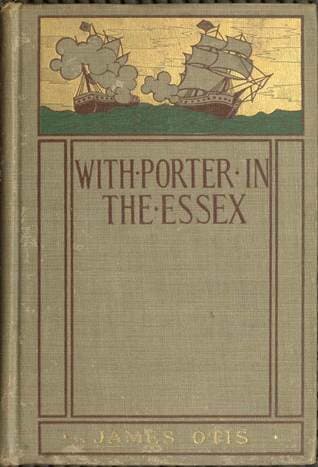
WITH PORTER IN THE ESSEX. A Story of his Famous Cruise in Southern Waters during the War of 1812. 344 pp. Cloth. $1.50.
THE CRUISE OF THE ENTERPRISE. Being the Story of the Struggle and Defeat of the French Privateering Expeditions against the United States in 1779. 359 pp. Cloth. $1.50.
IT WAS ONLY NECESSARY THAT THE CREW SHOULD REACH OUT AND PULL US ON BOARD.
WITH PORTER IN THE ESSEX
A Story of his Famous Cruise in Southern Waters during the War of 1812
BY
JAMES OTIS
ILLUSTRATED BY WILLIAM F. STECHER
BOSTON AND CHICAGO W. A. WILDE COMPANY
Copyright, 1901, By W. A. Wilde Company. All rights reserved.
WITH PORTER IN THE ESSEX.
CONTENTS
ILLUSTRATIONS.
PROLOGUE.
The manuscript of this story was written by Ezra McKnight, a cousin of that Stephen Decatur McKnight of Hartford, Connecticut, who was captured after the action between the Essex and the Phœbe and Cherub, and with a companion named James Lyman went to Rio de Janeiro as exchanged prisoners of war. From that port, according to Lossing, these two shipped for England in a Swedish vessel, and, although the ship arrived in safety, her captain never gave any account of his prisoners, nor was it known what had become of them. That they were murdered would be the natural inference, since in event of their being treacherously sent to England some record must have been found regarding them.
He who wrote the story of the cruise of the Essex which follows here, searched long but vainly for some clew to the fate of his brave cousin; in fact, after leaving the United States Navy it was his lifework to discover the fate of that brave lieutenant who was the only officer uninjured on board the Essex after that unequal conquest was cowardly forced upon her by Captain Hillyar of the Phœbe, whose vessel and life had once been spared by Captain Porter.
Failing to gain any information concerning the lieutenant, Ezra McKnight set himself down to write the story of that marvellous cruise of the Essex, the United States frigate of thirty-two guns, commanded by Captain David Porter who was born in Boston on the first of February, 1780. How this manuscript came into the hands of the editor it is not necessary to state. Suffice it to say that no change has been made in the original arrangement of the tale, nor in any of the details; it is here presented virtually as Ezra McKnight wrote it, with only so much of editing as seemed necessary in order to bring it within the requirements of a story of the present day.
To those who may read that which follows for the purpose of learning somewhat of their country's history, it is well to state a few facts which would not naturally appear in what was originally intended for an account of the adventurous voyage.
The commander of the Essex gained his first experience in the navy on board the frigate Constellation, which vessel he entered as midshipman in 1798. Concerning him Lossing says that "he was in the action between the Constellation and the L'Insurgente in February, 1799, when his gallantry was so conspicuous that he was immediately promoted to lieutenant. He accompanied the first United States squadron that ever sailed to the Mediterranean in 1803, and was on board the Philadelphia when she struck on the rock in the harbor of Tripoli. There he suffered imprisonment. In 1806 he was appointed to the command of the Enterprise, and cruised in the Mediterranean for six years. On his return to the United States he was placed in command of the flotilla station near New Orleans, where he remained until war was declared in 1812, when he was promoted to captain and assigned to the command of the frigate Essex, taking with him, on this last cruise, his adopted son, David G. Farragut, who, during the War of the Rebellion, was made an admiral."
Now, in order that the memory of the reader may be refreshed as to the strength of the United States Navy while this cruise was being made, the following extract is taken from Lossing's "War of 1812."
"As we take a survey from a standpoint at mid-autumn, 1813, we observe with astonishment only three American frigates at sea, namely, the President, 44; the Congress, 38; and the Essex, 32. The Constitution, 44, was undergoing repairs; the Constellation, 38, was blockaded at Norfolk; and the United States, 44, and Macedonian, 38, were prisoners in the Thames above New London. The Adams, 28, was undergoing repairs and alterations, while the John Adams, 28, New York, 36, and Boston, 28, were virtually condemned. All the brigs, excepting the Enterprise, had been captured, and she was not to be trusted at sea much longer. The Essex, Commodore Porter, was the only government vessel of size which was then sustaining the reputation of the American Navy, and she was in far distant seas, with a track equal to more than a third of the circumference of the globe between her and the home port from which she sailed. She was then making one of the most remarkable cruises on record."
In October, 1812, Captain William Bainbridge was appointed the successor of Captain Hull in the command of the Constitution; and, according to Lossing, "a small squadron, consisting of the Constitution, 44, Essex, 32, and Hornet, 18, were placed in his charge. When Bainbridge entered upon his duty in the new sphere of flag officer, the Constitution and Hornet were lying in Boston harbor, and the Essex, Captain Porter, was in the Delaware. Orders were sent to the latter to cruise in the track of the English West Indiamen, and at the specified time to rendezvous at certain ports, when, if he should not fall in with the flagship of the squadron, he would be at liberty to follow the dictates of his own judgment. Such contingency occurred, and the Essex sailed on a very long and most eventful cruise in the South Atlantic and Pacific Oceans."
The Essex left the Delaware October, 1812, in pursuance with the command received by Captain Porter; and he must have already outlined in his own mind what course to pursue in case he failed to meet the little squadron, for Lossing says, "Captain Porter took with him a larger number of officers and crew than was common for a vessel of that size. Her muster roll contained three hundred and nineteen names; and her supplies were so ample that she sank deep in the water, which greatly impeded her sailing qualities."
On Porter's monument, which stands in Woodlawn Cemetery, Pennsylvania, are the following inscriptions:
"Commodore David Porter, one of the most heroic sons of Pennsylvania, having long represented his country with fidelity as minister resident at Constantinople, died at that city in the patriotic discharge of his duties March 3, 1843."
"In the War of 1812 his merits were exhibited not merely as an intrepid commander, but in exploring new fields of success and glory. A career of brilliant good fortune was crowned by an engagement against superior force and fearful advantages, which history records as an event among the most remarkable in naval warfare."
"His early youth was conspicuous for skill and gallantry in the naval services of the United States when the American arms were exercised with romantic chivalry before the battlements of Tripoli. He was on all occasions among the bravest of the brave; zealous in the performance of every duty; ardent and resolute in the trying hour of calamity; composed and steady in the blaze of victory."