Transcriber’s Note: The reader may wish to be warned that this book contains language which is nowadays considered racially offensive.
Drawn by A. B. Frost
“Is anybody ever hear de beat er dat?”—“Brother Rabbit’s Laughing-Place”
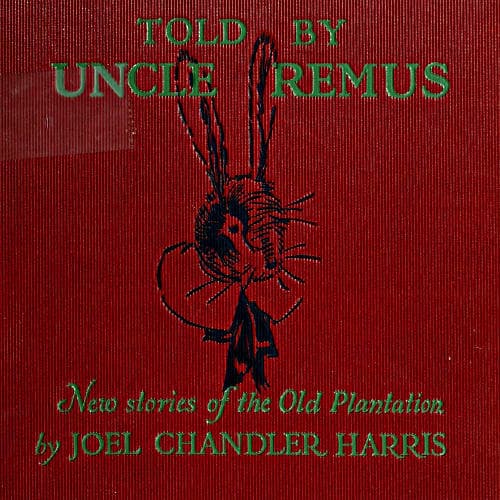
Told by UNCLE REMUS
New Stories of the Old Plantation
by JOEL CHANDLER HARRIS
Illustrated by A. B. FROST, J. M. CONDE and FRANK UERBECK
GROSSET & DUNLAP Publishers NEW YORK
Copyright, 1903, 1904, 1905, by JOEL CHANDLER HARRIS
Copyright, 1903, 1904, 1905, by P. F. Collier & Son Copyright, 1904, 1905, by The Metropolitan Magazine Company
PRINTED IN THE UNITED STATES AT THE COUNTRY LIFE PRESS, GARDEN CITY, N. Y.
CONTENTS
LIST OF FULL-PAGE ILLUSTRATIONS
TOLD BY UNCLE REMUS
THE REASON WHY
The main reason why Uncle Remus retired from business as a story-teller was because the little boy to whom he had told his tales grew to be a very big boy, and grew and grew till he couldn’t grow any bigger. Meanwhile, his father and mother moved to Atlanta, and lived there for several years. Uncle Remus moved with them, but he soon grew tired of the dubious ways of city life, and one day he told his Miss Sally that if she didn’t mind he was going back to the plantation where he could get a breath of fresh air.
He was overjoyed when the lady told him that they were all going back as soon as the son married. As this event was to occur in the course of a few weeks, Uncle Remus decided to wait for the rest of the family. The wedding came off, and then the father and mother returned to the plantation, and made their home there, much to the delight of the old negro.
In course of time, the man who had been the little boy for ever so long came to have a little boy of his own, and then it happened in the most natural way in the world that the little boy’s little boy fell under the spell of Uncle Remus, who was still hale and hearty in spite of his age.
This latest little boy was frailer and quieter than his father had been; indeed, he was fragile, and had hardly any color in his face. But he was a beautiful child, too beautiful for a boy. He had large, dreamy eyes, and the quaintest little ways that ever were seen; and he was polite and thoughtful of others. He was very choice in the use of words, and talked as if he had picked his language out of a book. He was a source of perpetual wonder to Uncle Remus; indeed, he was the wonder of wonders, and the old negro had a way of watching him curiously. Sometimes, as the result of this investigation, which was continuous, Uncle Remus would shake his head and chuckle; at other times, he would shake his head and sigh.
This little boy was not like the other little boy. He was more like a girl in his refinement; all the boyishness had been taken out of him by that mysterious course of discipline that some mothers know how to apply. He seemed to belong to a different age—to a different time; just how or why, it would be impossible to say. Still, the fact was so plain that any one old enough and wise enough to compare the two little boys—one the father of the other—could not fail to see the difference; and it was a difference not wholly on the surface. Miss Sally, the grandmother, could see it, and Uncle Remus could see it; but for all the rest the tendencies and characteristics of this later little boy were a matter of course.
“Miss Sally,” said Uncle Remus, a few days after the arrival of the little boy and his mother, “what dey gwineter do wid dat chile? What dey gwineter make out ’n ’im?”
“I’m sure I don’t know,” she replied. “A grandmother doesn’t count for much these days unless there is illness. She is everything for a few hours, and then she is nothing.” There was no bitterness in the lady’s tone, but there was plenty of feeling—feeling that only a grandmother can appreciate and understand.
“I speck dat’s so,” Uncle Remus remarked; “an’ a ole nigger dat oughter been dead long ago, by good rights, don’t count no time an’ nowhar. But it’s a pity—a mighty pity.”
“What is a pity?” the lady inquired, though she knew full well what was in the old negro’s mind.
“I can’t tell you, ma’am, an’ ’twouldn’t be my place ter tell you ef I could; but dar ’tis, an’ you can’t rub it out. I see it, but I can’t say it; I knows it, but I can’t show you how ter put yo’ finger on it; yit it’s dar ef I’m name Remus.”
The grandmother sat silent so long, and gazed at the old negro so seriously, that he became restive. He placed the weight of his body first on one foot and then on the other, and finally struck blindly at some imaginary object with the end of his walking-cane.
“I hope you ain’t mad wid me, Miss Sally,” he said.
“With you?” she cried. “Why——” She was sitting in an easy-chair on the back porch, where the warmth of the sun could reach her, but she rose suddenly and went into the house. She made a noise with her throat as she went, so that Uncle Remus thought she was laughing, and chuckled in response, though he felt little like chuckling. As a matter of fact, if his Miss Sally had remained on the porch one moment longer she would have burst into tears.
She went in the house, however, and was able to restrain herself. The little boy caught at the skirt of her dress, saying: “Grandmother, you have been sitting in the sun, and your face is red. Mother never allows me to sit in the sun for fear I will freckle. Father says a few freckles would help me, but mother says they would be shocking.”
Uncle Remus received his dinner from the big house that day, and by that token he knew that his Miss Sally was very well pleased with him. The dinner was brought on a waiter by a strapping black girl, with a saucy smile and ivory-white teeth. She was a favorite with Uncle Remus, because she was full of fun. “I dunner how come de white folks treat you better dan dey does de balance un us,” she declared, as she sat the waiter on the small pine table and removed the snowy napkin with which it was covered. “I know it ain’t on ’count er yo’ beauty, kaze yo’ ain’t no purtier dan what I is,” she went on, tossing her head and showing her white teeth.