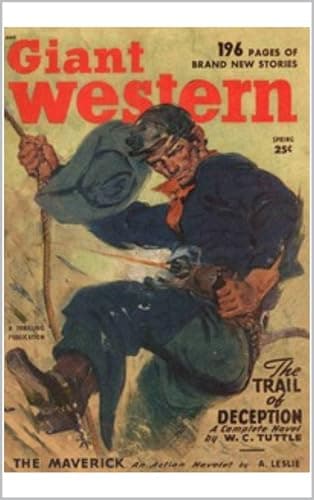
The Trail of Deception
Jim Bailey was reported dead—which gave him a clear field for a profitable game!
Jim Bailey was thoroughly disgusted and discouraged, as he sat down on a park bench. It was nearly dark, and the lights were blinking around him. Jim was only twenty-five years of age, fairly-well dressed, fairly good-looking; an average young man, trying to buck the world.
For two days he had tried to find a job, but with no success. He had two dollars in his pocket, owed ten dollars room rent, due right now—and an assurance from the landlady that unless he produced the back rent tonight—
Jim was a bookkeeper. That is, he tried to keep books, if he could have found some books to keep.
He tried to tell himself that he would be all right, if it was not for Cliff De Haven, that doggone chiseler! Cliff was an actor—a hoofer. That is, he was when there was a job for him. When there wasn’t he shared Jim’s room, but not in any financial sense of the word. He also ate at Jim’s expense. Cliff was a hard man to insult. At least, Jim Bailey found him so. Maybe Jim didn’t use the right words.
Cliff always had a big deal coming up. Last night he had told Jim that he was all set for the biggest deal of his life and that Jim would profit thereby. Cliff chummed with a down-at-the-heel private detective named Bob Hawley. Jim hated Hawley. Often he ate with Cliff, and Jim paid the check. Yes, if he could get rid of Cliff De Haven—but what was the use?
It was about eight o’clock when Jim got off the bench and walked to his room. He simply could not pay the bill, so there was no use trying to fool the landlady any longer.
The landlady was not in sight as Jim came in. He looked into the series of pigeon-holes at the desk, took out a letter addressed to Cliff De Haven and a folded sheet of paper, on which was printed in the landlady’s familiar hand:
Dear Mr. Bailey: Unless you can pay me ten dollars tonight, I must ask you to vacate early in the morning.
Jim Bailey crumpled the paper and tossed it into the wastebasket. No use keeping it. He went up to his room, where he tossed his hat aside and sat down on the edge of the bed. The built-in wardrobe door was open, facing him as he sat, and he got up quickly and investigated. His best suit was missing, his one best shirt, his best pair of shoes. On the table was a penciled note, which said:
Jim threw the letter aside in disgust. It was like Cliff to do a thing like that. Suddenly it occurred to him that Cliff had neglected to empty the pockets, in which were several letters, cards and things like that. He had probably dressed and got out in a hurry, knowing that Jim would soon be back.
Jim expected a visit from the landlady, but she did not put in an appearance, so he went to bed, leaving the door unlocked. Cliff would probably show up before daylight, full of apologies and other things.
But Cliff did not show up. Jim got up about eight o’clock. He had an old suit-case, but little to put in it until Cliff came back with that suit and clothes. He went out to get some breakfast and ran into a new chambermaid at the bottom of the steps. He inquired about the landlady, and the woman said she was sick.
“Will she be here today?” he asked.
“She will not,” replied the woman. “She has some sort of infiction.”
Jim went out to the street, grinning. He said half-aloud, “I’ll bet she bit herself.”
He ate breakfast in a cheap restaurant and bought a paper, mostly for the want-ads. He glanced at the front page and his own name seemed to jump up at him. A smash-up between a truck and a street car—gasoline explosion—several people killed and injured! Only two bodies identified. Robert Hawley, a private detective. The other was, according to the police, Jim Bailey, address unknown. Partly-burned papers in his pocket and a wrist watch positively identified him. Hawley was identified by unburned articles in his possession.
Jim Bailey leaned against a post and drew a deep breath. His suit! His watch! He looked vacantly at the traffic along the street. Jim Bailey was dead—it said so in the paper. Walking in sort of a daze he went back to his room. Address unknown. He sat down on the edge of the bed and tried to realize what had happened. Jim Bailey was dead. That was a good joke.
He started to light a cigaret, then remembered the letter for Cliff De Haven. It was there on the table. There was no letterhead on the envelope, and the postmark was blurred. He opened the letter and looked it over. Cliff would never read it. It said:
You will find transportation waiting for you at the S. P. ticket office. Come to Pinnacle City and contact me at once. Office on the main street. Bob Hawley says you can do the job. Remember, your name is Jim Meade. Don’t talk with anyone, until we can get together on this deal, and don’t mention anything that Bob has told you. Wear no fancy clothes—you’re supposed to be in meager circumstances.
Jim Bailey read it twice and then sat there, an unlighted cigaret between his lips. This must have been the deal that Cliff had mentioned. He studied the postmark again and now he could see that it was Pinnacle City, Arizona. What sort of a deal was this, he wondered? Cliff was supposed to go to Pinnacle City, take the name of Meade—and what else?
Pinnacle City sounded interesting, like a small town. Jim Bailey had always lived in a big city. A sudden thought caused him to squint at the faded wall-paper of his room. Just suppose this Ed McLean had never—of course he had never seen Cliff De Haven. Bob Hawley had told McLean about Cliff. Why not take a chance? No job, no home, no ties of any kind. Jim Bailey grinned slowly.
“Wear no fancy clothes,” he quoted aloud. “You’re supposed to be in meager circumstances. Brother, you meant me!”
He took his almost-empty suit-case and left the house. There was no one in the lobby. He walked to the ticket office, where he asked about the transportation. After being shunted from desk to desk, he was sent into an office, where the man said:
“Have you anything for identification?”
Jim Bailey shook his head. “Not a thing. Oh, yes—this letter.”
It was the one sent to Cliff De Haven. The man looked at it.
“You look honest, young man,” he said smiling. “Here is your ticket, and here is the ten dollars expense money.”
Jim Bailey walked out of the office and headed for the depot.


