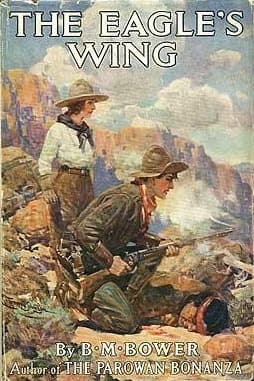
THE EAGLE’S WING
The man in the distance ducked out of sight amongst the bowlders.
THE EAGLE’S WING CHAPTER ONE KING, OF THE MOUNTED
On the wide south porch of the house where he had been born, Rawley King sat smoking his pipe in the dusk heavy with the scent of a thousand roses. The fragrant serenity of the great, laurel-hedged yard of the King homestead was charming after the hot, empty spaces of the desert. Even the somber west wing of the brooding old house seemed wrapped in the peace that enfolds lives moving gently through long, uneventful months and years. The smoke of his pipe billowed lazily upward in the perfumed air; incense burned by the prodigal son upon the home altar after his wanderings.
The old Indian, Johnny Buffalo, came walking straight as an arrow across the strip of grass beside the syringa bushes that banked the west wing. Rawley straightened and stared, the bowl of his pipe sagging to the palm of his hand. As far back as he could remember, none had ever crossed that space of clipped grass to hold speech with the Kings. But now Johnny Buffalo walked steadily forward and halted beside the porch.
“Your grandfather say you come,” he announced calmly and turned back to the somber west wing.
Sheer amazement held Rawley motionless for a moment. Until the Indian spoke to him he had almost forgotten the strangeness of that hidden, remote life of his grandfather. From the time he could toddle, Rawley had been taught that he must not go near the west wing of the house or approach the brooding old man in the wheel chair. As for the Indian who served his grandfather, Rawley had been too much afraid of him to attempt any friendly overtures. There had been vague hints that Grandfather King was not quite right in his mind; that a brooding melancholy held him, and that he would suffer no one but his Indian servant near him. Now, after nearly thirty years of studied aloofness, his grandfather had summoned him.
The Indian was waiting in the shadowed west porch when Rawley tardily arrived at the steps. He turned without speaking and opened the door, waiting for Rawley to pass. Still dumb with astonishment, a bit awed, Rawley crossed the threshold and for the first time in his life stood in the presence of his grandfather.
A powerful figure the old man must have been in his youth. Old age had shrunk him, had sagged his shoulders and dried the flesh upon his bones; but years could not hide the breadth of those shoulders or change the length of those arms. His eyes were piercingly blue and his lips were firm under the drooping white mustache. His snow-white hair was heavy and lay upon his shoulders in natural waves that made it seem heavier than it really was,—just so he had probably worn it in the old, old days on the frontier. His eyebrows were domineering and jet black, and the whole rugged countenance betrayed the savage strength of the spirit that dwelt back of his eyes. But the great, gaunt body stopped short at the knees, and the gray blanket smoothed over his lap could not hide the tragic mutilation; nor could the great mustache conceal the bitter lines around his mouth.
“Back from Arizona, hey?” he launched abruptly at Rawley, and his voice was grim as his face.
Rawley started. Perhaps he expected a cracked, senile tone; it would have fitted better the tradition of the old man’s mental weakness.
“Just got back to-day, Grandfather.” Instinctively Rawley swung to a matter-of-fact manner, warding off his embarrassment over the amazing interview.
“Mining expert, hey? Know your business?”
“Well enough to be paid for working at it,” grinned Rawley, trying unsuccessfully to keep his eyes from straying curiously around the room filled with ancient trophies of a soldier’s life half a century before.
“Not much like your father! I’ll bet he couldn’t have told you the meaning of the words. Damned milksop. Bank clerk! Not a drop of King blood in his body—far as looks and actions went. Guess he thought gold grew on bushes, stamped with the date of the harvest!”
“I remember him vaguely. He never seemed well or strong,” Rawley defended his dead father.
“Never had the King make-up. Only weakling the Kings ever produced—and he had to be my son! Take a look at that picture on the bureau. That’s what I mean by King blood. Johnny, give him the picture.”
The Indian moved silently to a high chest of drawers against the farther wall and lifted from it an enlarged, framed photograph, evidently copied from an earlier crude effort of some pioneer in the art. He placed it reverently in Rawley’s hands and retreated to a respectful distance.
“Taken before I started out with Moorehead’s expedition in ’59. Six feet two in my bare feet, and not an ounce of soft flesh in my body. Not a man in the company I couldn’t throw. Johnny could tell you.” A note of pride had crept into the old man’s voice.
“I can see it, Grandfather. I—I’d give anything to have been with you in those days. Lord, what a physique!”
The fierce old eyes sparkled. The bony fingers gripped the arms of the wheel chair like steel claws.
“That’s the King blood. Give me two legs and I’d be a King yet, old as I am—instead of a hunk of meat in a wheel chair.”
“It’s the spirit that counts, Grandfather,” Rawley observed hearteningly, his eyes still on the picture but lifting now to the old man’s face. “The picture’s like you yet.”
The old man grunted doubtfully, his eyes fixed sharply upon Rawley’s face. His fingers drummed restlessly upon the arm of his chair, as if he were seeing in the young man his own care-free youth, and was yearning over it in secret. Indeed, as he stood there in the light of the old-fashioned lamp, Rawley King might have been mistaken for the original of the picture with the costume set fifty years ahead.
“Johnny, get the box.” Grandfather King spoke without taking his eyes off Rawley.
The old Indian slipped away. In a moment he returned with a square metal box which he placed on the old man’s knees. Rawley found himself wondering what his mother would say when he told her that Grandfather King had sent for him, was actually talking to him, giving him a glimpse of that sealed past of his. He watched his grandfather fit a key into the lock of the metal box.
“You’re a King, thank God. I’ve watched you grow. Six feet and over, and no water in your blood, by the looks. You’re like I was at your age. Johnny knows. He can remember how I looked when I had two legs. Here. You take these—they’re yours, and all the good you can get out of them. Read ’em both. Read ’em till you get the good that’s in ’em. If you’re a King, you’ll do it.”
He held out two worn little books. Rawley took them, eyeing them queerly. One was a Bible, the old-fashioned, leather-bound pocket size edition, with a metal clasp. The other book was smaller; a diary, evidently, with a leather band going around, the end slipping under a flap to hold it secure.
“I will—you bet!” Rawley made his voice as hearty as his puzzlement would permit. “Thanks, Grandfather.”
“I meant ’em for your father—but he wasn’t the man to get anything out of ’em worth while. A milksop—wore spectacles before he wore pants! His idea of success was to shove money out to other people through a grated window. Paugh! When he told me that was his ambition, I came near burning the books. Johnny could tell you. He stopped me—only time in his life he ever stuck his foot through the wheel of my chair and anchored me out of reach of the fire. Out of reach of my guns, too, or I’d have killed him maybe! Johnny said, ‘You wait. Maybe more Kings come—like Grandfather.’