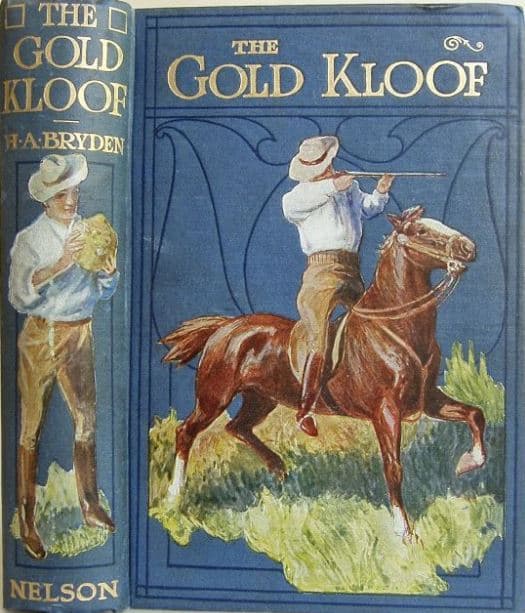
H.A. Bryden
"Tales of South Africa"
Chapter One.
The Secret of Verloren Vlei.
It was not until my second season’s hunting with Koenraad du Plessis that I heard of Verloren Vlei, a place I am never likely to forget. Du Plessis was a Transvaal Boer, descended, as his name implies, from that good Huguenot stock which, after the revocation of the Edict of Nantes, made its way to the Cape to replenish the Dutch settlers. The French language quickly died out in South Africa, mainly from a stern repression; yet here and there, all over that vast land, you may see at this day, in the strong and stubborn Boer breed, plain traces of the French admixture. Du Plessis bore about him very certain indications of his ancestry. He was shortish for a Boer, very dark of complexion, keen-eyed, merry, alert, vigorous and active as a cat.
Nineteen years ago, the north and east of the Transvaal, and the countries just across the border, were wild and little-known lands, still teeming with game. I was wandering through this region, hunting and exploring. The gold-fever had recently broken out, and as I understood something of mining and geology, I put in a good deal of prospecting as well. It was a vagrant, delightful existence, and I thoroughly enjoyed it.
Du Plessis and I met first in the north of Waterberg. I found him an excellent good fellow; he took to me; and we quickly became great friends. We trekked along the Crocodile River together, crossed it before it takes its southerly bend, and, for the whole of the dry winter season, hunted in a glorious veldt abounding in game. So excellent a comrade had I found the Boer, and so well had we enjoyed one another’s company, that we engaged to meet again the following season. Thus, at the end of July, 1876, we were once more hunting together in that wild and distant region north-east of the Crocodile.
One evening—I remember it well—we were outspanned in a delightful valley between low hills, through which a pleasant stream ran—a rare thing in the prevailing drought. We had had a good hunt that day, and the flesh of a fat buffalo cow filled our stew-pot. Our oxen lay peacefully in a strong thorn kraal close at hand—for there were lions about—and our horses were tied up to the wagon-wheels; the fires blazed ruddily against the outer darkness. At one of these fires were gathered our native boys, feasting and chattering, and laughing in high good humour; at the other, Du Plessis and I sat in our wagon-chairs. We had finished our meal, and were smoking our fragrant Rustenburg tobacco and drinking our coffee; for the day had been hot, and our hunt a long and exciting one, and our thirst was still unassuaged. We were talking about gold and prospecting. The Dutchman was not over-keen about it, but he was anxious to help me.
“There’s a kloof somewhere about here, Fairmount,” (that’s my name), he said, “in which I shot a white rhinoceros five years ago. I should like you to see it; I remember some natives brought me a quill of gold which they had collected up there. I think you would find it worth looking at; but this country is so broken, that I can’t for the life of me make out the exact spot. We shall hit it off presently, no doubt; but just now it’s almost as hard to find as poor Tobias Steenkamp’s ‘Verloren Vlei.’”
“Verloren Vlei,” I replied in Cape Dutch, in which we habitually spoke. “I never heard of the place. Where’s that?”
“Allemaghte! that’s a very queer story,” answered Du Plessis. “Tobias Steenkamp was a cousin of mine. One day four years ago he came to our farm and outspanned. He had had a hard trek, and lost some oxen, and was himself smitten with fever. He stayed a week, and he was for ever talking of a wonderful vlei (Pronounced flay, A vlei is the Dutch name for a shallow lake.) he had discovered somewhere in an inaccessible mountain range in this direction, on the shores of which he had found much gold. He showed us some fine nuggets; and, indeed, he excited my brother Hans and myself so much, that we half promised to go back with him and have a look at the place.
“Well, Tobias got over his fever, obtained fresh oxen, refitted his wagon, and started off again for his wonderful vlei. Hans and I could not get away at that moment; but we meant to hunt in that direction, and we promised to follow him up in a little time. He left a boy with us to show us the road. In two months’ time we had trekked up to the neighbourhood of Tobias’s great discovery, and then we received a shock. We met his driver and servants returning with the wagon, and no master. They told us that they had outspanned near the vlei—which they themselves had never seen; that their master had started off alone up the mountain next morning—he would never permit any of his boys to go with him; and that he had never returned. They had waited and waited, and had then searched for him in every direction without result. For a fortnight this had gone on; and now they had given up the search, and believed their master dead. Well, Hans and I took the men back with us to the mountain again, and made a thorough search, and sent out parties in every direction into the country round. We might as well have looked for the Fiend himself; we never again found a trace of Tobias Steenkamp. He is dead, undoubtedly, and his fate is wrapped in black mystery. How he disappeared, where he went, I cannot say. We did find spoor of a man and donkey to the north-east. The man had disappeared, and the donkey had been eaten by a lion. What their mystery was, I know not either. We found no trace of a passage up the grim mountain-walls where poor Tobias had vanished; and as for the vlei itself, well, Hans and I could make nothing of it. We never set eyes on it, and half doubted its existence. We have always called it since ‘Verloren Vlei,’ and by that name we and our friends still know it. And yet Tobias was no fool; he described the vlei very plainly to us more than once; and he firmly believed in it. Allemaghte! yes, of that I am quite certain; and what’s more, he showed me the gold he had found there. It’s incomprehensible.”
“That’s a queer story of yours, Koenraad,” said I. “I wonder I never heard you mention it before. How far away is this place you speak of?”
“About six days’ journey from here, I suppose,” replied Du Plessis; “and it’s a rough trek.”
“Has any one else ever tried to discover this secret?” I went on.
“Two or three people only,” rejoined the Dutchman. “Tobias’s brother and three other Boers who knew him went on two different occasions; but they came away no wiser than ourselves. Neither Tobias nor his bones have ever come to light.”
We went on chatting by the fire that night, and presently turned into our wagons.
I am bound to confess that the Dutchman’s grim story grew upon and fascinated me. Mystery has always a curious attraction. Here was hidden away some dark episode, in which this simple, unfortunate Boer had lost his life. I determined to try to unravel the clew; and the gold, too, lent an additional motive to the search.
I had small difficulty in persuading Koenraad du Plessis next morning to lead me to the place of misfortune. We settled to trek thither, hunting on our way; and in six days’ time we found ourselves outspanned for the night beneath the loom of the great rock fortress which held so securely the Dutchman’s secret. It was the hour of sunset as we neared the mountain range, which lay between us and the north-west. The sky was a sheet of red and gold, against which the rugged mass stood out in a wonderful relief. Up above the mountain tops, long skeins of great birds, all following one another slowly and majestically in an endless maze of evolutions, were silhouetted black against the flaming heavens. We were a good mile away from the nearest string, but there was a wonderful stillness of the atmosphere; all nature seemed hushed, except for the birds—and the faint notes of their peculiar plaintive whistle told me instantly what they were.
“Why, Koenraad,” I said, “those are pelicans, and they’re just going down to water somewhere in the mountains! See, there they go!”
As I spoke the lower skein sank gently into the mountains, and presently chain after chain of the singular evolutionaries disappeared softly within the range, until the last bird had vanished, and the now fading sky lay clear and unflecked.
“Allemaghte!” ejaculated Du Plessis in his deepest tones; “those are pelicans surely, and they have gone down to water. Strange that I have never seen them there before. There is the vlei, sure enough! We will never rest now till we find it.”
We were up at dawn next morning, and as we breakfasted we saw with intense interest the pelicans rise from the heart of the mountain, slowly circle about the sky, and then stretch their flight, in their leisurely and majestic fashion, in our direction. As they quitted the mountain, they sank lower towards the flat country, and some of them were evidently about to pass right overhead.
“They’ll come over the wagons,” said Du Plessis; “they’re off for that big salt pan we passed yesterday morning.”
I dived into my wagon, and took down my rifle. An idea had struck me. I pushed a cartridge into the breech, and, as the great birds passed slowly a hundred yards overhead, took aim at one and fired. The target was a big and an easy one: the stricken bird toppled downwards, turning over and over in its fall, and presently hit the earth with a tremendous thud. One of the boys ran and brought it to me. I opened its bill. The pouch contained seven fresh fish—six smallish and carp-like, well-known to the Boers as karpers, the seventh a “yellow fish,” a barbel-like fish of a pound and a half.
“Here, Koenraad,” I said to my companion, “is proof positive that your mysterious vlei lies in the mountain and holds water. These fish are fresh—they were caught early this morning; and the birds are away to the salt pan for the day to eat and digest them.”
We finished breakfast hastily, and sallied forth on our search. First, we followed the tiny stream near which we were camped. This led us to the westerly side of the mountain, and manifestly took its rise in some marshy ground immediately beneath the rock walls. A careful examination convinced me that the marsh itself owed its origin to some subterraneous escape—very probably from the vlei itself—from within the mountains. But there was no hope of ingress in that direction. Pursuing our investigations, we rode carefully round the whole western and southern face of the mountain-wall, scanning closely every yard of its surface. This mountain-wall ran in a great semicircle; its dark-red, rampart-like cliffs were sheer, and wonderfully free from projections and undergrowth. We spent the whole day searching for any trace of path or ingress, and retired to our wagons for the evening completely discomfited. There was not foothold for the hardiest cliff climber that ever risked his life in search of wildfowl eggs.
Next morning, we followed this cliff face along the southerly aspect. Here, after a little way, it was met by another mass of mountains, into which it ran, terminating in a chimney-like cul-de-sac at the end of a short narrow gorge. Here, too, apparently, there was no possible approach upward or inward.
“It was here,” said Du Plessis, “that the spoor of my cousin was last seen. His servants tracked him to this spot, and from there no trace of him could be found. It’s a mystery I cannot fathom. He could not possibly have climbed this way.”
We looked up at the dark grim rock walls above us, narrowing so that a foot or two of pale blue sky could alone be seen, and the thing seemed an impossibility. No living man could have made his way up that terrible chimney.