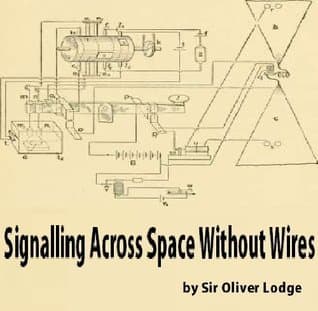
SIGNALLING ACROSS SPACE WITHOUT WIRES.
BEING A DESCRIPTION OF
THE WORK OF HERTZ & HIS SUCCESSORS.
BY
PROF. OLIVER J. LODGE, F.R.S.
THIRD EDITION, With Additional Remarks concerning the Application to Telegraphy, and Later Developments.
LONDON: “THE ELECTRICIAN” PRINTING AND PUBLISHING COMPANY, LIMITED, Salisbury Court, Fleet Street.
Copyright.
Works by Dr. O. J. LODGE.
Lightning Conductors and Lightning Guards. A Complete Treatise on the subject of Electric Discharges in general.
Pioneers of Science. A popular Illustrated History of the Early Astronomers and their Work up to Recent Times.
Modern Views of Electricity.
Elementary Mechanics.
Protection of Buildings from Lightning. Mann Lectures to the Society of Arts, 1888.
Secondary Batteries and the Electrical Storage of Energy. Cantor Lectures to the Society of Arts, 1883.
TABLE OF CONTENTS.
(The lines in italics which look like headings of paragraphs are really statements about experiments which were at that place shown.)
SIGNALLING THROUGH SPACE WITHOUT WIRES.
THE WORK OF HERTZ AND SOME OF HIS SUCCESSORS.
The following pages (up to page 42) are the Notes of a Lecture delivered by Dr. O. J. Lodge before the Royal Institution of Great Britain on Friday evening, June 1, 1894. These notes have been revised by Dr. Lodge, and prepared for publication in the form here presented. After page 42 an account is given of the later applications of Hertzian wave experiments to wireless telegraphy, and a series of Appendices are also given.
Introductory.—1894.
The untimely end of a young and brilliant career cannot fail to strike a note of sadness and awaken a chord of sympathy in the hearts of his friends and fellow-workers. Of men thus cut down in the early prime of their powers there will occur to us here the names of Fresnel, of Carnot, of Clifford, and now of Hertz. His was a strenuous and favoured youth; he was surrounded from his birth with all the influences that go to make an accomplished man of science—accomplished both on the experimental and on the mathematical side. The front rank of scientific workers is weaker by his death, which occurred on January 1, 1894, the thirty-seventh year of his life. Yet did he not go till he had effected an achievement which will hand his name down to posterity as the founder of an epoch in experimental physics.
In mathematical and speculative physics others had sown the seed. It was sown by Faraday, it was sown by Thomson and by Stokes, by Weber also doubtless, and by Helmholtz; but in this particular department it was sown by none more fruitfully and plentifully than by Clerk Maxwell. Of the seed thus sown Hertz reaped the fruits. Through his experimental discovery, Germany awoke to the truth of Clerk Maxwell’s theory of light, of light and electricity combined, and the able army of workers in that country (not forgetting some in Switzerland, France, and Ireland) have done most of the gleaning after Hertz.
This is the work of Hertz which is best known, the work which brought him immediate fame. It is not always that public notice is so well justified. The popular instinct is generous and trustful, and it is apt to be misled. The scientific eminence accorded to a few energetic persons by popular estimate is more or less amusing to those working on the same lines. In the case of Hertz no such mistake has been made. His name is not over well-known, and his work is immensely greater in every way than that of several who have made more noise.
His best known discovery is by no means his only one, and no less than eighteen Papers were contributed to German periodicals by him, in addition to the papers incorporated in his now well-known book on electric waves.
In closing these introductory and personal remarks, I should like to say that the enthusiastic admiration for Hertz’s spirit and character felt and expressed by students and workers who came into contact with him is not easily to be exaggerated. Never was a man more painfully anxious to avoid wounding the susceptibilities of others; and he was accustomed to deprecate the prominence given to him by speakers and writers in this country, lest it might seem to exalt him unduly above other and older workers among his own sensitive countrymen.
Speaking of the other great workers in physics in Germany, it is not out of place to record the sorrow with which we have heard of the recent death of Dr. August Kundt, Professor in the University of Berlin, successor to Von Helmholtz in that capacity.
When I consented to discourse on the work of Hertz, my intention was to repeat some of his actual experiments, and especially to demonstrate his less-known discoveries and observations. But the fascination exerted upon me by electric oscillation experiments, when I, too, was independently working at them in the spring of 1888,[1] resumed its hold, and my lecture will accordingly consist of experimental demonstrations of the outcome of Hertz’s work rather than any precise repetition of portions of that work itself.
In case a minority of my audience are in the predicament of not knowing anything about the subject, a five minutes’ explanatory prelude may be permitted; and the simplest way will be for me hastily to summarise our knowledge of the subject before the era of Hertz.
Fig. 1.—Oscillations of Dumb-bell Hertz Vibrator (after Bjerknes).