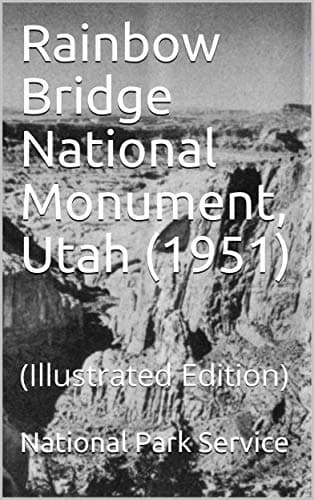
RAINBOW BRIDGE NATIONAL MONUMENT UTAH
UNITED STATES DEPARTMENT OF THE INTERIOR Oscar L. Chapman, Secretary
NATIONAL PARK SERVICE Arthur E. Demaray, Director
RAINBOW BRIDGE NATIONAL MONUMENT
Remote in spectacular red canyon country stands majestically beautiful Rainbow Bridge, the most stupendous of its kind and one of the great wonders of the world.
The inspiration gained by a visit to Rainbow Bridge National Monument is supreme. The majestic beauty of the bridge affects people in many ways. The delicate balance, graceful sweep, symmetry, beautiful toning of color, and superb setting of this rainbow-shaped stone arch suggest Divine guidance during its creation. The aborigines must have sensed this, for they built altars here.
Rainbow Bridge stands in the semidesert country of southeastern Utah. It nestles among canyons carved by streams that wind their way from the northern side of Navajo Mountain toward the Colorado River. It spans Rainbow Bridge Canyon and the tiny streamlet in its bottom.
Rainbow Bridge is greater than any other known natural bridge in size, in color, and in its almost perfect symmetry. With a 278-foot span, the bridge gracefully arches to a height of 309 feet—large enough to straddle our capitol building in Washington, D. C. Thicker at the top than a three-story building (42 feet), it is wide enough (33 feet) to accommodate the average highway.
Rainbow Bridge stands in one of the most remote and inaccessible areas in the United States. So rugged is the surrounding Rainbow Plateau that few of the Navajo and Paiute Indians who live nearby have ever seen the bridge.
HISTORY OF DISCOVERY
While leading an archeological expedition through southeastern Utah and northern Arizona during the summer of 1908, Dr. Byron Cummings, then Dean of Arts and Sciences, University of Utah, became interested in rumors of a great stone arch somewhere in the vicinity of Navajo Mountain. Mr. and Mrs. John Wetherill, of Oljato, Utah, related to him rumors of the arch which were prevalent among the Indians. Mrs. Wetherill later learned from Nasja, a Paiute Indian from Paiute Canyon, that his son, Nasja-begay, had actually seen the great stone arch and could return to it.
During July 1909, Dr. Cummings formulated plans to set out in search of the bridge. There were delays in obtaining the necessary guides. In the meantime, Dr. Cummings received word that W. B. Douglass, a Government surveyor, was en route to the area also to look for the arch. Subsequently, the Cummings-Douglass parties met and joined in the search for the Nonnozoshi, which was the Navajo word for the great stone arch.
The journey lasted several days. The party crossed canyons and “slick rock” surfaces where the horses slipped and skidded. Frequently, it was necessary to retrace portions of the course, because forward progress was blocked by “rimrock” ledges which the horses were unable to cross. There were more canyons, some with dry, boulder-choked beds, others with water and dense brush.
Across a scrub juniper (cedar) flat, and down into the last canyon they went. This was Nonnezoshi Biko, the Indian guide’s name for the canyon of the great stone arch, or Rainbow Bridge Canyon of the present.
The horses, as well as the men, were fagged because of the hard trail and shortage of forage and water. The footsore procession trudged forward; and in the late afternoon of August 14, 1909, the party rounded a bend in the canyon, and Dr. Cummings became the first white man to see the largest and most beautiful of all known stone arches, Rainbow Bridge.
How a natural bridge is formed
HOW WAS IT FORMED?
Geologists tell us that, at the time of the formation of the rocks from which Rainbow Bridge was later carved, the physical environment of that vicinity may not have differed greatly from much of the present Southwest. Broad valleys surrounded by highlands were present.
Run-off from rainfall in the highlands brought great quantities of gravel, sand, and mud, which were spread as horizontal sheets over the floors of the valleys. Locally there were shallow lakes.
Mud and sand were deposited in the lakes, and evaporation of the water produced limy and gypsum-filled muds. These sediments were compressed by being deeply buried to form the layers belonging to the Kayenta formation, part of which is the thin-bedded stratum exposed in the canyon beneath Rainbow Bridge.
Following this period of deposition, there was a changed environment during which sand accumulated until it was several hundred feet in thickness. It was deposited in curved cross-bedded layers in dunes, later to be blown away and redeposited again and again. This produced a complex system of cross-bedding throughout the entire formation.
In time, a blanket of other rock materials was deposited by wind and water over the shifting sand. Percolating water, with lime 3 and gypsum in solution, aided in making the material firm and hard to form what has been named the Navajo sandstone.
Then followed a general uplift of the entire region. Drainage courses traversed the newly formed rocks and the principal streams carved broad valleys with sweeping curves or meanders. The wind and other forces of weather chiseled away at the rocks to form “slick rock” surfaces and the dome-shaped hills called whalebacks and baldheads.
A large mass of molten rock pushed outward from the interior, arching the earth’s crust to form Navajo Mountain. This local uplift caused small streams to furrow canyons across the soft cross-bedded Navajo sandstone. It also caused the large streams to deepen their channels; those with broad valleys, through necessity, followed the former meandering course.
This frequently gave rise to blocks of solid rock, called “fins” and “necks,” standing between entrenched meanders. It was one of these “necks” from which Rainbow Bridge was formed.
When the “neck” was once formed, running water laden with cobbles and sand scoured at the sides. Frost action and expansion and contraction, due to temperature changes, loosened great slabs of rock as well as particles. Gravity helped to remove them. Eventually, an opening was worn through the “neck.” This gave the stream a direct course through the “neck” rather than around it. Continuing erosion enlarged the opening and deepened the gorge. Thus, the canyon spanned by Rainbow Bridge came into being.
Mother Nature used the less severe forces of weathering for shaping and polishing the outline of Rainbow Bridge. For example, when moisture freezes within a crevice it exerts pressure on the surface of a rock and causes the outer portion to shell off, forming a relatively smooth surface. The Navajo sandstone is particularly subject to this type of weathering. It is porous and the curved 4 layers of the cross-beds are held together with weak, natural cement that is easily removed by percolating water.
Dissolving of the cementing materials and prying action by frost are the chief agents for carving the rock. The cross-bedding is important in controlling the shape. Thus, the combination of several factors, over a long period of time, developed for us the arch as we now see it.
In the words of J. B. Priestly “How do we know that the Rainbow Bridge is not itself a kind of symphony, no more to be completely explained by geology than Beethoven is by acoustics?”
RAINBOW BRIDGE TRAIL FROM RAINBOW LODGE, ARIZONA, TO RAINBOW BRIDGE NATIONAL MONUMENT, UTAH