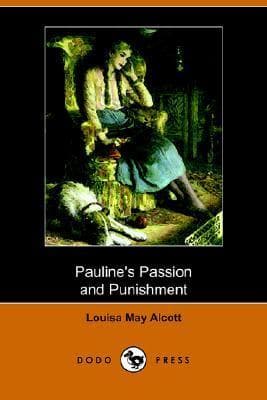
PAULINE'S PASSION
and
PUNISHMENT
by Louisa May Alcott
CONTENTS
Chapter I
Chapter II
Chapter III
Chapter IV
Chapter I
To and fro, like a wild creature in its cage, paced that handsome woman, with bent head, locked hands, and restless steps. Some mental storm, swift and sudden as a tempest of the tropics, had swept over her and left its marks behind. As if in anger at the beauty now proved powerless, all ornaments had been flung away, yet still it shone undimmed, and filled her with a passionate regret. A jewel glittered at her feet, leaving the lace rent to shreds on the indignant bosom that had worn it; the wreaths of hair that had crowned her with a woman's most womanly adornment fell disordered upon shoulders that gleamed the fairer for the scarlet of the pomegranate flowers clinging to the bright meshes that had imprisoned them an hour ago; and over the face, once so affluent in youthful bloom, a stern pallor had fallen like a blight, for pride was slowly conquering passion, and despair had murdered hope.
Pausing in her troubled march, she swept away the curtain swaying in the wind and looked out, as if imploring help from Nature, the great mother of us all. A summer moon rode high in a cloudless heaven, and far as eye could reach stretched the green wilderness of a Cuban cafetal. No forest, but a tropical orchard, rich in lime, banana, plantain, palm, and orange trees, under whose protective shade grew the evergreen coffee plant, whose dark-red berries are the fortune of their possessor, and the luxury of one-half the world. Wide avenues diverging from the mansion, with its belt of brilliant shrubs and flowers, formed shadowy vistas, along which, on the wings of the wind, came a breath of far-off music, like a wooing voice; for the magic of night and distance lulled the cadence of a Spanish contradanza to a trance of sound, soft, subdued, and infinitely sweet. It was a southern scene, but not a southern face that looked out upon it with such unerring glance; there was no southern languor in the figure, stately and erect; no southern swarthiness on fairest cheek and arm; no southern darkness in the shadowy gold of the neglected hair; the light frost of northern snows lurked in the features, delicately cut, yet vividly alive, betraying a temperament ardent, dominant, and subtle. For passion burned in the deep eyes, changing their violet to black. Pride sat on the forehead, with its dark brows; all a woman's sweetest spells touched the lips, whose shape was a smile; and in the spirited carriage of the head appeared the freedom of an intellect ripened under colder skies, the energy of a nature that could wring strength from suffering, and dare to act where feebler souls would only dare desire.
Standing thus, conscious only of the wound that bled in that high heart of hers, and the longing that gradually took shape and deepened to a purpose, an alien presence changed the tragic atmosphere of that still room and woke her from her dangerous mood. A wonderfully winning guise this apparition wore, for youth, hope, and love endowed it with the charm that gives beauty to the plainest, while their reign endures. A boy in any other climate, in this his nineteen years had given him the stature of a man; and Spain, the land of romance, seemed embodied in this figure, full of the lithe slenderness of the whispering palms overhead, the warm coloring of the deep-toned flowers sleeping in the room, the native grace of the tame antelope lifting its human eyes to his as he lingered on the threshold in an attitude eager yet timid, watching that other figure as it looked into the night and found no solace there.
“Pauline!”
She turned as if her thought had taken voice and answered her, regarded him a moment, as if hesitating to receive the granted wish, then beckoned with the one word.
“Come!”
Instantly the fear vanished, the ardor deepened, and with an imperious “Lie down!” to his docile attendant, the young man obeyed with equal docility, looking as wistfully toward his mistress as the brute toward her master, while he waited proudly humble for her commands.
“Manuel, why are you here?”
“Forgive me! I saw Dolores bring a letter; you vanished, an hour passed, I could wait no longer, and I came.”
“I am glad, I needed my one friend. Read that.”
She offered a letter, and with her steady eyes upon him, her purpose strengthening as she looked, stood watching the changes of that expressive countenance. This was the letter:
Pauline—
Six months ago I left you, promising to return and take you home my wife; I loved you, but I deceived you; for though my heart was wholly yours, my hand was not mine to give. This it was that haunted me through all that blissful summer, this that marred my happiness when you owned you loved me, and this drove me from you, hoping I could break the tie with which I had rashly bound myself. I could not, I am married, and there all ends. Hate me, forget me, solace your pride with the memory that none knew your wrong, assure your peace with the knowledge that mine is destroyed forever, and leave my punishment to remorse and time.
Gilbert
With a gesture of wrathful contempt, Manuel flung the paper from him as he flashed a look at his companion, muttering through his teeth, “Traitor! Shall I kill him?”
Pauline laughed low to herself, a dreary sound, but answered with a slow darkening of the face that gave her words an ominous significance. “Why should you? Such revenge is brief and paltry, fit only for mock tragedies or poor souls who have neither the will to devise nor the will to execute a better. There are fates more terrible than death; weapons more keen than poniards, more noiseless than pistols. Women use such, and work out a subtler vengeance than men can conceive. Leave Gilbert to remorse—and me.”
She paused an instant, and by some strong effort banished the black frown from her brow, quenched the baleful fire of her eyes, and left nothing visible but the pale determination that made her beautiful face more eloquent than her words.
“Manuel, in a week I leave the island.”
“Alone, Pauline?”
“No, not alone.”


