Contents.
Some typographical errors have been corrected.
List of Illustrations (In certain versions of this etext [in certain browsers] clicking on the image will bring up a larger version.)
(etext transcriber's note)
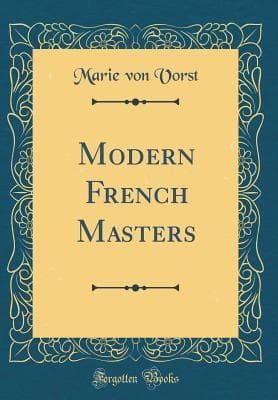
MODERN FRENCH MASTERS
MODERN FRENCH MASTERS
BY
MARIE VAN VORST
WITH PREFACE BY
ALEXANDER HARRISON
PARIS BRENTANO’S 37 AVENUE DE L’OPERA AND UNION SQUARE, NEW YORK 1904
Printed by Ballantyne, Hanson & Co. At the Ballantyne Press
IN GRATEFUL APPRECIATION
OF THE HOSPITALITY
OF THE PALL MALL MAGAZINE
I INSCRIBE THIS COLLECTION OF ESSAYS WHICH
HAVE ALREADY APPEARED IN ITS PAGES
TO MY FRIEND
GEORGE R. HALKETT
Paris, 1904 90 Rue de Varenne
PREFACE
The source of art is the fountain of Love: the winged spirits, Painting, Sculpture, and Poetry, spring from it hand in hand. With affectionate leave-takings and cries of joy at their liberation, they soar into space, the angel of Music out-winging the rest because of more lambent fibre, but she is no more vital nor pulsating than her sisters.
Genius is Love, Talent is the sure perception of essentials combined with the power of expression. Talent, coupled with genius, produces the Love-Child that men call a Masterpiece.
The love-child in Art is the most perfect of all human creations, whether the artist lover be conventional or academic, or rebellious against form and schools, or capricious and eccentric. Emerson said: “Write above your door the word, ‘Whim.’” This, Alfred Stevens, Besnard, Dégas, and the great sculptor Carries would have applauded, and above all—Whistler!
Whether the lover be brutal and aggressive (Courbet and at times Besnard), shy and distinguished (Puvis de Chavannes), dreamy and caressing (Corot and Cazin), alert and pulsating (Sargent, Zorn), retiring and retrospective (Millet-Lobre), nobly dominating (like Rodin, who says “il faut planer”)—or varied in impulse—one might say capricious—like Whistler, Bastien Lepage and Monticeli—the obsession of the motif will infallibly assert itself in convincing form, the vital impulse of loyal desire will in every case assume masterly shape, and if sequent be great. And as all the world loves a lover, so all the world sooner or later will love the lover’s work.
It is extremely difficult to justly decide how potent for good or evil upon the individuality of genius is the influence of the so-called “Schools.” The influences of early education and distant ideals often impede true progress. Youth submits naturally to an instruction which may or may not be misdirected. Broad cultivation of general, vital, and æsthetic force, and encouragement of impulse, are advantageous, whereas the domination of the pupil by the master-teacher may be detrimental.
The valiant and revered old soldier-artist Gérome constantly asserted: Le dessin c’est la probité de l’art.
Puvis de Chavannes would have formulated that Art is the expression of love, not of military probity! None the less, however, are those wrong who cavil against the Schools purely from a spirit of adverse criticism.
Great Bastien Lepage, the year before his death, told me that it was his constant struggle to overcome bad habits formed in the École des Beaux Arts, whilst on the other hand, other temperaments have profited normally by the codes of the École.
Jules Breton is said to have left the School a failure, and to have afterwards wrought out his real success in the loneliness of his native fastnesses.