THE
FABLES OF LA FONTAINE
Translated From The French
By
Elizur Wright.
A New Edition, With Notes
By
J. W. M. Gibbs.
1882
PREFACE
To The Present Edition,
With Some Account Of The Translator.
The first edition of this translation of La Fontaine's Fables appeared in Boston, U.S., in 1841. It achieved a considerable success, and six editions were printed in three years. Since then it has been allowed to pass out of print, except in the shape of a small-type edition produced in London immediately after the first publication in Boston, and the present publishers have thought that a reprint in a readable yet popular form would be generally acceptable.
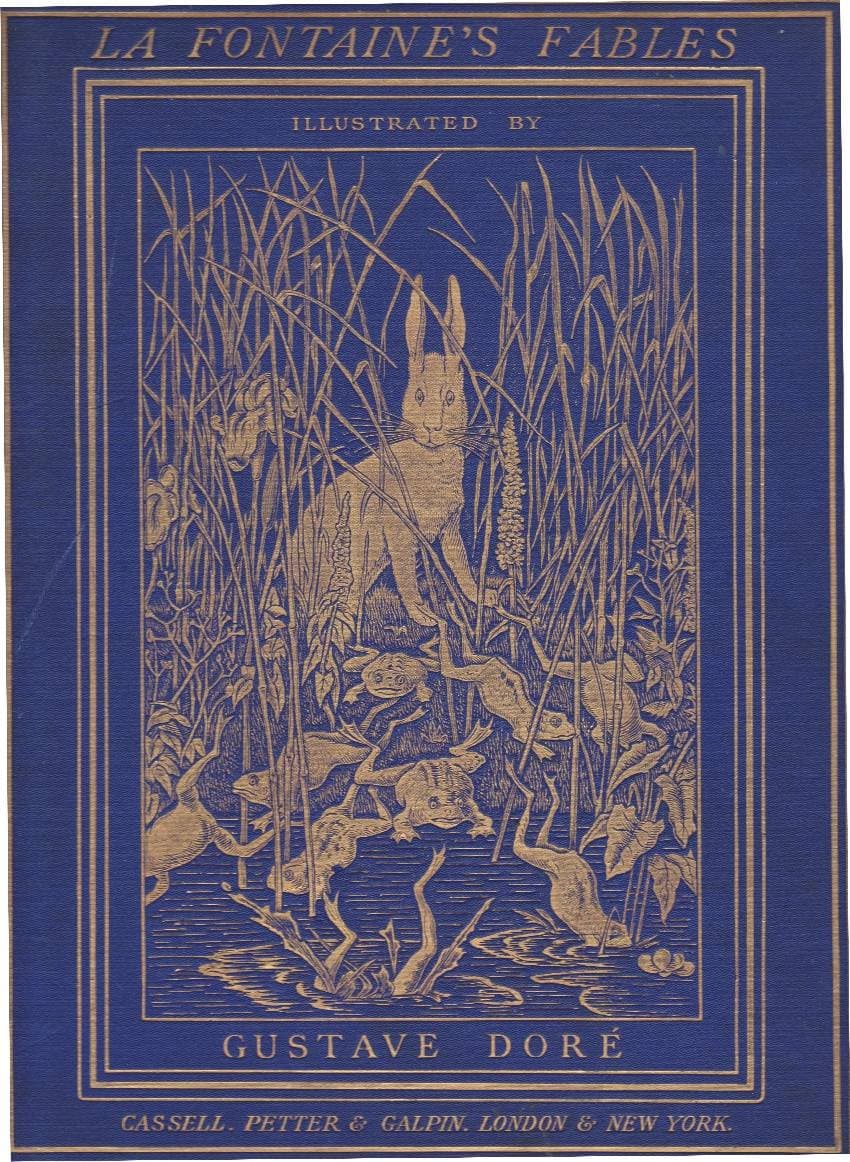
The translator has remarked, in the "Advertisement" to his original edition (which follows these pages), on the singular neglect of La Fontaine by English translators up to the time of his own work. Forty years have elapsed since those remarks were penned, yet translations into English of the complete Fables of the chief among modern fabulists are almost as few in number as they were then. Mr. George Ticknor (the author of the "History of Spanish Literature," &c.), in praising Mr. Wright's translation when it first appeared, said La Fontaine's was "a book till now untranslated;" and since Mr. Wright so happily accomplished his self-imposed task, there has been but one other complete translation, viz., that of the late Mr. Walter Thornbury. This latter, however, seems to have been undertaken chiefly with a view to supplying the necessary accompaniment to the English issue of M. Doré's well-known designs for the Fables (first published as illustrations to a Paris edition), and existing as it does only in the large quarto form given to those illustrations, it cannot make any claim to be a handy-volume edition. Mr. Wright's translation, however, still holds its place as the best English version, and the present reprint, besides having undergone careful revision, embodies the corrections (but not the expurgations) of the sixth edition, which differed from those preceding it. The notes too, have, for the most part, been added by the reviser.
Some account of the translator, who is still one of the living notables of his nation, may not be out of place here. Elizur Wright, junior, is the son of Elizur Wright, who published some papers in mathematics, but was principally engaged in agricultural pursuits at Canaan, Litchfield Co., Connecticut, U.S. The younger Elizur Wright was born at Canaan in 1804. He graduated at Yale College in 1826, and afterwards taught in a school at Groton. In 1829, he became Professor of Mathematics in Hudson College, from which post he went to New York in 1833, on being appointed secretary to the American Anti-Slavery Society. In 1838 he removed to the literary centre of the United States, Boston, where he edited several papers successively, and where he published his "La Fontaine;" which thus, whilst, it still remains his most considerable work, was also one of his earliest. How he was led to undertake it, he has himself narrated in the advertisement to his first edition. But previously to 1841, the date of the first publication of the complete "Fables," he tried the effect of a partial publication. In 1839 he published, anonymously, a little 12mo volume, "La Fontaine; A Present for the Young." This, as appears from the title, was a book for children, and though the substance of these few (and simpler) fables may be traced in the later and complete edition, the latter shows a considerable improvement upon the work of his "'prentice hand." The complete work was published, as we have said, in 1841. It appeared in an expensive and sumptuous form, and was adorned with the French artist Grandville's illustrations--which had first appeared only two years previously in the Paris edition of La Fontaine's Fables, published by Fournier Ainé. The book was well received both in America and England, and four other editions were speedily called for. The sixth edition, published in 1843, was a slightly expurgated one, designed for schools. The expurgation, however, almost wholly consisted of the omission bodily of five of the fables, whose places were, as Mr. Wright stated in his preface, filled by six original fables of his own. From his "Notice" affixed to this sixth edition, it seems evident that he by no means relished the task, usually a hateful one, of expurgating his author. Having, however, been urged to the task by "criticisms both friendly and unfriendly" (as he says) he did it; and did it wisely, because sparingly. But in his prefatory words he in a measure protests. He says:--"In this age, distinguished for almost everything more than sincerity, there are some people who would seem too delicate and refined to read their Bibles." And he concludes with the appeal,--"But the unsophisticated lovers of nature, who have not had the opportunity to acquaint themselves with the French language, I have no doubt will thank me for interpreting to them these honest and truthful fictions of the frank old JEAN, and will beg me to proceed no farther in the work of expurgation." The first of the substituted fables of the sixth edition--The Fly and the Game, given below--may also be viewed as a protest to the same purpose. As a specimen of Mr. Wright's powers at once as an original poet and an original fabulist, we here print (for the first time in England, we believe) the substituted fables of his sixth edition. We may add, that they appeared in lieu of the following five fables as given in Mr. Wright's complete edition--and in the present edition:--The Bitch and her Friend, The Mountain in Labour, The Young Widow, The Women and the Secret, and, The Husband, the Wife, and the Thief. It should also be borne in mind that these original fables were inserted in an edition professedly meant for schools rather than for the general public.
THE FLY AND THE GAME.
THE DOG AND CAT.
THE GOLDEN PITCHER.
PARTY STRIFE.
THE CAT AND THE THRUSH.
In 1844 Mr. Wright wrote the Preface to the first collected edition of the works of the poet J. G. Whittier; and soon after he seems to have become completely absorbed in politics, and in the mighty anti-slavery struggle, which constituted the greater part of the politics of the United States in those and many succeeding years. He became a journalist in the anti-slavery cause; and, in 1850, he wrote a trenchant answer to Mr. Carlyle's then just published "Latter Day Pamphlets." Later on, slavery having been at length abolished, he appeared as a writer in yet another field, publishing several works, one as lately as 1877, on life-assurance.
London, 1881.
ADVERTISEMENT
To The First Edition Of This Translation.
[Boston, U.S.A., 1841.]
Four years ago, I dropped into Charles de Behr's repository of foreign books, in Broadway, New York, and there, for the first time, saw La Fontaine's Fables. It was a cheap copy, adorned with some two hundred woodcuts, which, by their worn appearance, betokened an extensive manufacture. I became a purchaser, and gave the book to my little boy, then just beginning to feel the intellectual magnetism of pictures. In the course of the next year, he frequently tasked my imperfect knowledge of French for the story which belonged to some favourite vignette. This led me to inquire whether any English version existed; and, not finding any, I resolved, though quite unused to literary exercises of the sort, to cheat sleep of an hour every morning till there should be one. The result is before you. If in this I have wronged La Fontaine, I hope the best-natured of poets, as well as yourselves, will forgive me, and lay the blame on the better qualified, who have so long neglected the task. Cowper should have done it. The author of "John Gilpin," and the "Retired Cat," would have put La Fontaine into every chimney-corner which resounds with the Anglo-Saxon tongue.... To you who have so generously enabled me to publish this work with so great advantages, and without selling the copyright for the promise of a song, I return my heartfelt thanks. A hatchet-faced, spectacled, threadbare stranger knocked at your doors, with a prospectus, unbacked by "the trade," soliciting your subscription to a costly edition of a mere translation. It is a most inglorious, unsatisfactory species of literature. The slightest preponderance of that worldly wisdom which never buys a pig-in-a-poke would have sent him and his translation packing. But a kind faith in your species got the better in your case. You not only gave the hungry-looking stranger your good wishes, but your good names. A list of those names it would delight me to insert; and I should certainly do it if I felt authorized. As it is, I hope to be pardoned for mentioning some of the individuals, who have not only given their names, but expressed an interest in my enterprise which has assisted me in its accomplishment. Rev. John Pierpont, Prof. George Ticknor, Prof. Henry W. Longfellow, William H. Prescott, Esq., Hon. Theodore Lyman, Prof. Silliman, Prof. Denison Olmsted, Chancellor Kent, William C. Bryant, Esq., Dr. J. W. Francis, Hon. Peter A. Jay, Hon. Luther Bradish, and Prof. J. Molinard, have special claims to my gratitude....
The work--as it is, not as it ought to be--I commit to your kindness. I do not claim to have succeeded in translating "the inimitable La Fontaine,"--perhaps I have not even a right to say in his own language--
However this may be, I am, gratefully,
Your obedient servant,
Elizur Wright, Jr.