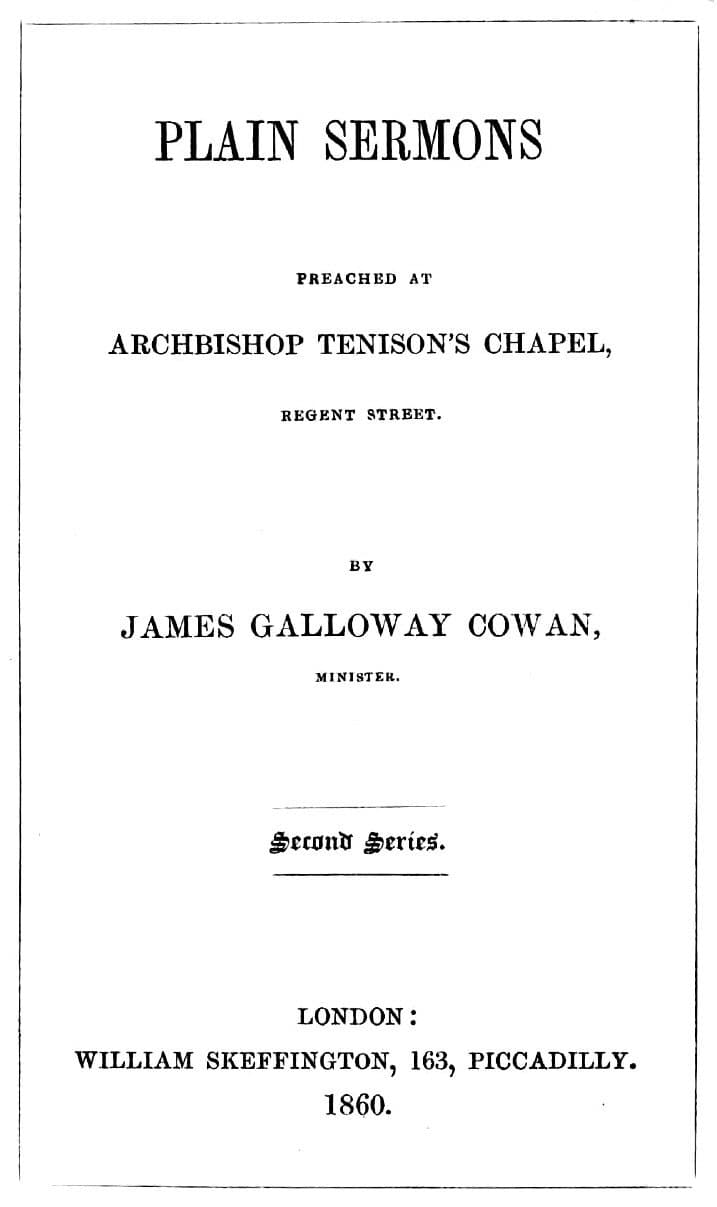
Transcribed from the 1862 William Skeffington edition by David Price.
“BEAR YE ONE ANOTHER’S BURDENS.”
A PLAIN SERMON
ON
THE LANCASHIRE DISTRESS.
BY THE
REV. JAMES GALLOWAY COWAN,
MINISTER OF ARCHBISHOP TENISON’S CHAPEL, REGENT STREET.
LONDON:
WILLIAM SKEFFINGTON, 163, PICCADILLY.
1862.
By the same Author.
Just published, cloth, 5s., by post, 5s. 4d.
Plain Sermons. Third Series. Containing a Course for Advent, for Lent; also Epiphany, Easter, and Miscellaneous Sermons.
Also, just out, price 1d., FOR DISTRIBUTION, or 6s. per 100, A Few Words to all on the Present Distress of our Brethren in Lancashire. II. Cor., viii, 14.
A PLAIN SERMON.
Galatians, vi., 2.
“Bear ye one another’s burdens, and so fulfil the law of Christ.”
There are certain burdens which every man must bear for himself, which none can bear for him. Such are the burdens brought upon him by sin—fear, remorse, punishment. Such again are the burdens of responsibility which belong to his gifts and opportunities from God. Of these it is not the Divine will that he should be relieved by others. Rightly is he made to eat the fruit of his own wilful doings; rightly is he accountable to God for all that has been lent to him, for all that he has been commanded to do. It is true indeed that the co-operation or opposition of other men may, in some measure, affect the bearing of these burdens; but still mainly, if not entirely, is it a question between him and his God—with which a stranger intermeddleth not—what he shall suffer, what reckoning shall be made with him: “The son shall not bear the iniquity of the father;” “Every man shall receive his own reward according to his own work;” “Every one of us shall give an account of himself to God.”
These burdens may be considered appropriate and peculiar to the individual or class of individuals upon whom they are laid: so that you may anticipate, almost with certainty, the judgment which imposes them; may observe without wonder or questioning who have to bear them; may trace back the effect to its cause, the duty to its obligation, and justify and approve the law of their imposition.
But there are other burdens which seem to light “hap-hazard” upon their bearers, incurred by no special misconduct, corresponding with no particular powers and opportunities. There is no reason that can be discerned why these men should have them, and those be free from them. Nay, there seems every reason why it should be otherwise: the back is weak upon which the heavy weight is laid; the understanding is simple which has perplexities to unravel; the life is upright which has been afflicted; the hand is willing which has no work to do. These are the burdens, the “heavy things,” the grievances of which the text speaks, burdens from beneath which the bearers may naturally cry, “Why am I thus?” burdens the beholding whereof from afar should prompt the humble, adoring exclamation, “Why am I not thus?”
The last part of the text answers both classes of inquirers. It is, that opportunity may be afforded for fulfilling “the law of Christ,” the rule which He set Himself, that in His earthly course He should minister to others, bearing their infirmities, taking on Himself their burdens, supplying their wants, binding up their wounds, healing their sicknesses, and leaving us an example that we should follow his steps; the new commandment that we should love one another as He has loved us, the exercise of that sympathy, for the working of which He made of Himself and Christians one body, binding them to mutual help and dependence, that “whether one member suffer all the members suffer with it, or one member be honoured all the members rejoice with it.”
No man ever came into this world, certainly none was ever incorporated in the Christian Church with license or power to live to himself or by himself. Christ has constituted us all in Him members one of another. Faculties and gifts He has bestowed on some, which cannot be used but in communicating to others; needs He has created, and burdens imposed, for the relief of which men must look to their brethren. Hence the richly endowed are to hold their possessions in common, and to distribute them liberally according as every man has need; hence the burden of the suffering and oppressed is to be borne by the free. “Here take of my good things,” we are to say to the needy, “for I hold them as a steward for thee. Here, give me of thy evil things, for they are laid upon thee that I may take them off or bear them with thee.” This, brethren, is the law of Christ, a law to be observed as holy duty, as blessed privilege, in the full measure of the demand, or at least of the ability to meet it, in the spirit of love.
We may not refuse when there is a cry for help, and we have it to bestow; we may not plead another’s liability to exempt ourselves. We may not give just what we will, when more is wanted, and we possess more, or can get it. We may not excuse ourselves from further care, where our utmost effort has failed to remove the oppressing load; we have then to add taking to our giving, to go under the burden and help to bear it.
Let these general remarks suffice to introduce and recommend the special appeal which I have to make to you to-day on behalf of your burdened brethren, the distressed operatives of Lancashire.
You know their case. The blockade of the American harbours has intercepted the large supply of cotton which till lately was regularly received from thence. Consequently, the mill-owners have either suspended work and closed their mills, or have reduced the number of “hands” to a small fraction of that usually employed. Thousands and thousands of able, active, industrious men and women are thus, with their families, deprived of the means of subsistence. Theirs is not the case, remember, of men who will not work, and who, therefore, according to the Apostolic rule, may justly be left to bear their own burden: “If any man will not work, neither shall he eat.” They want to work. They are compelled to be idle; the door of the factory is shut against them, and were they qualified for other kind of work, it could not be found for them. What, then, is to be done for them? And, who are to do it? There has been much talk, as you probably know, about the backwardness of the mill-owners generally to sustain the hands which built up their fortunes. An increased rate, or a loan upon the rates, has been suggested. The intervention of Government has been invoked. But while men are disputing about the agency which ought to remove the burden, it is lying sore upon those beneath it—it is crushing them to death! It is true that “private charity” has done something; according to the world’s standard, has done much. But, after all, the present emergency has been mocked rather than met, and day by day the crowd of sufferers is increasing, and the growing severity of the season is intensifying their suffering. Surely, here is a demand for the operation of the law of Christ. Whoso seeth his brother in such need, and shutteth up his compassion from him, how dwelleth the love of God in him? If Christ, by and by, will reject with indignation those who have left the least of his brethren unfed, unclad, unvisited, how will He treat those who have neglected these sufferers? For, assuredly, they are not the “least” of His brethren. It is no vicious or imprudent course that has brought them to this pass. It is the deliberate policy of our nation which has forced upon them, all helpless, their grievous burden. It is what we have done in self-love which has made them miserable! And how nobly, how heroically, how religiously, are they bending to the burden! There is no bitter outcry against the blockaders, no intemperate act or speech against the mill-owners, no riotous agitation for national intervention, no lawless depredation, and desperate helping of themselves, no clamour for relief, no greedy grasping of what is offered. Their very failings lean to virtue’s side. They have struggled to be independent. They have drawn from the savings’ bank the little fruits of their prudence and frugality: “one by one they have parted with their few luxuries, their half-dozen books, and their musical instrument, whatever it was; then the old clock ceased its familiar ticking; then, lingeringly left behind, the old family Bible, with its little family record, and its many associations with the past; and then their very clothing and bedding.” While they could help themselves, they would not ask, they would not have, help from others, and even now, when all is gone, the spirit of independence, the abhorrence of pauperism, the desire to bear their own burden, will hardly let them receive, on much persuasion and entreaty, the miserable pittance which is called “relief.”
My brethren, shall such men with their wives and little ones be hungry and naked, and lie on bare boards, and shiver, and starve, and die, while we have aught of money, food, or raiment that we can send them?
I should do you much wrong, if I feared that you would not respond to such an appeal, if I did not feel confident that you would make now the very largest offering you can, and go home with the burning resolution to repeat it and surpass it if possible. Your hearts must be touched, your hands must be ready. You would not be human, much less Christian, were it otherwise.
But, brethren, zeal and love often burn themselves out without affecting much around them, for want of direction and management.
Let me, therefore, offer you a few practical suggestions whereby you may be helped to sustain and make productive the feelings now aroused.