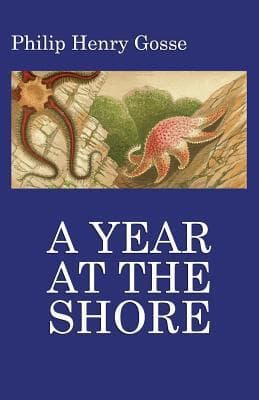
In the html version of this eBook, illustrations are linked to higher-resolution versions of the plates.
A YEAR AT THE SHORE.
A YEAR AT THE SHORE
BY PHILIP HENRY GOSSE, F.R.S.
WITH THIRTY-SIX ILLUSTRATIONS BY THE AUTHOR, PRINTED IN COLOURS BY LEIGHTON BROTHERS
ALEXANDER STRAHAN, PUBLISHER 148, STRAND, LONDON 1865
EDINBURGH: T. CONSTABLE, PRINTER TO THE QUEEN, AND TO THE UNIVERSITY.
CONTENTS.
LIST OF ILLUSTRATIONS.
A YEAR AT THE SHORE.
I. JANUARY.
How grandly those heavy waves are rolling in upon this long shingle-beach! Onward they come, with an even deliberate march that tells of power, out of that lowering sky that broods over the southern horizon; onward they come, onward! onward!—each following its precursor in serried ranks, ever coming nearer and nearer, ever looming larger and larger, like the resistless legions of a great invading army, sternly proud in its conscious strength; and ever and anon, as one and another dark billow breaks in a crest of foam, we may fancy we see the standards and ensigns of the threatening host waving here and there above the mass.
Still they drive in; and each in turn curls over its green head, and rushes up the sloping beach in a long-drawn sheet of the purest, whitest foam. The drifted snow itself is not more purely, spotlessly white than is that sheet of foaming water. How it seethes and sparkles! how it boils and bubbles! how it rings and hisses! The wind sings shrilly out of the driving clouds, now sinking to a moan, now rising to a roar; but we cannot hear it, for its tones are drowned in the ceaseless rushing of the mighty waves upon the beach and the rattle of the recoiling pebbles. Along the curvature of the shore the shrill hoarse voice runs, becoming softer and mellower as it recedes; while the echo of the bounding cliffs confines and repeats it, and mingles it with the succeeding ones, till all are blended on the ear in one deafening roar.
But let us climb these slippery rocks, and picking our way cautiously over yonder craggy ledges, leaping the chasms that yawn between and reveal the hissing waters below, let us strive to attain the vantage-ground of that ridge that we see some fifty feet above the beach. It is perilous work, this scrambling over rocks, alternately slimy with treacherous sea-weed, and bristling with sharp needle-points of honey-combed limestone; now climbing a precipice, with the hands clutching these same rough points, and the toes finding a precarious hold in their interstices; now descending to a ledge awfully overhung; now creeping along a narrow shelf, by working each foot on, a few inches at a time; while the fingers nervously cling to the stony precipice, and the mind strives to forget the rugged depths below, and what would happen if—(ah! that “if!” let us cast it to the winds): another long stride across a gulf, a bound upward, and here we are.
Yes, here we stand, on the bluff, looking out to seaward in the very eye of the wind. We might have supposed it a tolerably smooth slope of stone when we looked at the point from the sea, or from the various parts of the shore whence we can see this promontory. But very different is it on a close acquaintance. It is a wilderness of craggy points and huge castellated masses of compact limestone marble, piled one on another in the wildest and most magnificent confusion. We have secured a comfortable berth, where, wedged in between two of these masses, we can without danger lean on one breast-high, and gaze over it down upon the very theatre of the elemental war. Is not this a sight worth the toil and trouble and peril of the ascent? The rock below is fringed with great insular peaks and blocks, bristling up amidst the sea, of various sizes and of the most fantastic and singular forms, which the sea at high-water would mostly cover; though now the far-receding tide exposes their horrid points, and the brown leprous coating of barnacles with which their lower sides are covered is broadly seen between the swelling seas.
Heavily rolls in the long deep swell of the ocean from the south-west; and as it approaches with its huge undulations driven up into foaming crests before the howling gale, each mighty wave breasts up against these rocks, as when an army of veteran legions assaults an impregnable fortress. Impregnable indeed! for having spent its fury in a rising wall of mingled water and foam, it shoots up perpendicularly to an immense elevation, as if it would scale the heights it could not overthrow, only to lie the next moment a broken ruin of water, murmuring and shrieking in the moats below. The insular peaks and blocks receive the incoming surge in an overwhelming flood, which, immediately, as the spent wave recedes, pours off through the interstices in a hundred beautiful jets and cascades; while in the narrow straits and passages the rushing sea boils and whirls about in curling sheets of snowy whiteness, curdling the surface; or, where it breaks away, of the most delicate pea-green hue, the tint produced by the bubbles seen through the water as they crowd to the air from the depths where they were formed,—the evidence of the unseen combat fiercely raging between earth and sea far below.
The shrieking gusts, as the gale rises yet higher and more furious, whip off the crests of the breaking billows, and bear the spray like a shower of salt sleet to the height where we stand; while the foam, as it forms and accumulates around the base of the headland, is seized by the same power in broad masses, and carried against the sides of the projecting rocks; flying hither and thither like fleeces of wool, and adhering like so much mortar to the face of the precipice, till it covers great spaces, to the height of many fathoms above the highest range of the tide. The gulls flit wailing through the storm, now breasting the wind, and beating the air with their long wings as they make slow headway; then, yielding the vain essay, they turn and are whirled away, till, recovering themselves, they come up again with a sweep, only again to be discomfited. Their white forms, now seen against the leaden-grey sky, now lost amidst the snowy foam, then coming into strong relief against the black rocks; their piping screams, now sounding close against the ear, then blending with the sounds of the elements, combine to add a wildness to the scene which was already sufficiently savage.
But the spring-tide is nearly at its lowest; a rocky path leads down from our eminence to a recess in the precipice, whence in these conditions access may be obtained to a sea-cavern, that we may possibly find entertainment in exploring.
We reluctantly turn our backs upon the magnificent battle of sea and land, and following this sheep-track, scramble down, holding fast by the tufts of thrift, round and soft and yielding, but sufficiently firm to present some resistance, or by the tussocks of wiry grass, till we leap down on the great piled masses of marble that past ages have thrown from the cliffs upon the beach. Among these we find many basins and pools of still water, for we are in a deep recess of the promontory, whose shelter renders us almost unconscious of the fury of the winter wind without; and the masses of rock that lie piled about so curb and break the force of the incoming sea, that it percolates rather than rushes into these secluded nooks. Tall walls of stone, too, shut out much of the light of day; and as to the sun, only his most slant evening rays ever reach this spot: it is enshrouded in an obscurity which is most congenial to both the plants and the animals which resort to our shores; and here, doubtless, though the season is still midwinter, we shall find our searchings rewarded by not a few of those creatures, beautiful and wondrous, in which the devout naturalist delights to trace the handiwork of the God of glory.
At the very first glance into this little rock-hollow, all fringed with crimson and purple weed, lined with scales of lilac coralline, and partly shadowed by the olive fronds of the leathery tangle, we discern many forms of animal life. Here, for instance, is a fine handsome shelled mollusk, the Purple-spotted Top.[1] Before we take him up, let us notice for a moment with what an easy even movement he glides along over the leaves of the sea-weed, now over the stony projections of the pool, now on the broad weeds again. On lifting the shell, we find that the fine, fleshy, apricot-coloured animal clings with considerable force to the weed; and on transferring it to a glass bottle, we get a better sight of the organ by which it maintains both its stability and its movements. The under-surface of the creature, then, forms a long, nearly parallel-sided sole, abruptly pointed behind, where it stretches to a considerable distance in the rear of the shell, and bounded in front by a slightly-thickened transverse rim, a little arched, and projecting on each side. This organ is the foot, and it is composed of muscular fibres elaborately interwoven, much as in the human tongue, whereby great versatility and power of motion are communicated to it; indeed, when in motion, it strongly reminds one of the human tongue.
Plate 1.
P. H. GOSSE, del. LEIGHTON, BROS.
DOG-WHELK. PELICAN’S FOOT. TOP. COWRY.
The sensitive and muscular foot of our captive has already taken hold of the glass side of its prison, and it is now smoothly mounting up it. With a lens you may see that though it is one undivided area, yet in the arrangement of its muscles, it is separated into two portions by a line which runs down the middle; and that these two sides move alternately. The muscles of the right half, for example, are moved a little onward, and take a fresh hold of the ground, while those of the left remain clinging; then the right half clings, while the left relaxes and advances a little beyond the right, and again clings, when the right makes its forward move. So that the effect is exactly that of two feet advancing by alternate steps; and if your own two feet were enclosed in one elastic stocking, your own progress would appear very much like that of the Trochus. Indeed, some shell-fishes not distantly allied to this, as the pretty little Pheasant-shell,[2] which I occasionally find among these rocks, really have the foot divided into two distinct and separate halves, in which this alternate motion is, of course, more obvious.
Looked at from above, we discern that this foot thickens towards the middle, where it is overlapped by a broad wing-like expansion on each side. This, for manifest reasons, is known by the name of the cloak or mantle. In all cases it performs important offices in the economy of the animal, as I shall presently describe; and in this instance we see it is adorned along its edges with certain lappets and long fleshy taper threads (called cirri), which wave vivaciously to and fro as the creature crawls. These are probably the seats of a delicate sense; perhaps receiving impressions analogous to those of touch, from the strokes they continually make on the surrounding fluid.
In front we see a distinct head, with a broad flat muzzle not altogether unlike that of an ox. On each side of the back part of this head, there is another long taper thread: these are called tentacles, but neither in form nor in structure can we discern any difference between these and the cirri that fringe the mantle. In all probability they are alike organs of a highly delicate sense of touch.
Immediately behind each of these head-tentacles you see a little wart, which has a black bead set as it were in its substance. You have often, doubtless, observed the similar black points that are placed at the tips of the upper pair of the horns (tentacles) of the common garden snail; and I daresay, when a child, you have amused yourself by touching them, and noticing how instantaneously the sensitive creature would roll them in, so to speak, concealing them far in the interior of the inturned horns. And every child is taught that these black spots are the snail’s eyes; and so, indeed, they are; and these spots on our Top’s warts are its eyes too, notwithstanding that some learned naturalists, apparently from the mere love of paradox, have affected to doubt the fact that such is their function. If you could dissect out one of these points, and submit it to careful examination with a good microscope, you would find all the parts essential to an organ of vision; there is a sclerotic coat, a distinct little pupil and iris, a cornea in front, and a dark pigment layer within, with vitreous and aqueous humours, and even a crystalline lens for the condensation of the rays of light. Minute these parts are, to be sure, but not less exquisitely finished for that. Indeed, the more skill they require in the demonstrator, the more they reflect the inimitable skill of the Creator. Swammerdam, the Dutch physiologist, who so beautifully showed the structure of the snail’s eye, seems to have feared the doubts of his conclusions that would ensue from the difficulty of repeating his investigations. “But who will credit this?” he says; “for does it not seem impossible that on a point not larger than the nib of the pen with which I write, such exquisite art and so many miracles should be displayed?”
Now, leaving the animal, though we might devote a few moments to the admiration of its rich colours, adorned as is its deep yellow hue with lines and clouds of deeper brown, let us look at the shell, the solid house of stone, which our friend Trochus has himself built up to cover his head in the hour of danger. How well has he combined the utile cum dulci!—the comfortable with the ornamental! Its general form is that of a cone of much regularity, but with an oblique base, and perhaps you may be surprised to learn that this conical form is but the result of the winding of a very long cone upon itself in a spire. But if you examine a dead shell with care, you will see that it is so. Supposing you had a very long and slender hollow cone of plastic material, and, beginning with the acute point, you twined the whole upon itself, descending in a spiral form, you would have the representation of a turbinate shell, which, by a little gentle pressure of the fingers, might be moulded, without at all losing its essential character, into the exact shape of our Trochus, in which the progress of the spire can without difficulty be followed as well by slight inequalities of surface as by the arrangement of the colours.
It is one of our showy shells. This specimen before us has for its ground colour a chaste, cool grey, occasionally varied with tints of reddish buff, but most conspicuously adorned with a series of large and regular spots of purplish crimson running along the lower angle of the spire from the base to the summit. Each of these spots passes off into an oblique line above, the repetition of which augments the beauty of the pattern.
The interior of the shell has a glory of quite another character. It is covered with a coat of nacre or pearl, of exceedingly brilliant and rich lustre, and the presence of this inward pearliness is quite characteristic of this genus, and of most of the others belonging to the same family, the Turbinidæ. Many of the fine large tropical species are specially conspicuous for this adornment, as I have seen in those that lie along the dazzling beach of coral-sand in lovely Jamaica. The pearl of these shells is used in the arts. De Montfort mentions a necklace which he had seen, that was made out of the nacred part of the shell of the Turbo smaragdus, and which was much more brilliant and beautiful than any of the finest orient pearls.[3] And Chenu observes:—“Les grandes espèces fournissent une fort belle nacre, employée pour les ouvrages de marqueterie. Quelques espèces ont reçu des noms sous lesquels les marchands les distinguent: il y a le Burgau ou Nacré; la Veuve Perlée, dont les tubercles extérieurs usés ressemblent à des perles; la Bouche-d’Or, dont la nacre est d’un beau jaune doré; la Bouche-d’Argent; le Perroquet, ou Turbo Impérial,” etc.[4]